
CXR Recruiting Awards Finalist: GALLO
How Gallo built an AI offer checker to manage 1,400+ scenarios — and what it took to get the logic right before writing a line of code.
 play_arrow
Empathy, AI, and the Business of People Alessa Rivera Badillo
 play_arrow
Building the TA Machine Alessa Rivera Badillo
 play_arrow
The AI Talent Race Alessa Rivera Badillo
 play_arrow
Built for Change: Tracey Friend’s Career Crossroads Alessa Rivera Badillo
Featured Guests:
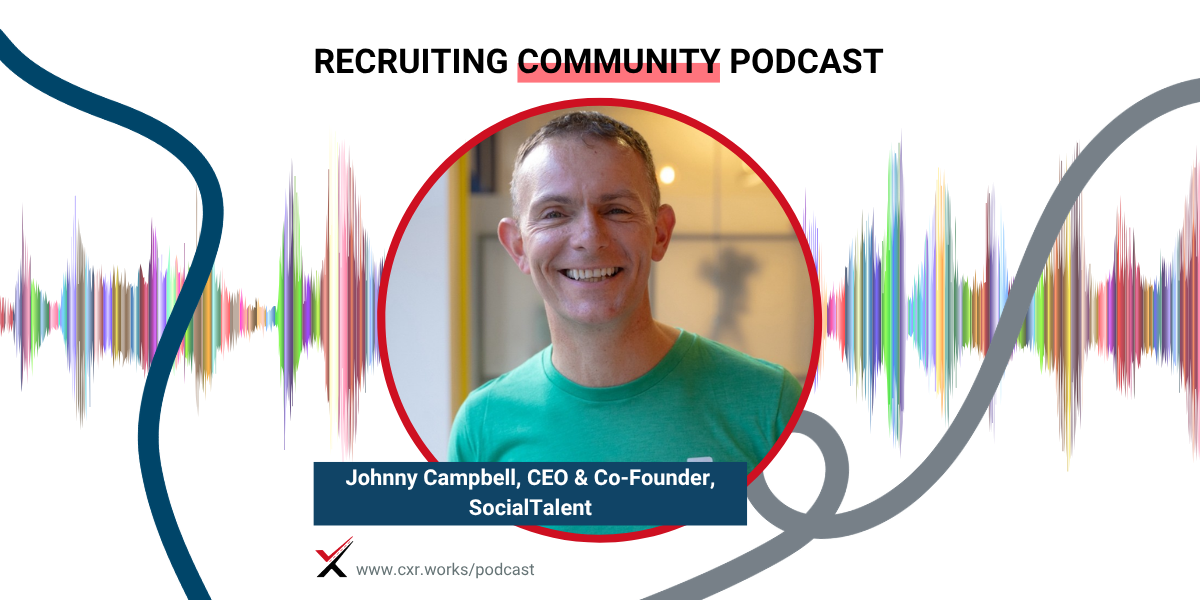
Johnny Campbell, CEO, SocialTalent
Hosts:
Chris Hoyt, President, CareerXroads (CXR)
Episode Overview:
Chris Hoyt and Johnny Campbell discuss a two-week learning challenge co-hosted by CXR and SocialTalent, running July 13–27 on the CXR community platform. The challenge features two themed weeks—AI in recruiting and interviewing excellence—with curated curricula, individual and organizational leaderboards, and prizes. The conversation covers why upskilling feels urgent now, how gamification drives learning behavior, and what practitioners can expect to gain from the program’s featured instructors.
Key Topics:
The CXR and SocialTalent two-week learning challenge (July 13–27), including structure, access, and competitive elements
Why AI upskilling is urgent: teams being asked to do more with less and pressure to show measurable returns
“Micro AI” or “marginal gains AI”—individual recruiters building small, replicable AI solutions for immediate workflow problems
The gap between organizations in AI adoption, from basic ChatGPT access to full governance frameworks
Why interviewing excellence was selected as the second theme, including concerns about candidates using AI to game interviews
How gamification (streaks, leaderboards, prizes) drives actual learning completion among competitive practitioners
Featured instructors Glenn Cathey (AI and sourcing) and John Vlastelica (behavioral and situational interviewing)
The importance of recruiting-specific AI training versus general AI instruction
How even evergreen interviewing content has required updates due to AI use by candidates
Notable Quotes:
“Everyone’s being asked to do more with less right now, and these two content clusters allow your team to do exactly that, through learning, at no additional cost.” — Johnny Campbell
“It starts with a single recruiter writing a prompt to save time or make their work more consistent. That grows into something shared across the whole team, and suddenly you’ve got 15 in-house tools that transform how you deliver recruiting.” — Johnny Campbell
“I want to know how to recruit using AI, not how to use AI. That’s a different thing.” — Johnny Campbell
“I learned when I watched John’s first course on our platform and realized I didn’t actually know how to interview.” — Johnny Campbell
“Things aren’t going to slow down.” — Chris Hoyt
Takeaways:
The CXR and SocialTalent learning challenge offers practitioners a focused, time-limited opportunity to build skills in two high-priority areas: AI application in recruiting workflows and interviewing best practices. The program features recruiting-specific instruction from recognized experts, making the content immediately applicable rather than conceptual. Competitive elements like leaderboards and prizes are intentional—designed to convert good intentions into completed learning.
Want more conversations like this? Subscribe to the CXR podcast and explore how top talent leaders are shaping the future of recruiting. Learn more about the CareerXroads community at cxr.works.
Chris Hoyt: All right, everybody, welcome to the Recruiting Community Podcast. I’m Chris Hoyt, president of CXR, and I’ll be your host today. This show is all about bringing you industry insights and updates in the form of a fun conversation, brought to you by the CXR CareerXroads community.
I want to jump right in, because there is a lot of talk these days about how fast our profession is changing. AI tools are showing up in every corner of the funnel, and the skills bar is moving seemingly by the week, if not the hour. It’s easy to feel like keeping up is a someday project—like leaders are thinking, “We’ll get to this when things slow down.” Here’s a spoiler alert: things aren’t going to slow down. So today I want to talk about doing something about that, together as a community.
The CXR community has partnered with SocialTalent for a two-week learning challenge, and I am genuinely excited about this. It runs July 13th through the 27th, right on our community platform. There are two themed weeks: week one is AI in recruiting, week two is interviewing excellence. Each has a focused curriculum with courses hand-selected from hundreds of options by the SocialTalent and CXR teams. You can only access this during that window, so there’s a real reason to show up and lean in.
We’ve also made it a little competitive—because why not? There’s an individual leaderboard and an organizational leaderboard, so a team’s collective learning adds up. There are bragging rights on the line, and yes, we’re doing prizes for top performers. But the heart of it is simple: this is a chance for practitioners to sharpen their craft, benchmark themselves against their peers, and get access to what we believe is some of the deepest TA-specific training out there—all as a community, all at the same time.
To talk about how this came together, I’m thrilled to be joined by a CXR member and the CEO of SocialTalent. Before we jump in—we’re streaming on YouTube, Facebook, and LinkedIn. You can also check out cxr.works/podcast for all past episodes, hundreds of interviews with TA leaders and practitioners doing interesting work around attracting, recruiting, and managing talent teams around the world. You’ll also find easy ways to like, subscribe, and let us know if you want to join the conversation. And last but not least—this is an ad-free labor of love. Nobody pays to be on the show, and we don’t pay anybody to be here.
Announcer: Welcome to the Recruiting Community Podcast, the go-to channel for talent acquisition leaders and practitioners. This show is brought to you by CXR, a trusted community of thousands, connecting the best minds in the industry to explore topics like attracting, engaging, and retaining top talent. Hosted by Chris Hoyt and Gerry Crispin, we’re thrilled to have you join the conversation.
Chris Hoyt: Johnny, I feel like I just did the whole show right there.
Johnny Campbell: You did, Chris. You did a great job. Brilliant. I’ll just go get coffee—are we good?
Chris Hoyt: When I don’t have Gerry on to give me the occasional “uh-huh” and “yeah”…
Johnny Campbell: Yeah, that’s all he does, Chris. How dare you reduce his role to “mm-hmm, mm-hmm”?
Chris Hoyt: He certainly keeps me humble, that’s for sure. Look, I am excited about this one. We’re kind of hot on the heels of the CXR Recruiting Awards and a recent competition, so that competitive streak is still flowing. And now the CXR community is teaming up with your team at SocialTalent for this two-week learning challenge. I want to start there. For folks who may not know SocialTalent yet, can you give us the once-over? Tell us who you are and what makes this partnership feel like the right fit right now.
Johnny Campbell: I’m the guy in the green t-shirt—that’s how a lot of people know me. I run SocialTalent. I’m a career recruiter who set up a learning business 15 years ago. We’ve expanded beyond just learning into AI tools that help recruiting teams both automate and elevate their work. We’ve been partners with CXR for a number of years, and CXR members already get access to a portion of our library, plus some extra CXR training content.
A couple of months ago, you and Barb were chatting and came to me asking, “What are the big themes people are learning on your platform that our members don’t have access to yet? Could we do something?” The idea came up to give members free access to our richest, most in-demand content—but make it time-limited so people are encouraged to focus and actually dive in. The bigger theme was that there’s so much great knowledge we want to share, and we want to incentivize people to get after it—hence the prizes, the points, all of that. These are really important themes. Everyone’s being asked to do more with less right now, and these two content clusters allow your team to do exactly that, through learning, at no additional cost. We’re thrilled to support it.
Chris Hoyt: Let’s talk about timing, because this doesn’t feel like a someday problem. The pitch is essentially that practitioners who understand these tools are already pulling ahead. From where you sit, what are you seeing in the market that makes a focused upskilling push feel urgent right now?
Johnny Campbell: The big thing around AI is that a lot of teams—particularly larger ones—are being asked to do more with less, and specifically to show how AI is taking over transactional work. From a cost-savings standpoint, from an elevation-of-the-role standpoint, all of it. Most teams go after big projects: automate sourcing, automate selection, and so on. And while there are amazing tools that do that, they’re hard to get approved, hard to roll out, and behavioral change takes time. They’re not going to deliver a return immediately, and there’s still pressure to deliver today.
What’s emerged over the last couple of years is actually one of the most exciting things AI is doing for recruiting teams: recruiters building their own solutions for the problems right in front of them. Call it micro AI, marginal gains AI, whatever you like—it’s become the thing every team needs. It starts with a single recruiter writing a prompt to save time or make their work more consistent. That grows into something shared across the whole team, and suddenly you’ve got 15 in-house tools that transform how you deliver recruiting. It’s exciting, it’s accessible, the cost is just whatever LLM you’re using and the time you invest. And it’s replicable—every team can do this.
We still have huge gaps between teams, though. Some are at, “Yeah, we let people use ChatGPT.” That’s it. And others have a full governance process, a shared drive, rules, a committee, quarterly projects, and measured gains. We want to close that gap and make sure more people know what they’re missing and can get there faster.
The second piece we chose is interviewing—which I still believe is where you can have the biggest impact on quality of hire. The first theme is about productivity, automation, and elevating the role. The second is about how we show up in the interview and what we ask. There’s some great evergreen content there, but there’s also a new element: the conversation being driven by hiring managers around fraudulent or exaggerated candidates. There’s a real fear that the interview itself is at risk—that candidates are gaming it with AI tools. So we’re going back to basics. What should the interview look like? How can we show up better? It’s become a hot topic being pulled from the business side, not just from recruiting. So that’s why we picked these two themes, why they’re relevant right now, and why I’m excited.
Chris Hoyt: AI in recruiting is kind of a no-brainer—it’s everywhere we look, it’s every conversation we’re having with leaders. But I love that we pulled in interviewing, because I think it’s something every team does and almost no team formally trains for, which is really surprising. The pairing is going to be great. We talked a bit last week when we were together in person about how we’ve kind of done a full loop—we were all in on interviewing for a while, then sat on our laurels a bit, and now it’s coming back with even more muscle.
Johnny Campbell: I agree. The risk of not doing a good interview before wasn’t as measurable. People knew it led to bad hires, knew there were potential risks, but they ignored it because it had just been sitting there for so long. Then AI use on the candidate side re-highlighted those risks and magnified them. That’s why it’s back. But it’s an evergreen topic—we’ve always known how to solve it. People just don’t have the training or the processes, and that’s what we’re trying to address.
Chris Hoyt: It’s a whole other podcast episode, but I think AI is floating the basics back to the surface. We could talk about that for hours. But I want to dive into the competitive layer we’ve built into this. We’ve got individual leaderboards, an organizational leaderboard, and real prizes. Can you share the thinking behind that? Why does turning upskilling into a friendly team competition help people actually follow through? You’re the expert on the learning side.
Johnny Campbell: It’s funny—I came to learning from recruiting, Chris, so I didn’t know much about it. I just knew how a recruiter thought. And I knew she didn’t want to learn. She wanted to get on with her work and get results. Learning felt like a chore. Then I had an insight years ago watching my eldest kid gaming—PS4 at the time, I think. He told me he had to play that night. I asked why, and he said, “I’ll lose my streak.” That really got me thinking. He told me about streaks, and then about leaderboards, and I started to understand gamification. He wasn’t playing because he loved the game—he was playing because he didn’t want to be beaten and didn’t want to lose that streak.
So we brought gamification into learning. We work with customers to bring in awards, prizes, spotlighting who’s done the most, and it works. It really works to drive behavior. You’d think people would just learn for learning’s sake. If you survey them and ask, “Do you want to learn?” they’ll say, “Absolutely, learning is so important, I have a learning mindset.” But ask if they’ll take an hour for a course this week and it’s, “Not this week, it’s a bad week—but I will, I promise.” It goes on the long finger every time.
Gamification forces people to compete. And recruiters are competitive—we know this. So we’re saying: you’ve got two weeks, you need to learn, the learning benefits you, there are prizes, and we’re going to call out the people and the companies who do the most. That’s what works. You remember from your recruiting days, Chris—leaderboards for most hires, most interviews, whatever. It always motivates us. So I’m really hoping we get some great excitement from individuals and companies who want to, let’s say, outperform everyone else.
Chris Hoyt: I think it’s going to be a lot of fun. And you’re right—some of the best recruiters I know are also some of the most competitive. For the practitioner listening right now who’s on the fence about jumping in on July 13th—which is right around the corner, Johnny—what do you realistically hope they walk away with after going through the program?
Johnny Campbell: So with the AI training—you’ve probably done AI courses, watched YouTube videos, maybe gone through some programs. They’re almost all generic: how do you prompt, what’s the difference between the LLMs. That’s not what this is. This training is: how do I build a sourcing plan using AI? How do I prep for a hiring manager strategy meeting? How do I assess a candidate practically? These are real problems you need to solve for, and the people delivering the training have actually done this work. They’re the best at it.
I do a couple of courses myself, but honestly, the ones I’d really point people to are from people like Glenn Cathey—a hero of mine, the Boolean Black Belt. Glenn has gone so deep on this. His articles and blogs are extraordinary, he works with Randstad’s clients teaching and learning from them, and he’s brought so many cool ideas to the platform. I watch his training and come away with new ideas. We did a webinar series with him a couple of weeks ago and I was scribbling notes the entire time. But it’s all in the context of recruiting—because every other course is just general. I want to know how to recruit using AI, not how to use AI. That’s a different thing.
The interviewing content is largely delivered by John Vlastelica, who is just a legend. John’s training gets 97% customer satisfaction scores—I honestly think the other 3% just had it on mute. He tells so many stories, he’s worked with so many teams, and he frames everything brilliantly. You might think interviewing is interviewing is interviewing—not when you’ve heard John deliver it. You’ll learn behavioral interviewing structure, situational interviewing, the value of assessments, the importance of the right brief in advance, how to dig and probe, how to pivot.
I’ll be honest—someone asked me this week when I learned how to interview. I could have said when I first joined recruiting, but the truth is I learned when I watched John’s first course on our platform and realized I didn’t actually know how to interview. I knew the concepts, I knew what a behavioral question was, but he gets into the practical stuff: “When the candidate says this—and they will say this—what are you going to respond with?” And you’re nodding along thinking, yes, that’s exactly what happens. Then he gives you the answer and it’s just brilliant.
So it’s AI content that is immediately applicable to the work you’re doing right now, and interviewing content that feels like this person has been in the room with you for every interview you’ve ever done and knows exactly how to make it better. That’s why I think this stands out.
Chris Hoyt: I think it’s great. You have some of the best trainers in the space. Funny side note—when we were at a speakeasy in Louisville, someone asked that classic party question: dead or alive, real or imaginary, who do you have dinner with? It pivoted to industry people, and Glenn Cathey came up at two different tables independently. So you’ve got real heavy hitters lined up for this training, and I’m just super pumped about it.
Johnny Campbell: They’re great, and the thing is, a few good people attract more good people, and it just keeps growing. Our authors are brilliant. And we’re constantly filming new content—Glenn filmed AI content for us about 12 months ago, and we just filmed a whole new batch because it’s changing that fast.
Chris Hoyt: Oh yeah.
Johnny Campbell: Even John’s interviewing content, which you might think is totally evergreen, had to be updated because now it’s interviewing in an AI context where candidates may be using AI tools. So it’s not just that they’re brilliant—they keep it fresh, and I love that.
Chris Hoyt: Fantastic. Well, Johnny, I know we’re on a tight timeline this morning. I’m really grateful for the attention you’re giving this, and for the partnership you bring as a CXR member. You’ve been with us for years, and the members love you. They love the content, they love the access, and this is going to be a fun adventure. Thanks for leaning in with us.
Johnny Campbell: And I want to thank everyone in advance for getting on board, getting into the competition, and owning that leaderboard. Hope you enjoy it, folks.
Chris Hoyt: Good stuff. Everybody, to check out the podcast, head to cxr.works/podcast. To learn more about the SocialTalent collaboration and the competition, go to cxr.works. Members, log in—you’re going to see a change on the site, you won’t be able to miss it. We’re excited about that too. Until then, we’ll see everybody next time. Take care.
Announcer: Thanks for listening to the Recruiting Community Podcast, where talent acquisition leaders connect, learn, and grow together. Be sure to visit cxr.works/podcast to explore past episodes, see what’s coming up next, and find out how you can join the conversation. Whether you’ve got insights to share or want to be a guest on the show, we’d love to hear from you. If you’re interested in learning more about becoming a CXR community member, visit us at cxr.works. We’ll catch you in the next episode.
How Gallo built an AI offer checker to manage 1,400+ scenarios — and what it took to get the logic right before writing a line of code.