
Social Talent Takeover
AI tools are reshaping recruiting fast. CXR and SocialTalent launch a two-week learning challenge to help practitioners keep pace—competitively.
 play_arrow
Empathy, AI, and the Business of People Alessa Rivera Badillo
 play_arrow
Building the TA Machine Alessa Rivera Badillo
 play_arrow
The AI Talent Race Alessa Rivera Badillo
 play_arrow
Built for Change: Tracey Friend’s Career Crossroads Alessa Rivera Badillo
Featured Guests:
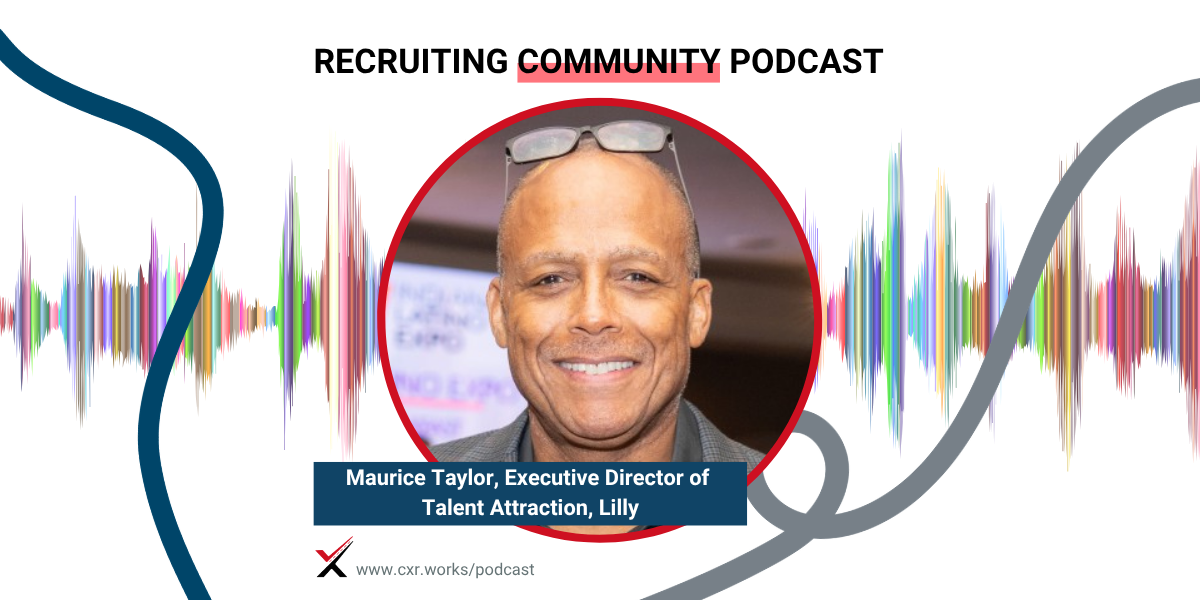
Maurice Taylor, Head of Sourcing and Talent Marketing, Lilly
Hosts:
Chris Hoyt, President, CareerXroads
Gerry Crispin, Co-Founder, CareerXroads
Episode Overview:
Maurice Taylor, who leads both sourcing and talent marketing at Lilly, discusses how he built a centralized recruitment marketing function over nearly 27 years at the company. The conversation covers how he established internal partnerships across corporate communications, global brand, compliance, and legal teams; how Lilly anchors its employer brand to its patient-care mission; the challenges of expanding talent marketing globally; and how to demonstrate ROI to business partners who may not yet understand the discipline.
Key Topics:
How Maurice’s role expanded to encompass both sourcing and talent marketing, and the organic path that led there
The importance of including internal partners — corporate communications, global brand, compliance — early in the process rather than moving too fast without them
Connecting employer brand messaging to Lilly’s patient-care mission as the foundation for a consistent, mission-driven talent marketing strategy
Diagnosing business problems before prescribing solutions — listening first, then determining which lever to pull
The distinction between employer branding and recruitment marketing, and how to communicate each to business partners
Challenges of global expansion: local cultural nuances, translation and dialect issues, and maintaining brand consistency while allowing regional flexibility
Building a metrics-driven practice — reach, audience engagement, video play time — to validate talent marketing investment
The retention effect of recruitment marketing: Lilly employees watching their own company’s recruiting videos and sharing them externally
Budget strategy: proving value to business partners to secure their investment rather than relying solely on central budget
Hiring for the talent marketing discipline specifically — why general social media or HR recruiting backgrounds are not sufficient substitutes
Notable Quotes:
“I’d leave, need a change, come back, need another change, and come back again.” — Maurice Taylor
“My job is to tell this to the world. Because if you share that message, people are going to want to come work here.” — Maurice Taylor
“The most important question to ask a business partner upfront is, ‘Tell me about your problem.'” — Maurice Taylor
“It’s going to be an art, not a science.” — Maurice Taylor
“You’re not just engaging external candidates — you’re reinforcing the brand internally to your own employees. That’s a win-win for the organization.” — Maurice Taylor
“The most effective hires are people who have actually done this specific work, because there’s a contextual layer to it that’s different from general marketing or social media roles.” — Maurice Taylor
Takeaways:
Effective talent marketing requires more than creative execution — it demands internal alignment, disciplined diagnosis of business problems, and the ability to speak in metrics. Maurice Taylor’s experience at Lilly illustrates that when talent marketing is grounded in a clear organizational mission and built in partnership with brand, communications, and compliance teams, it creates value well beyond candidate attraction — including reinforcing culture and retention among existing employees.
Want more conversations like this?
Subscribe to the CXR podcast and explore how top talent leaders are shaping the future of recruiting. Learn more about the CareerXroads community at cxr.works.
Chris Hoyt: And we are back for another round of the Recruiting Community Podcast. I’m Chris Hoyt, president of CXR and your host, along with my brother from another mother, Gerry Crispin, co-founder of CareerXroads. Gerry, how are you today?
Gerry Crispin: I’m doing fine. Life is good, and it’s sunny. I can’t think of anything else.
Chris Hoyt: It’s sunny. Good for you. We were just talking about this — you’re waiting for all that World Cup traffic in your neck of the woods, yeah?
Gerry Crispin: Yes, and I’m very happy that I’m on the Long Island side as opposed to the New Jersey side.
Chris Hoyt: And how much is an Uber or a Lyft going to be running?
Gerry Crispin: They were complaining about it. The mayor of New York even got involved, because if you go to New York City and pay however much you’re paying for a hotel room, and then you want an Uber to take you to New Jersey for the game, it could cost you $1,000.
Chris Hoyt: It’s insanity.
Gerry Crispin: It’s a problem.
Chris Hoyt: Well, luckily we’re not charging anybody $1,000 on this show. But this is where we do our best to bring everybody industry insights and updates from people doing interesting things — all in a conversational format. We don’t have a super strict structure. What you’re going to get is a chat. We have some high-level topics we want to make sure we tackle, and we’re pretty excited about today’s guest.
We’ve got Maurice Taylor from Lilly.
Maurice Taylor: Lilly.
Chris Hoyt: Lilly. “Eli Willy” would be a terrible name for a company. We’ve got a great range of conversation ahead because I love this space — I used to live in it. This is the art and science of modern talent marketing. Maurice is going to share his approach to internal partnerships, and I think we’ll touch on global expansion, vendor strategies, and of course making the case to business partners that talent marketing is way more than just recruiting advertising. It goes a lot deeper than that.
Before we jump in, a few things. We are streaming on YouTube, Facebook, and LinkedIn. You can check all of that out, and explore past and upcoming episodes at cxr.works/podcast. We’ve got hundreds of interviews in there with leaders, practitioners, and people doing interesting work at impressive companies — just like our guest today. It covers how we attract and recruit top talent around the world and how we manage global teams. On that site you’ll also find an easy way to like and subscribe, and let us know if you’d like to join the conversation.
One last reminder: this is an ad-free labor of love. Gerry and I do this because we love the people on the show and we like to shine a light on the good work they’re doing. Nobody paid to be here, and we’re not paying anybody to be here. Did I miss anything, Gerry?
Gerry Crispin: Nope. You got it.
Chris Hoyt: All right. Let’s do this.
Announcer: Welcome to the Recruiting Community Podcast, the go-to channel for talent acquisition leaders and practitioners. This show is brought to you by CXR, a trusted community of thousands, connecting the best minds in the industry to explore topics like attracting, engaging, and retaining top talent. Hosted by Chris Hoyt and Gerry Crispin, we’re thrilled to have you join the conversation.
Chris Hoyt: Maurice, I’m super excited that you’re here. For those who haven’t had a chance to meet you yet or hear about the work you’re doing, why don’t you give us a quick rundown on what you do and how long you’ve been at Lilly?
Maurice Taylor: When I graduated from undergrad, I was fortunate enough to land one of my first jobs in human resources. I’m old enough to say that those were generalist roles — recruiting was part of it, everything under the sun was part of it, including running newspaper ads for job postings. Over time I worked for a couple of companies and eventually joined Lilly about 26 and a half, almost 27 years ago.
My career has been split roughly 60/40 — about 60% in recruiting, and 40% supporting business partners from a strategic HR perspective. This is actually my third time coming back into the recruiting organization. I’d leave, need a change, come back, need another change, and come back again.
When I returned this last time, I had the opportunity to lead a sourcing team. The person handling marketing at the time — I was always at her desk saying, “Hey, we should collaborate on this. How are you doing that so our sourcers can do the same?” When she moved on to another role, I went to my boss and said it probably made sense for me to take on responsibility for both sourcing and marketing. She agreed.
I brought in my first sourcing associate, who had come from retail. He was amazing at finding talent — in retail, the holiday season meant hiring thousands of people, and he was a genius at it. The funny thing is, I hired him and went to CXR the very next week. Gerry said, “Hey, I just saw a great person speak about recruitment marketing and employer branding.” I asked for the name, and it was the guy I’d just hired. He had no formal marketing background when he started with us, but he was creative, a risk-taker, and he really helped me understand the discipline.
That’s how we got the team started. Right now I have both sourcing and marketing — both are centralized. Sourcing is more global; marketing is currently US-focused, but we’re expanding globally, and I’m really excited about that. I have about five marketers on my team, and we’re ready to conquer the world.
Chris Hoyt: First, I love that story. And now I’m 50/50 on whether Gerry already knew you had hired that person. Gerry, did you know?
Gerry Crispin: Yes, I did. And I was thinking about the fact that we go back almost 25 years — nearly to 2000 — when Mark and I went into Lilly to give them feedback on their first career site. I remember it well because in those days we didn’t provide written reports. We just had a conversation for two, three, four hours — however long they wanted — and they were expected to take notes. Lilly was the one company that actually arranged for a recording crew to come in. There were two or three people with full video and TV equipment, and they basically recorded us for almost an entire day.
Maurice Taylor: I think I remember hearing about your feedback from that time. It really is a small world.
Gerry Crispin: It was a long time ago and a lot of fun.
Chris Hoyt: There’s probably a statue of Gerry in the lobby with a button you press to play the recording.
Gerry Crispin: There is actually a desk of Lilly’s now.
Maurice Taylor: Yes, there is. And we always have to remind people in marketing that Lilly is the organization, and Lilly was the person. He does have a desk in our heritage hall — our museum.
Chris Hoyt: That’s great. Maurice, let’s jump in, because talent marketing sits at the intersection of several different functions — communications, brand, compliance, legal. How do you actually build those internal partnerships in a way that gives talent marketing a real seat at the table? How do you avoid just being an order taker or a service provider?
Maurice Taylor: Lesson learned: in the beginning, I wanted to move fast. I would move fast, and then I’d get feedback that I’d moved too quickly, that it would have been nice to have included our partners along the way. When I think about our organization, we have our corporate communications group, our global brand group, our compliance group — and I’ve learned to treat them as part of the team.
The great thing about Lilly is that everyone understands how important it is to bring in talent. Everyone knows it’s a priority, and that talent is the difference maker here. Once I slowed down and started including those partners in the conversation, the partnership became incredible. Our relationship with the global brand organization in particular really elevated the work, because they started informing our strategy — making sure there was a connection between what we say to consumers, what our corporate goals are, and what we communicate from a recruiting perspective.
We landed on a more mission-driven approach to talent marketing, which we believe is what best-in-class companies do. If you look at those companies, there’s a clear connection between what they tell their customers and what an employee actually sees and experiences once they join. For us, it comes down to making life better for the patients we serve. That’s easy to get people motivated and inspired around — we have hard work to do, and we need people who are mission-driven and committed to that.
If you’re an IT professional, you can do great IT work at any tech company. But here, you can do great IT work that directly impacts patients. We anchor on that. And the partnerships we’ve built help reinforce a consistent message — to internal employees, to customers, and to potential candidates. That consistency has been a real differentiator for us.
It’s not easy, to be honest. These partners may have strong opinions about your work and push you to think differently. But that kind of feedback has been a gift. It’s helped us maintain consistency of message and be successful in this space.
Chris Hoyt: You said something early on there that really rings true for me — and I’ve said this for years because someone said it to me — the difference a great leader makes isn’t just that they’re getting things done. It’s that they’re taking people with them. What you’re describing, including people on the journey rather than just checking boxes and moving fast, that’s what good leadership looks like.
Maurice Taylor: Yeah, and the thing that got me truly passionate about this work is that when I joined Lilly, I’d been working 13 to 15 years. A lot of people here — and you’d see this if you visited — had 25, 27, 30 years of service. You’d always ask, “Why have you been here so long?” And they’d say, “Great company culture. We take care of people. We value people.” All these wonderful things. And you think, “My job is to tell this to the world.” Because if you share that message, people are going to want to come work here. I was passionate about it, and once I was here, I saw that there really was something special about working at Lilly.
Chris Hoyt: I love it. You touched on this, and I think you mentioned it during our prep — knowing which levers to pull within the organization, and when to pull them. Can you break that down for folks who are listening? How do you actually run that diagnostic in practice? How do you decide whether a business need calls for employer branding, targeted recruitment marketing, a new vendor partner, or maybe something nobody’s ever done before?
Maurice Taylor: It actually starts with trial and error. Marketing is a space where you have to try a lot of things to see what works, and then you learn. But I think the most important question to ask a business partner upfront is, “Tell me about your problem.” Focus on what problem they’re trying to solve, rather than walking in with a menu of cool things you can do — social media, out-of-home, whatever. Listen and diagnose first.
Because I sit at the intersection of sourcing and marketing, I can usually determine what the right solution is. Is it a job board partner? A social media campaign? Is it a clear branding issue? Right now we’re growing and building sites in geographies where we’ve never had a presence before. The data and census information is there, but in a couple of our new geographies, we made the decision to sit down with the small number of employees we already had and ask: How did you find out about Lilly? What’s your perception of the company? How can we get more people like you here?
That conversation informs which levers you pull. Asking a lot of questions, diagnosing the problem, and really listening before jumping to conclusions — or defaulting to something you’ve done before that may not be the right tool for this situation — is critical.
Chris Hoyt: You’re touching on something here around global expansion. And I think that type of growth sounds exciting until you’re actually trying to deliver a unified employer brand across regions with completely different labor markets, different cultural expectations, and different platform preferences. Have you gotten to the point yet where you’ve figured out where consistency ends and local flexibility has to take over?
Maurice Taylor: We have, because the function we work closely with is expanding globally, and you’re right — we have to be very mindful that we can’t approach everything from a US-centric point of view. We have to ask what resonates locally. At the same time, we want consistency. We want people globally to have the same foundational understanding of the organization.
So we allow local nuances to guide how we execute, while maintaining that consistent core. As we build out the talent marketing COE, we’re committed to listening, making sure our imagery resonates locally, and making sure the language we use isn’t our interpretation of how it should sound — but how people actually speak it in that region. That’s critically important.
I think it’s going to be the toughest work I’ve ever done. Different countries will have different perspectives and approaches, some of which will be completely valid and need to be honored, while others might pull us away from the consistent global brand we’re trying to build. It’s going to be an art, not a science.
Chris Hoyt: That’s going to be a fascinating evolution to watch as you continue your journey. I remember the translation and localization piece being the biggest administrative headache — just when you thought you’d nailed it and had a local translator do the work, a new team would come in and tell you it was the wrong dialect, and there goes another $1,000 and another round of revisions. It spirals quickly.
And then there’s the cultural learning — how people like to start a meeting, which countries show up on time and which don’t, what’s normal and what’s to be expected. You’ve got a fun journey ahead. Is the 80/20 model still the approach — 80% consistent message, 20% local flexibility?
Maurice Taylor: I think that’s yet to be determined. As I learn more, I think there’s some leeway depending on the country and how different the culture is from how we operate. I don’t think it’s going to be a hard 80 and a hard 20. You have to be able to ebb and flow based on how distinct that culture really is.
Chris Hoyt: We’re going to have to have you back a year in when you’ve got some battle scars.
Maurice Taylor: Probably a deeper hairline too. We’ll see.
Chris Hoyt: We can all appreciate that. Let me ask you one more thing before we let you go — I want to come back to the business partner piece. How do you make the case today to a business partner who still thinks talent marketing is basically posting jobs or running LinkedIn ads? What’s the conversation that actually shifts that thinking, and how do you hold that ground once you’ve got it?
Maurice Taylor: That’s a great question, because I don’t even use the term “talent marketing” with business partners. It might mean exactly what you just described. I talk about it as employer branding and recruitment marketing, and I explain the purpose of each. After diagnosing the problem, I can walk them through which levers are appropriate to pull.
But the question every practitioner in this space is going to get is: “How do I know what you’re doing is working?” So you have to be metric-driven. Now, the metrics we show — reach, audience engagement, video play time — may not be numbers they immediately connect with. But those are how we measure marketing activity, and they tell us whether to do more, do less, or pivot.
What often happens is a business partner comes to me with a problem, I pull the lever, and then they say, “We’re getting more talent than we ever expected — turn it off.” My response is: “Okay, but let me show you why and how that happened. Let me walk you through the metrics. The campaign had great engagement, great reach, strong views — this is how it worked.” Or if we underperformed against benchmarks, I explain why.
We have to equip ourselves to talk about metrics consistently and clearly communicate the distinction between employer branding and recruitment marketing.
Chris Hoyt: A lot of organizations would be surprised to hear the level of tracking you’re describing. I talked to a CEO of an agency just yesterday with an impressive client roster — large corporations — and she said less than 1% of her customer base has any kind of pixel-level tracking that allows for full-cycle attribution on the impact of their marketing or advertising. So I want to both celebrate that Lilly is digging into this and recognizing the power of that data — and also remind folks listening that the vast majority of organizations haven’t mastered it to the point where they can stand in front of a line of business and confidently say, “This is exactly what worked” or “This didn’t move the needle.” The fact that you’re leaning all the way in is something to applaud.
Maurice Taylor: And real quickly — in the beginning, we didn’t really have a budget to do much. It was very limited. So our approach was to go to business partners and say, “If you want our help, we need you to contribute to this effort. We need your budget to make it happen.” And we proved ourselves repeatedly.
One of the things that really validated the work was when we invested heavily in video and found great partners to help us produce it. Employees would come back to their managers and say, “My cousin saw that Lilly recruiting video — it was really impressive.” It actually built pride among our existing employees. We put the videos on YouTube and noticed that Lilly employees were watching them even though they already worked here.
There’s a retention component to this work that I can’t fully quantify, but it’s real. People say it’s effective. You’re not just engaging external candidates — you’re reinforcing the brand internally to your own employees. That’s a win-win for the organization.
Chris Hoyt: Not nothing.
Maurice Taylor: Not nothing at all.
Chris Hoyt: Maurice, before we let you off the hook, we have to ask the question we ask every guest. If you were going to write a book about the work you’re doing — the lessons you’ve learned and what’s ahead — what would the title be?
Maurice Taylor: It would probably be Talent Marketing: The Competitive Edge — dot dot dot — But It’s Not Easy.
Chris Hoyt: In small print right underneath.
Maurice Taylor: Exactly. And the reason I say it’s not easy is because if you’ve ever hired in this space, a huge number of people apply who have social media marketing skills or HR recruiting skills — but separately. What I’ve found is that the most effective hires are people who have actually done this specific work, because there’s a contextual layer to it that’s different from general marketing or social media roles. That’s a critical skill set.
Chris Hoyt: So if I managed a Twitter account for my church, I may not be your ideal candidate?
Maurice Taylor: Probably not the perfect match, no.
Chris Hoyt: Fair enough. Maurice, I would absolutely read that book if you wrote it. Who — present company excluded — would you give the first signed copy to?
Maurice Taylor: I’d give it to the gentleman I mentioned earlier who helped us get started. He brought an innovation and creativity to our team that we were able to leverage to build what I think is a world-class recruitment marketing function here at the company. He deserves a lot of the credit.
Chris Hoyt: I love it. Maurice, you are a scholar and a gentleman, and we love having you on the show. Looking forward to seeing you face-to-face soon — Kentucky, right?
Maurice Taylor: Kentucky, right.
Chris Hoyt: That’s going to be a great time. Thank you so much for making the time and sharing all of this with everyone.
Maurice Taylor: My pleasure. Thank you.
Gerry Crispin: Loved catching up with you, Maurice.
Maurice Taylor: Same here.
Chris Hoyt: All right, everybody — cxr.works/podcast. Hundreds of episodes to watch and download. If you want to be a guest or you know someone who would be great on the show, let us know. Until then, hit like, hit subscribe, make Gerry internet famous, and we’ll see you next time. Take care.
Announcer: Thanks for listening to the Recruiting Community Podcast, where talent acquisition leaders connect, learn, and grow together. Visit cxr.works/podcast to explore past episodes, see what’s coming up next, and find out how you can join the conversation. Whether you have insights to share or want to be a guest on the show, we’d love to hear from you. If you’re interested in learning more about becoming a member of the CXR community, visit us at cxr.works. We’ll catch you in the next episode.
AI tools are reshaping recruiting fast. CXR and SocialTalent launch a two-week learning challenge to help practitioners keep pace—competitively.