
AI Hiring, On Trial
AI didn’t invent hiring bias, but it gave it a paper trail. Warden AI’s Martyn Redstone breaks down the Mobley-Workday case and the 2026 legal patchwork.
 play_arrow
Empathy, AI, and the Business of People Alessa Rivera Badillo
 play_arrow
Building the TA Machine Alessa Rivera Badillo
 play_arrow
The AI Talent Race Alessa Rivera Badillo
 play_arrow
Built for Change: Tracey Friend’s Career Crossroads Alessa Rivera Badillo
Title:
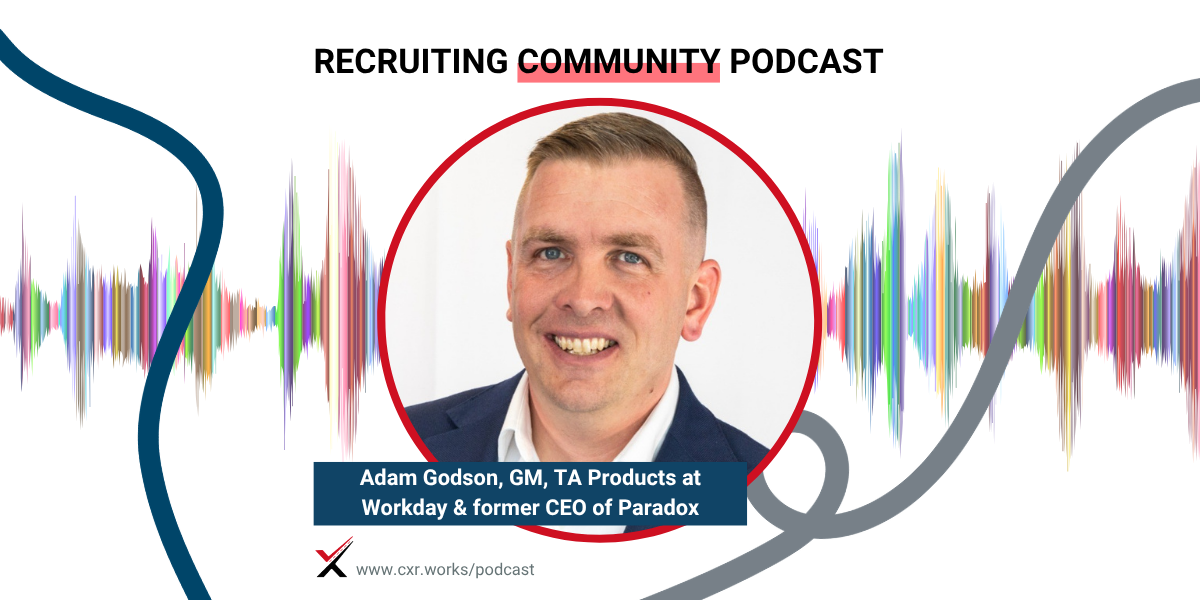
Adam Godson on Fixing Frontline Hiring Friction
Featured Guests:
Adam Godson, GM of Talent Acquisition Products, Workday (formerly CEO of Paradox)
Hosts:
Chris Hoyt, President, CXR
Gerry Crispin, Co-founder, CareerXroads
Episode Overview:
Chris Hoyt and Gerry Crispin sit down with Adam Godson, who moved from CPO to CEO at Paradox and now leads Talent Acquisition Products at Workday following Workday’s acquisition of Paradox in October 2025. The conversation traces Godson’s path from recruiter to technologist to TA product leader, and centers on frontline hiring: why it has historically taken far longer than necessary, how process redesign—not just new technology—solved the problem at Paradox, and what the Workday-Paradox combination unlocks going forward. Godson shares field research from visiting retail and restaurant locations, discusses persona-based process design, application abandonment, the role of AI and agents in hiring, and where he sees frontline recruiting headed over the next few years.
Key Topics:
Adam Godson’s career path: recruiter to Cielo to Paradox co-founder/CEO to Workday GM of Talent Acquisition Products
Field research visiting retail and restaurant locations to observe real hiring friction
The problem of treating all hiring (executive vs. frontline) as a single, identical process
Redesigning applications to ask disqualifying/qualifying questions upfront rather than collecting full information for every candidate
The “tunnel” vs. “door” metaphor for application and rejection design
Frontline hiring as a task often owned by store/restaurant managers rather than dedicated recruiters
Application abandonment (Godson cites roughly 60% of frontline candidates starting but not finishing applications) and removing login/account-creation friction
Reframing recruiting into two distinct future roles: process design and traditional relationship-based recruiting
Where AI helps in frontline hiring: removing logistical/coordinating friction (e.g., interview scheduling) versus where it risks creating “theater” for candidates
Using AI/agents to gather broader candidate signal beyond the resume, with attention to protecting candidate experience
The Workday-Paradox combination: connected/compliant core systems paired with agent-driven experience layers (including Paradox and HiredScore)
Time-to-hire benchmarks: from a 21-day market average three years ago to roughly 3.5 days among adopters, with a widening gap between technology “haves and have-nots”
Notable Quotes:
“The point of AI in hiring was never to automate the human moments. It’s really to get rid of everything standing in their way.” — Chris Hoyt, framing Adam Godson’s argument
“I like my job again because we’re fully staffed.” — Adam Godson, quoting a hiring manager
“No one gets self-actualization from this process — they want it fast and right.” — Adam Godson
“I’m highly in favor of expanding the amount of information a company has to make a decision about a person’s match to the job… so long as we’re careful not to waste people’s time with theater.” — Adam Godson
Takeaways:
Frontline hiring friction stems less from a lack of technology and more from process design that treats all roles and candidates identically. Rethinking the application experience around persona-specific, front-loaded qualifying questions—paired with removing unnecessary barriers like account creation—has driven measurable improvements in time-to-hire. As Workday and Paradox integrate, the combination of a compliant, connected core system with agent-driven experience layers aims to close the gap between technology adopters and non-adopters in frontline hiring speed.
Want more conversations like this?
Subscribe to the CXR podcast and explore how top talent leaders are shaping the future of recruiting. Learn more about the CareerXroads community at cxr.works.
Chris Hoyt: Well, well, well, here we are again, Mr. Gerry. Every time we dial in, we show up, and we chat. That’s it. I love it. For those who have just stumbled upon us, welcome to the Recruiting Community Podcast. I am Chris Hoyt, president of CXR. I’ll be your host of this podcast, along with Gerry Crispin, co-founder of CareerXroads. On this show, the way we like to phrase it, we do our best to bring you industry insights in the form of a fun conversation.
It’s all brought to you by the CXR CareerXroads community. Today, our guest has spent his career on one stubborn problem: why does it take weeks, if not months, to hire somebody for a job when in theory it should take days? Adam Godson went from CPO to CEO of Paradox, and now, after Workday completed its acquisition of Paradox back in October 2025, he’s the GM of Talent Acquisition Products over at Workday.
Adam’s argument is one you don’t hear often from an AI-forward company: the point of AI in hiring was never to automate the human moments. It’s really to get rid of everything standing in their way. We’re going to talk frontline hiring today with him — what’s broken, what’s changed, and where TA leaders should actually start.
Before we jump in, a couple of things Gerry and I want to share with you. We’re streaming on the socials — YouTube, LinkedIn. We’re still trying to figure out why we’re on Facebook, but we’re there for now. You can check us out at cxr.works/podcast. You’ll find past and future episodes there — hundreds of interviews we’ve done with TA leaders and practitioners, people doing really interesting work that touches on how we attract and recruit talent, as well as manage and lead global teams.
On that site, you’ll also find easy ways to like and subscribe, and let us know if you want to be part of the conversation, or if you’ve got someone else you think would be a good guest — they can jump right in and chat with us. And lastly, our big disclaimer: this is an ad-free labor of love. Nobody pays to be on the show, and we don’t pay guests to be here. We just like what they have to say, and we invite them in to talk about it. Gerry, did I miss anything?
Gerry Crispin: God, no. You went through it pretty quickly, too.
Chris Hoyt: That was fast. I did. It’s like we’ve done it a few times.
Announcer: Welcome to the Recruiting Community Podcast, the go-to channel for talent acquisition leaders and practitioners. This show is brought to you by CXR, a trusted community of thousands, connecting the best minds in the industry to explore topics like attracting, engaging, and retaining top talent. Hosted by Chris Hoyt and Gerry Crispin, we’re thrilled to have you join the conversation.
Chris Hoyt: Adam, welcome back to the show. You’ve been here before. Welcome, man.
Adam Godson: Hey, Chris. Hey, Gerry. Great to be with you.
Chris Hoyt: Lovely to have you, always. For those who haven’t been fortunate enough to get a little time with you, Adam, or know a bit about your background, why don’t you give us that elevator pitch — who is Adam Godson, and why should we be listening to what he has to say today?
Adam Godson: Twenty-three years ago, I was a recruiter, and I fell in love with the job. I loved the curiosity, the spark of talking to people, understanding their why. But the scale problem bothered me. So, also being a technologist, I got into recruiting technology and started building solutions and programs to figure out how we could solve some of the scale problem in hiring.
I spent about a decade in the outsourcing industry at Cielo, putting together different technologies and solutions and getting to use all of them. Then I joined Paradox with my friend Aaron as head of product and engineering, became CEO in 2024, and now I lead Talent Acquisition Products at Workday. I’m on a mission to make recruiting better through technology.
Chris Hoyt: Your path runs from Cielo to founding team and CEO at Paradox to Workday. What was the moment that frontline hiring became the problem you wanted to dive in and solve?
Adam Godson: Mostly, I thought it was done so poorly, and it didn’t have to be. We’d look at companies that were chronically understaffed, and there was just so much friction in the process. For Paradox, it was chat — if you squint a little and the technology gets a little better, you can see how this could fundamentally transform how companies get staffed and how people find jobs. And luckily, it did. Technology got better, and we continued to grow.
But I remember a seminal moment — we decided to do some field research. We went to try to get a frontline job. We went to a shopping mall, went to a bunch of restaurants, and said, “Let’s go experience how this works.” We walked in and said, “I would like a job. How does this work?” And the most common answer we got was, “You should leave and go apply online, on our website.” You’d never do that at the cash register, right? “Oh, this is also available online — leave my store and go buy it online.” And yet that was the most common response we got. It felt fundamentally broken — no one was really solving it, and it was a problem worth solving.
Chris Hoyt: I love that tie-in. I don’t know why the experience has to be different. I think what I’ve also heard you say is that when you visited customers in restaurants, retail, or even healthcare, hires were taking 20, 30 days, and there was nothing special happening in those days — it was all just wait or waste, in your words. Can you walk us through what “broken” actually looks like inside those 30 days?
Adam Godson: One of the fundamental problems — and some of the early applicant tracking systems were to blame for this — was that everyone thought hiring was one process. There was no persona research to say, “We should probably hire the CEO and the cashier and the project manager differently.” It was just, “No, our ATS has one workflow, this is what we’re doing.” We didn’t think critically enough, even though it’s really logical — would I hire the cashier and the CEO the same way? No. But it got fundamentally broken.
The field research was really important — walking into a restaurant and asking, “How do you do this?” And hearing, “Oh, I actually only look at applications on Tuesdays — but not every Tuesday, sometimes every other Tuesday.” Watching people wait while those applications expire. Watching hiring managers review an application and say, “What are you looking for?” And they’d say, “Well, I want to know if they’re old enough to work here, eligible to work in this country, meet the physical requirements of the job, and have the right certification.” It occurred to us — why fill out all this stuff on an application? Just ask those questions.
So we did, and that was the breakthrough — ask those questions, and once someone clears that bar and is scheduled for an interview, then they can fill in the rest, because we already know they’re qualified. Rethinking the process like that, we started to see restaurants reach incredible staffing levels, and retail places really understand their sales per square foot — that they were driving revenue from having people where they needed them.
One of my favorite messages ever from a hiring manager was, “I like my job again because we’re fully staffed.” If you’ve worked at a restaurant, you know that being short-staffed can be miserable, and being fully staffed can be a lot of fun. So it wasn’t just the person who got hired — the rest of the team was happier too. I thought it was a great way to create happiness and net good in the world.
Gerry Crispin: What you’re describing sounds like a door at the beginning of the application process — a checklist that says, “Here are four things. Do you have those four? Okay, go through the door.”
Adam Godson: Yeah, and I think there are parallels outside of frontline hiring too. We’ve designed a lot of recruiting processes as tunnels that aren’t interconnected the way they should be. You go all the way through the process, and instead of saying “does not compute” and rejecting the person at the end, we should be thinking about that at the front — should you even go in this tunnel to begin with? Maybe there’s a better job for you in the middle of the tunnel.
That redesign has mattered a lot, especially in frontline hiring, where there often isn’t a recruiter per se — it’s the store manager, and recruiting is part of someone’s job, not their entire job. That’s where technology can really help, acting as an assistant. That’s where early chat technology, and now AI, is well suited — offloading work so the manager, whose expertise is running a store or a restaurant, can just make the decisions while the assistant handles everything else.
Chris Hoyt: That ties back to your earlier point about letting people get back to doing the job they were hired to do, rather than being shoehorned into filling gaps in an understaffed store.
Gerry Crispin: Absolutely.
Chris Hoyt: You’ve shared data suggesting something like 60% of frontline candidates start an application but never finish it. When we talk about implementing technology to address that — is the fix more tech, or something else, or a combination?
Adam Godson: It’s a combination of a few things, but one of the most fundamental is making the entry point as seamless as possible. Most jobs online, when you click to apply, put a login right in your face. No one remembers a login for a site they’ve never applied to before, and if you scroll to the bottom, there’s a small “create account” link. I think about my son, who’s 16 — he doesn’t know he needs an account. He’s like, “Why would I need to create an account?” Sometimes it says “register,” and people just don’t know what to do.
So we replaced that with, “Hi, what’s your name?” instead of “create an account,” because everyone knows their name. That gets the conversation started, and then the entire application happens through a conversation — via text messaging, WhatsApp, or a web application. In many ways, it’s back to basics — before any of this technology existed, you lived in a local economy, walked into a store, said you wanted a job, and the person said, “Okay, tell me about you.” It’s a back-to-basics moment enabled by technology, making technology more personal again.
Chris Hoyt: Rethinking the process seems to be the core of the difference. As TA leaders, we need good partners and good technology, but getting back to basics — asking ourselves why we recruit this way, why we ask these questions, why we put this requirement in front of candidates — seems like the best place to start when improving speed or other metrics. Are you seeing leaders take a step back and assess the process before just saying, “I need a new tool”? Because chasing the next shiny tool was a real problem a few years ago.
Adam Godson: I see really thoughtful leaders redesigning processes, though there are still people shopping for tools. You hit it well, Chris. I’ve been asked a lot over the years, “Why could no one copy Paradox? What did you have that was special?” Redesigning the process was one of the things that was really special. Paradox was founded by old recruiters — Aaron, me, Corey Smith — who knew the domain and knew process redesign was just as important as any tech you could build. The tech is good, but tech alone couldn’t do it. Lots of others slapped a chatbot on their career site and thought they’d copied Paradox, but the magic was in process redesign and a lot of other things.
I see a lot of recruiters and talent leaders today thinking about process redesign and persona-driven design — how frontline is different from a specialized role, and thinking more deeply about process. As I think about the future of recruiting, I think there are really two jobs: a process design job, where you bring technology together for thoughtful process design, and an old-fashioned recruiting job, focused on personal connection and being a great recruiter in the traditional sense. Over the last ten years, we’ve had a lot of people stuck in the middle, pushing buttons on the system without doing either job well, or unhappily doing half of their job. I think we’re heading toward real industrial process design and great people engagement, and the middle will sort itself out.
Chris Hoyt: I love that framing. Not too long ago, leaders were told their future recruiting talent needed to be a “conductor of agents,” managing agentic recruiting teams. Now it sounds like you’re seeing the same thing we are — yes, they need learning agility for new tech and someone who can manage that language, but they also need someone who can forge relationships and build trust — not just “you should come work here,” but real relationships that lean into what candidates are looking for. I’m glad it’s not a divergence but a realization that it’s not an all-or-nothing type of recruiter we need going forward.
Adam Godson: Yeah, and being clear about those differences matters. Trying to force someone who wants to be talking to candidates all day to design the ATS process — no one’s happy with that. Getting the right people with the right skills into the right job is the magic of building a great TA team in 2026.
Chris Hoyt: You’ve made the case before that AI actually makes hiring more human, not less. Where does AI genuinely help in frontline hiring — and maybe just as interesting, where does it not?
Adam Godson: The goal for someone applying to a job is to interact with the decision maker as quickly as possible. AI does a great job of getting rid of the surface-level stuff, coordinating logistics, and getting to that point fast. We’ve taken time-to-hire from 21 days — the market average three years ago — down to three and a half days among our clients. We’re clearing out boring stuff that didn’t matter.
Interview scheduling is an obvious example. I built my first interview scheduling tool in 2011. People said, “Wow, that’s so impersonal.” I said, “No one gets self-actualization from this process — they want it fast and right.” We schedule over 30 million interviews a year, and taking that transaction out and making it faster and accurate means people get to talk to people faster, which is what they want. Companies can also be more agile — if they need someone on Monday, they can have someone start Wednesday.
Gerry Crispin: I understand the frontline worker at that level. Do you see the top of the funnel being handled by agents capable of interviewing 200 or 300 applicants — a first step to let everyone compete, at least to some degree, in a consistent way, so we can move people more quickly to the humans in the loop who deal with those we move forward with?
Adam Godson: It’s a good question, Gerry. I’m highly in favor of expanding the amount of information a company has to make a decision about a person’s match to the job, and AI can be an effective way to do that — so long as we’re careful not to waste people’s time with theater. I push back when people say, “I want every candidate to feel like they had a chance.” What I hear is, “I want to waste people’s time — they don’t really have a chance, but I want them to feel like they did.”
I think we’ll see some collapse here. If someone applies to 15 jobs today and has to do 15 different AI interviews, that gets old fast. Being able to centralize that information will matter, along with controlling it — leasing it to others, potentially as their own agent, that can apply to a job that has an agent, and sorting out the marketplace that way. But to come back to it, Gerry — I’m highly in favor of getting signal from candidates in non-traditional ways. The resume or job application may not have the right information in 2026, so as we get candidates to express themselves and share more about why they’re a fit, I’m highly in favor of that. But I’ll also have an opinion about protecting the candidate and making sure we don’t create silly experiences for invalid reasons.
Gerry Crispin: Part of that is the door you mentioned earlier — that early conversation could start with the key issues that close the door: why waste your time applying for the rest of this if you’re not going to be qualified? But here’s what else you could be doing.
Adam Godson: That’s right. One of the core tenets is getting someone to the right job as quickly as possible, too. Most people come to a company’s career site through a side door — they found it through a search on Google, Indeed, wherever — and land on a job detail page, one job out of maybe a thousand, that may or may not be the right one for them. Employers can help by saying, “This is the job you selected — you may or may not be a good fit for it, but you’re a great fit for this other role.” Helping people find that, while letting them make their own decisions about what to apply to, and making the best recommendations, will help companies find the most relevant talent for those roles.
Chris Hoyt: You mentioned earlier the original recruiting team that got Paradox off the ground. I remember talking to Aaron once, and he mentioned Workday and Paradox had over 200 mutual customers and a handful of certified integrations well before the deal. Now that you’re on the inside after the merger, what does that combination unlock for frontline hiring that maybe neither company could do alone?
Adam Godson: It’s really interesting, Chris. I’ve bought systems in this space for 20 years, and you always had to choose — do you want a connected system tied to all your other tools on a platform that has the people, data, rules, and permissions, but doesn’t have all the features you want? Or do you want best-of-breed, with all the features you want, but you have to build and maintain all the integrations yourself forever? You had to choose which devil you wanted, and the market swung back and forth pretty consistently in roughly 15-year cycles.
I think agents open up a new path. There’s the foundation of the system, the business process, and frankly the compliance — that’s one thing Workday Recruiting is great at: compliance, business process, flexibility. We can do things differently in Germany versus Thailand, for frontline roles or not, within that business process framework. Then you put experience on top with agents — including Paradox, HiredScore, and natively built agents that can handle many things within that system.
So the job now is really integrating Paradox and Workday very deeply to get that magic, then orchestrating with other agents across Workday — from workforce planning (“we shipped a million packages yesterday, what does that mean for our labor plan?”) right into requisition creation, hiring, onboarding, and new integrations on the other end. That’s what we’ve wanted to do for a generation, and I think there’s a real shot at doing it by blending the foundational systems with agents on top.
Chris Hoyt: I can’t tell you how many “Frankenstacks” I’ve worked in or helped build. It seems like that magic is unfolding where it doesn’t have to feel or function like that anymore.
Adam Godson: That’s right. It’s going to get substantially better — you won’t have to create the Frankenstack anymore, because the functionality is already in the connected system. Thoughtful experiences will go a long way toward making that happen.
Chris Hoyt: For the TA leader who’s dialed in right now, still chugging away, who knows their frontline process is leaking candidates — Adam, where would you tell them to start? Or bigger picture, where do you think frontline hiring is headed in the next couple of years?
Adam Godson: I think there’s not going to be much of an excuse to have a hiring process with friction in it, because better alternatives are available. Even at the US macro level — three years ago, time to hire was around 21 days. Now we’ve moved this whole frontline labor market into a hump of people getting hired in about three and a half days, and another hump of non-technology adopters still hiring in about 24 days. The average is now 16, which is better, but it’s a “haves and have-nots” situation — the technology adopters are hiring really fast, and the non-adopters are hiring only slightly slower.
So really look at how to get there from a technology standpoint, to be sure you’re part of the “haves” and enabling your team to have better staffing. The paths at this point are pretty well-worn, and I’d love to have conversations with TA leaders looking for the “how” on that. I think the path is proven.
Chris Hoyt: I love that you’re keeping an eye on that shift, and I like the “haves” pivot. Adam, we ask everybody this before we let them go — if you were going to write a book on what you’ve learned in the last year in our space, what would the title be?
Adam Godson: The one I want to write is “How We Solved Frontline Recruiting.” We’ll see if I get to write it, but I don’t claim to have all the answers. I think we’re making great progress, and what I hope to do is make a difference in the lives of candidates — get them to work faster, put food on their table, make people happier at work when their organization is fully staffed, and prove that talent acquisition can be truly strategic and drive top-line results for the company. If we can nail those things, we’ll sleep pretty well at night.
Chris Hoyt: You’re talking my language, Adam. Present company excluded — who gets the first signed copy of your book?
Adam Godson: Probably Aaron, to be honest. I couldn’t have done the product journey without Aaron, so he probably gets the first one.
Chris Hoyt: I love it. Well, Adam, thank you so much. I know you’re a wildly busy guy, and I’m looking forward to seeing you on the road — we’ll be at Workday Rising pretty soon, so we’ll get some time with you there. Thanks for cutting out some time to talk to all our listeners. Appreciate you, man.
Adam Godson: Of course. Looking forward to seeing you guys at Rising, and always love the conversation.
Chris Hoyt: Good stuff, everybody. Check us out — listen to this again, there’s good stuff in here. You can check out everything we’ve been doing, hundreds of interviews, at cxr.works/podcast. Just keep up with what’s going on in the community. Until then, we’ll see everybody next time. Thanks.
Announcer: Thanks for listening to the Recruiting Community Podcast, where talent acquisition leaders connect, learn, and grow together. Be sure to visit cxr.works/podcast to explore past episodes, see what’s coming up next, and find out how you can join the conversation. Whether you’ve got insights to share or want to be a guest on the show, we’d love to hear from you. If you’re interested in learning more about becoming a member of the CXR community, visit us at www.cxr.works. We’ll catch you in the next episode.
AI didn’t invent hiring bias, but it gave it a paper trail. Warden AI’s Martyn Redstone breaks down the Mobley-Workday case and the 2026 legal patchwork.