
Lean Team, Big Leadership Bench
How does a 2-3 person team drive 40 VP-plus hires a year? Grace Niwa of Vertex Pharmaceuticals shares her portfolio approach to executive recruiting.
 play_arrow
Building the TA Machine Alessa Rivera Badillo
 play_arrow
The AI Talent Race Alessa Rivera Badillo
 play_arrow
Built for Change: Tracey Friend’s Career Crossroads Alessa Rivera Badillo
 play_arrow
Both Sides of the Table: Why TA Is the Advantage Alessa Rivera Badillo
Featured Guest:
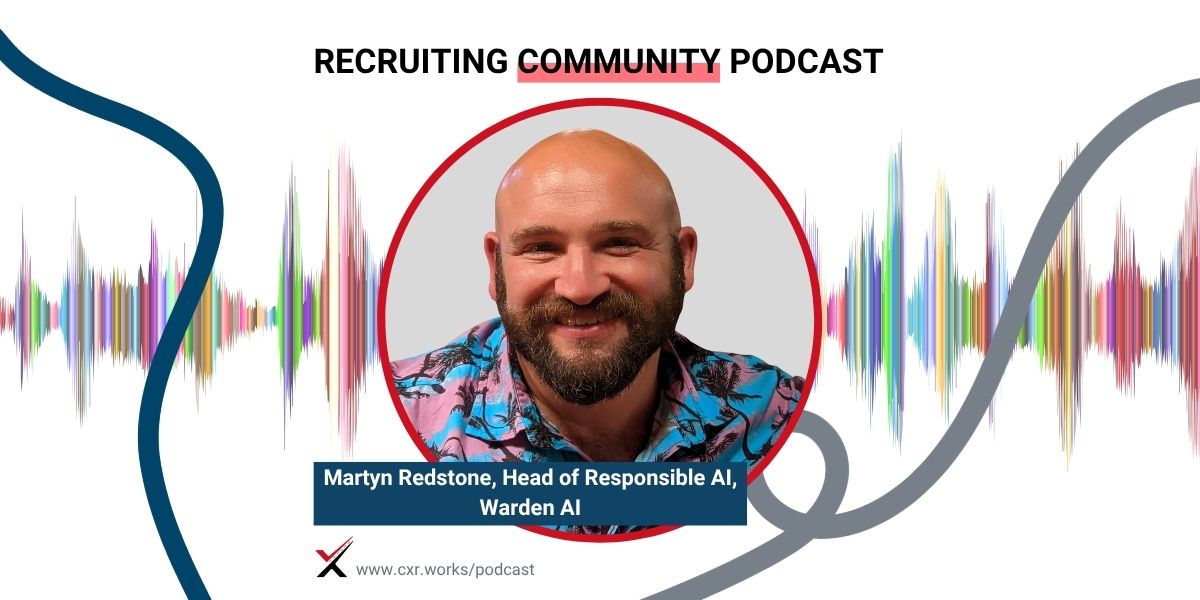
Martyn Redstone, Head of Responsible AI and Industry Engagement, Warden AI
Hosts:
Chris Hoyt, President, CXR
Gerry Crispin, Co-founder, CareerXroads
Episode Overview:
Chris Hoyt and Gerry Crispin are joined by Martyn Redstone of Warden AI to discuss the growing legal and regulatory scrutiny facing AI-driven hiring tools. The conversation covers the Mobley v. Workday case, the mixed legal theories being used against AI vendors and employers (including FCRA, ADA, Title VII, and California’s Fair Employment and Housing Act), the difference between AI “making” versus “influencing” hiring decisions, the patchwork of state and international AI regulation, and what TA leaders can practically do to manage risk starting immediately.
Key Topics:
Why 2026 has become a turning point for legal accountability around AI in hiring
The Mobley v. Workday case: allegations, class-action status, and the question of vendor liability
Use of California’s Fair Employment and Housing Act despite jobs being located outside California
Other active cases: Sirius XM (race discrimination), Eightfold (FCRA/credit-bureau theory), and past cases involving IBM, Meta, and iTutor Group
The “Monocultures in Hiring” research on pymetrics/Harver and job-level bias auditing gaps
Difference between standards (e.g., ISO 27001, ISO 42001), guidelines, and actual law
Automation bias/”rubber-stamping” versus proxy discrimination
Concepts of “developers” versus “deployers” under AI employment legislation
Patchwork of state laws (California, Texas, New York, Colorado, Illinois, Connecticut, New Jersey guidance, Massachusetts) and EU AI transparency requirements
Core regulatory themes: transparency, notice, opt-out rights, and explainability
Risk categories for AI hiring tools: bias, accuracy, consistency, and real-world stability
Practical first steps for TA leaders: tool inventory, vendor due diligence, and building internal audit/governance habits
CXR’s AI vendor evaluation resource (cxr.works/airfip)
Notable Quotes:
Martyn Redstone: “It’s really easy to build AI — it’s not very easy to build it responsibly, ethically, and legally.”
Martyn Redstone: “Nobody blames the recruiter anymore — they blame the technology.”
Martyn Redstone: “This isn’t about a machine making a decision, it’s about a machine influencing a decision.”
Martyn Redstone: “You’re not off the hook just because your state hasn’t created an AI-specific law.”
Martyn Redstone: “AI in Hiring: How to Be the Responsible Adult in the Room.”
Gerry Crispin: “At some point people are going to be looking in court to weigh the different pieces of what the human is doing versus what the AI is doing.”
Takeaways:
Legal accountability for AI in hiring is expanding beyond employers to include the vendors building and deploying these tools, with current litigation largely proceeding under decades-old anti-discrimination and consumer-protection laws rather than new AI-specific statutes. TA leaders operating across multiple states and countries face a patchwork of regulation, but most frameworks share common requirements around transparency, explainability, and bias mitigation. Practical next steps include inventorying all AI tools used across the hiring process, pressing vendors for proof of compliance and impact assessments, and establishing ongoing internal auditing for accuracy, consistency, and bias.
Want more conversations like this?
Subscribe to the CXR podcast and explore how top talent leaders are shaping the future of recruiting. Learn more about the CareerXroads community at cxr.works.
Chris Hoyt: All right, welcome to the Recruiting Community Podcast. I am Chris Hoyt, president of CXR and your host for this podcast, along with my partner in crime, Gerry Crispin, co-founder of Career Crossroads. Gerry, how are you on this glorious day?
Gerry Crispin: It is a lovely day, actually. I was up early. I had a few telehealth things going on with various folks, and I’d already had a couple of meetings. So, it’s a good day.
Chris Hoyt: I love it. You’re a busy man — kind of an early riser.
Gerry Crispin: Yeah, of late. Up late.
Chris Hoyt: Oh, up late. I thought you said you were late to being an early riser.
Gerry Crispin: Yeah, I was up late — that’s the whole thing. When I’m not up late, I’m an early riser.
Chris Hoyt: I’ve found in my 50s I very much like getting up at like 6:15, 6:30 in the morning. I don’t know why — it’s weird. My wife’s not excited about it, but I love it.
For those who have dialed in and plan to suffer through the next 30 minutes or so, as a reminder, we do our best here to bring you industry insights and updates in the form of a conversation. It’s all brought to you by the CXR, Career Crossroads community — you can check that out at cxr.works.
I want to get into this because I think this has been a long time coming, and it’s taken a while from a visibility standpoint. When we talk about hiring bias and AI, AI didn’t invent hiring bias — it seems, though, and we just posted a blog on this, that it gave it scale, speed, and, what we’re going to talk about today, a paper trail. I think this accountability and discoverability piece is something we’re talking about a lot lately, and now the lawyers have stumbled onto that paper trail — I mean that with all respect to any lawyers.
There’s a bellwether case, Gerry, that you know really well, working its way through federal court in California, and it’s asking whether the vendors behind an AI screening tool — not just the employer using it, but the vendors — can also be on the hook when things go sideways. There’s a lot of chatter about this with Workday and Mobley, and even a little chatter around the Indeed terms-of-service updates. All of these things are moving around at the same time, and states seem to be writing their own rule books that don’t line up or match.
So, to help us make sense of all the lawsuits and the patchwork, and what TA leaders should actually be doing about it, we’ve got Martyn Redstone with us today. Martyn has spent, I think, over two decades in recruitment and HR tech — he’ll tell us a bit more himself — and today he leads responsible AI and industry engagement at Warden AI, where they’re building what they call the standard for independent AI auditing and assurance in HR. Gerry, have I missed any of the complicated — “patchwork” might be my favorite term for this — mishmash, spaghetti-on-the-wall scenario we’re looking at here?
Gerry Crispin: No. It’s just a matter of cutting through all of that patchwork to get to what’s coming next and what we can do to get ahead of it.
Chris Hoyt: A hundred percent. It is a mess. Hopefully Martyn’s going to help us decipher some of that.
Before we jump in — we’re streaming on YouTube, we’re on LinkedIn, we’re not really sure why we’re on Facebook, but we’re there. You can check us out at cxr.works/podcast. You’ll see past and future episodes — literally hundreds of conversations and interviews with TA leaders and practitioners doing really interesting work that touches on how we attract and recruit talent, and how we manage and lead these global teams. You’ll also find easy ways to like and subscribe, and to let us know if you want to be part of the conversation — or if you’ve got somebody you want Gerry and me to talk to, let us know, even if that’s you. We’re always looking for fun guests. And my final disclaimer: this is an ad-free labor of love. Nobody pays Gerry and me to be on the show, and we certainly don’t pay anybody to join us.
Announcer: Welcome to the Recruiting Community Podcast, the go-to channel for talent acquisition leaders and practitioners. This show is brought to you by CXR, a trusted community of thousands connecting the best minds in the industry to explore topics like attracting, engaging, and retaining top talent. Hosted by Chris Hoyt and Gerry Crispin, we’re thrilled to have you join the conversation.
Chris Hoyt: Martyn, welcome to the show. Thanks for joining us.
Martyn Redstone: Thank you very much for having me. Apologies in advance — we’re flying to Vietnam tomorrow, so my office is being used as a luggage storage facility. So, apologies for the messy background, but that’s families for you. Thanks for having me on, Chris and Gerry. You did a better job than I could on introducing myself — that was a well-researched and rehearsed introduction, to say the least.
Chris Hoyt: We’ve been doing this for a bit, so some of it’s on autopilot, to be quite frank. Martyn, I think since the pandemic nobody blinks twice about what’s going on in anybody’s background. We’ve had babies on the show, cats attacking dogs, all the things — you’re in pretty good company with the luggage.
For those who haven’t had the pleasure of meeting you, or aren’t aware of Warden AI and what’s going on there, can you give listeners the elevator pitch? Who’s Martyn Redstone, why should we be paying attention, and what does Warden AI do?
Martyn Redstone: I’ve been in the industry for just coming up on 21 years now, and the last half of that has been in applied AI within recruitment and talent acquisition — building AI systems, conversational AI systems, since 2016, working with global employers on AI enablement and implementation, and working with vendors on building AI products. I’ve been doing it since before ChatGPT and AI became “sexy,” which is why people tend to listen to me on all things AI.
But actually, post-ChatGPT, what people realized was that it’s really easy to build AI — it’s not very easy to build it responsibly, ethically, and legally. I realized that very quickly, and post-ChatGPT I really focused on good governance, good compliance, and good risk mitigation in AI building. I’d been doing that freelance since about 2023, and then earlier this year I joined Warden AI as their head of responsible AI and industry engagement, as you said.
Quick pitch on Warden AI: we’re an AI assurance platform that specializes in AI usage within the employment process, AI decision-making, and algorithmic decision-making within the hiring process. We do ongoing, continuous auditing of AI systems for risk — specifically bias auditing. We look at AI systems used in hiring and other employment decisions to ensure they’re risk-managed, mitigated, and measured.
Chris Hoyt: I love the line — it’s almost a coffee mug or a T-shirt for me: it’s easy to build AI, it’s not easy to build it responsibly.
Why don’t we start with the “why now” question? Gerry and I were laughing about this the other day — hiring bias is as old as hiring itself. So when we talk about bringing AI into the picture, what’s actually changed? And what’s your take on why 2026 seems to be the year the legal teams — and the legal system — are finally catching up?
Martyn Redstone: Bias has always been part of the hiring process. We’ve been talking about it for as long as Gerry can remember — unconscious bias, all of it. It’s been there forever. The challenge with AI is the underlying concern that AI is trained by people, people are biased, and therefore AI magnifies and scales that bias. That seems to be the constant conversation.
Every single day there’s a news item: “I was rejected because of an AI system. I was rejected because of a biased AI system.” Nobody blames the recruiter anymore — they blame the technology. Which is maybe nice for recruiters, but the problem is, if I’m driving my car and I crash, it’s not the car’s fault, it’s my fault as the driver. I think lawyers are starting to understand that, and people are starting to understand that.
On the flip side, the stats vary depending on who you ask, but there’s been a huge increase in applications since 2023. An individual can’t handle that scale, so people are turning to technology. The fallacy that we don’t use automated screening tools in recruitment is over — there’s a lot more use of it in 2026. So organizations that want to implement these tools aren’t just believing the sales and marketing hype anymore. They’re asking vendors to prove it — prove it works, prove it works responsibly, prove it’s not going to land them in court.
That’s why 2026 has become the interesting year — buyers are pushing back on the sales pitch and saying, “You need to prove this is fair, prove it’s bias-free, prove it surfaces the best applicant every time.” That’s what we’re seeing happen in 2026.
Gerry Crispin: The failure to do that means the onus goes back on the company itself, not just the technology. But if you are doing your due diligence, then you’re pushing the issue back to the vendor in terms of whether they’re living up to their words — walking the talk.
Martyn Redstone: Absolutely. And you’re right — it’s a complete failure on the buying organization, the deployer of the tool, if they don’t do their due diligence properly. But that due diligence, done properly, is starting to raise the standard of the vendors as well. So it’s a positive all around.
That’s where one pressure is coming from. The other pressure is coming from the regulators — state legislators, federal, other countries around the world. There’s a lot of pressure now coming through regulation and law, which is very interesting as well.
Gerry Crispin: And you’re seeing it all over the place, Martyn. Chris alluded to it — sometimes these things don’t align. I look at ISO 27000, or whatever it’s called, focusing on this area, but there are several other competing standards too. How do you make sense of all of that?
Martyn Redstone: There are a lot of standards around. There’s a difference between standards, guidelines, and law. We look at standards as best working practice — 27001, 42001 — ultimately they’re management standards. They’re not the law. They’re not what’s going to get an organization into a lawsuit. Like everything with ISO, it’s basically laying out what you do and then proving to an auditor that you do what you say you do. As long as it matches those standards, you get the stamp of approval.
The challenge is: if you do what you say you do, and it’s at the right level in terms of best working practice, can you evidence that if it gets to a lawsuit? That’s the second part of the question. There’s no good just having a management system in place — it’s about making sure you can evidence that you do that, exactly as you say you do, matching those best working practices in a court of law.
Chris Hoyt: I think everybody in the space, at least the leaders we’re talking to, is watching the Mobley-Workday case. For listeners who aren’t tracking every docket entry — they’ve got other stuff to do — can you give a high-level overview of what that case is, and why it matters so much that a court says an AI vendor can be treated as the employer’s agent?
Martyn Redstone: There are a couple of interesting points coming out of this so far. At a really top level: Derek Mobley, a male applicant over 40, Black, and disabled, applied for over 100 roles through different employers who used Workday as an ATS. He didn’t get invited to any follow-up interviews, so he alleged there’s bias in the system against one or more of those protected characteristics.
This was raised two years ago. It was last year that the court decided it could be brought as a class action, and multiple people have since added to it — it’s going through the standard court process. What I love about our industry is that whenever there’s a new docket update, everybody explodes on LinkedIn about the Mobley-Workday case. Ultimately it’s just going through standard procedure, but there have been some interesting developments.
The first is: is it the employer or the technology provider? The logic is that the technology provider is processing the application. We’ve seen other cases where the employer is the one brought to court — Sirius XM, IBM, Meta, and in the past, iTutor Group. So it’s really a mixed bag, and it depends on how the court tests it. They’ve also brought in HireVue to the case, which was acquired after the alleged bias in the application occurred.
The second really interesting point is that it wasn’t only brought under federal law — it was also brought under California law, and the court upheld that. Workday pushed back, saying the jobs weren’t all in California, but the court said the processing was happening in California because Workday is a California-based company with systems based there, so it doesn’t matter where the applicant or the role was — they’re bringing this under California’s Fair Employment and Housing Act.
So, two very interesting things coming up. But court dockets come out all the time — there’s a series of processes, motions to reduce down certain things, evidence requests and pushbacks — you see it constantly. Right now it’s just going through the standard motions of a court case.
Chris Hoyt: I feel like I was behind — I know Mobley isn’t a one-off anymore, but I just learned about the Sirius XM piece, which comes at this from a race-discrimination angle, and we’ve known about the Eightfold case for a while, which argues they’re functioning basically as a credit bureau. I’d love your take on all these different legal theories — how do you explain plaintiffs circling around all these AI hiring tools?
Martyn Redstone: What’s interesting is that the vast majority of these cases are being brought under old legislation. You mentioned Eightfold — it’s not a discrimination case per se, it’s under FCRA, which has been around since the 1970s. Anti-discrimination law has been around just as long, and that’s what the Workday case is coming under.
So while states and federal discussions are happening around bias in AI and anti-discrimination in AI systems, all the court cases happening right now — because these pieces of regulation are so new — are happening under older law. People are circling because it’s an easier case to bring: the onus is on the accused, whether that’s the hiring organization or the technology provider, to prove they’ve done the right thing in deploying that system into the market.
Chris Hoyt: I heard this term recently — proxy discrimination — and the idea of what it means when no human ever sees a rejected candidate. That seems to be snowballing a bit, whereas before we wouldn’t think twice about using if-this-then-that screening, pre-screening, and knockout questions. Now everybody seems nervous.
Martyn Redstone: Proxy discrimination is something slightly different from rubber-stamping — there are two different thought processes there. Rubber-stamping is what you’re referring to — what we call automation bias. We just trust the computer; it’s a computer, it has to be right. So we never look at why somebody was rejected or moved forward, and we don’t question the decision.
A lot of legislation coming out now pushes back on that, saying: this isn’t about a machine making a decision, it’s about a machine influencing a decision. That’s a completely different mindset, because the defense we’ve always heard is, “It’s fine, the AI isn’t making the final hiring decision.” Unfortunately, that’s not going to hold up under current legislation.
Gerry Crispin: In a court of law, if there were 100 cases where AI said, “Here are the top 10 candidates,” and in every one of those 100 the human just interviewed those 10 — if I’m sitting in judgment of that, I’d suggest the AI has influenced the hiring manager and the recruiter, whether it’s because they’re too lazy to look beyond it or whatever, it doesn’t matter. They’re, in effect, following the algorithm that’s been set up for them. At some point people are going to be looking in court to weigh the different pieces of what the human is doing versus what the AI is doing, and that’s still to come. I can’t wait for some of those decisions.
Chris Hoyt: I have an off-the-wall question — half crazy. There are sites popping up like “rent a human,” where AI agents have been given small budgets and autonomy to hire humans — humans basically becoming the API for things the bots can’t do. Is there any talk about accountability for robots making hiring decisions? This is a fun dinner-conversation piece — I don’t mean to make light of the real legal conversations, but it’s a strange pivot, and I wonder if there’s already talk about how that rolls back to the humans who made or host the AI.
Martyn Redstone: It’s a fascinating topic. That’s a dinner party conversation for me too. But it comes back down to systems either influencing or making hiring decisions — it doesn’t matter whether it’s “Hire a Human,” Workday, Eightfold, or anybody else, because there still needs to be a human who oversees that.
Within the legislation, we have concepts of deployers and developers. Developers build the systems and have certain responsibilities depending on the legislation. Deployers put that system into the market to be used by the consumer — the candidate, the recruiter, etc. — and they’re typically the employers, who have a lot more responsibility. This is something a lot of people haven’t gotten their heads around: I can go to a developer of “Hire Humans” or whatever, and they’ll hand me an off-the-shelf system. When I implement it, I’m changing all the variables and criteria — my specific instance of that system is specific to me as an employer. And that’s where a lot of employers don’t realize where their onus lies under the legislation — they have to run their own assurance and governance processes. You can’t just rely on the vendor’s process and governance; it’s a good starting point when you’re buying it, to make sure they’re doing things correctly, but it doesn’t end there.
There was a lot of hype recently over a piece of research called “Monocultures in Hiring,” which looked at pymetrics — now Harver — and found that at the developer level, bias auditing was passing all the tests, it looked great. But they weren’t doing bias auditing at the job level: what does it look like when hiring a Java developer at this organization versus a healthcare worker? That’s where bias started creeping in, because that specific instance was trained on the organization’s past hiring outcomes — and as we said at the beginning, that’s when bias creeps in, because you’re training on past human behavior.
Gerry Crispin: Now you’re into predictive-validation mode. Very few companies are willing to spend the time it takes to determine whether the decision-making process survives over time — to show that the people it predicted would do well, actually did well, versus not. And that becomes very unique to the company itself.
Martyn Redstone: Exactly that. But it starts with making sure you’re not stopping somebody from having the opportunity right at the very start of the process. That’s the important part of where organizations should be managing their own governance posture.
Chris Hoyt: I want to do a callback, because of something you just said about companies selecting vendors. CXR put out a paper — it’s free for anybody who wants it — for when you’re evaluating a vendor that even whispers the word “AI.” You can find it at cxr.works/airfip; we’ll put it on the screen too. It’s free to download and run through procurement — I think it’s got 20-some questions on it. I wouldn’t sign a vendor until they’ve gone through that whole piece.
I want to talk a bit about the regulatory map, because as we were saying earlier — and I was on a call this morning about this — it’s a mess. Illinois’s law kicked in, Colorado passed a law and then rewrote it, Connecticut just signed one, and the EU is doing something far more structured and much stricter. If you’re a TA leader hiring in 12 states and three countries, what on earth are you supposed to build to?
Martyn Redstone: It’s a great question — I get asked this every day. Across the world it’s a patchwork of legislation. In the US, you’ve mentioned most of the big ones: California, Texas, New York, Colorado, Illinois, Connecticut. There’s guidance for anti-discrimination in New Jersey, and things coming out in Massachusetts and other states we’re monitoring. There’s a lot going on.
Most of the regulation, even across the EU, shares some very core concepts you can set as your standardized process: transparency, notice, data, opting out, and ensuring there’s no discrimination. At the point of interaction, you tell people when they’re interacting with an AI system — that actually just went live legally in the EU this past weekend. If you’re interacting with an AI chatbot, you need to tell people it’s an AI chatbot.
In a lot of regulation, if you’re going to be subject to an AI decision-making or decision-support system, you need to tell people, and potentially give them the opportunity to opt out of being processed by AI. You also need to be able to explain to people how that decision has been made or will be made — that’s transparency. Black-box solutions aren’t going to be accepted anymore. As a vendor, you don’t need to give away your IP, your secret sauce, but you do need to be able to explain how the algorithm works and what data it uses — going back to the Eightfold issue.
Gerry Crispin: At some level, they’re going to have to disclose the details of that algorithm to someone who can certify that it’s complying.
Martyn Redstone: The algorithm doesn’t have to “comply,” except for things like anti-discrimination. What the compliance requirement is, is being able to explain how it works — whether it’s a machine learning system or a large language model, it doesn’t matter. There’s no specific compliance around how it’s built, apart from making sure the data is collected properly and trained on relevant data. But it’s the explainability and transparency behind it that’s the regulation piece.
Chris Hoyt: Gerry, you’ll remember — about a year ago we were at HR Tech, standing at a booth with a company that shall not be named, and they were telling us how AI was going to make recruiting slicker and faster and help screen candidates. Then we started asking about that accountability factor, Martyn — “explain to us how it’s making these decisions” — and he couldn’t do it. The concept of needing to explain how the decision-making worked, out of that black box, was so foreign to this poor guy at the booth that he just froze — like a record glitch, he couldn’t get out of his own way. We said, “How can we sign with you if you can’t explain the basics of how it works, without getting into anything proprietary?” And that was just a year ago.
Martyn Redstone: There was already regulation demanding that of vendors back then. The challenge is balancing: you don’t need to provide all your intellectual property, you just need to be able to explain it in natural language that a layperson can understand. Any salesperson should be able to do that now.
Gerry Crispin: Martyn, you’re still going to have to defend in court that, from a given use case, with this set of data, the outcomes are fair.
Martyn Redstone: Yes.
Gerry Crispin: So you’ve explained it, but you’ve fed in a set of data collected from candidates, and you’ve got outcomes from that — you’ve got to demonstrate to me that those outcomes are fair.
Martyn Redstone: This comes under what I’d call risk mitigation strategies. When you look at using AI or automation within your recruitment process, there are various risks you need to measure, monitor, and mitigate. We talk about bias all the time, but that’s not the only risk. There’s accuracy — is it making the right decisions? There’s consistency — once you know where the standard is for the right decisions, is it maintaining that standard? Is the candidate who ranks first today going to rank first tomorrow, next week, next month? So we’ve got consistency, accuracy, bias, and real-world stability. There are a lot of risks you have to think about, and that falls under your best working practice for how you measure, monitor, and potentially mitigate them.
The challenge for a vendor is they can do all of that in their engineering teams, in pre-deployment. But the biggest challenge is how the organization — the deployer — actually manages and monitors those risks once it’s live. A vendor can say their pre-deployment testing looks brilliant, but that doesn’t tell you what happens when you’re hiring a healthcare worker in Connecticut versus a Java developer in California. That’s the biggest challenge in the industry right now. From a regulation perspective there isn’t necessarily a requirement for it, but you’re right — if it gets to a court of law, you might be asked to prove how you manage those risks, and that’s where guidance and standards come in.
Chris Hoyt: Martyn, I’ve got two questions left for the folks with their boots on the ground. I think one of these is a trap, and we heard it in one of our leadership meetings recently: “My state doesn’t have an AI law yet, so I’m fine.” Can you lay out why that stance is the wrong approach?
Martyn Redstone: Most state regulation coming out, when it talks about anti-discrimination and bias laws, refers back to either federal or state-based human rights law. So there are already laws in your state, and federal laws, that require things like bias testing within your systems. You’re not off the hook just because your state hasn’t created an AI-specific law.
Chris Hoyt: I think that’s fair — this goes back to decades-old statutes: ADEA, ADA, maybe 1981, and so on. These are still things that can bite them.
Martyn Redstone: Exactly, and that’s exactly what we’ve seen in current litigation — Eightfold under FCRA from the 1970s, Workday under ADA and Title VII, all from older laws. Those are the ones to worry about right now, because the new laws haven’t been tested yet — there’s no guidance around them. They will be tested in case law eventually, but we haven’t gotten there. People are circling on older laws that are still relevant.
Chris Hoyt: I love to wrap on this lately — one more question after this — but what’s a TA leader supposed to do on Monday? From a practical standpoint, what can TA leaders in place today actually control? If bias testing, adverse impact analysis, and audit trails are now the price of entry into TA — the new table stakes — where do they start Monday morning? What does “good” look like for them?
Martyn Redstone: The first thing I always recommend is inventory. We talked earlier about regulation now looking at decision influence, not just on a screening tool — it could be programmatic advertising, or anything across the entire recruitment process.
Gerry Crispin: Internal movement, succession planning — all of those things, right?
Martyn Redstone: Exactly. So: inventory, inventory, inventory. Work out exactly what tools you’re using and what their potential impact is on the decision that comes out the other end — that’s my first and most important suggestion.
The second is asking vendors the hard questions: prove it’s safe, prove it’s compliant, show us you’ve done impact assessments. Push back hard.
The third is getting your governance structure in place. I mentioned accuracy and consistency — it’s very simple to start: put a control group of resumes through, and ask your recruiters to do exactly the same process, then measure the two against each other. Is it similar? Is it completely different? Get to the bottom of it. Then put those resumes through every month and see whether the ranking or scoring changes. Just build those audit habits into your thinking. AI can absolutely transform the hiring process and make it much better, but it needs to be done properly, responsibly, and treated as something that needs to be measured and monitored.
Chris Hoyt: I love it. Martyn, last question, and we ask this of all our guests: if you were going to write a book on this topic today, what would the title be?
Martyn Redstone: I’d say, AI in Hiring: How to Be the Responsible Adult in the Room.
Chris Hoyt: Great dinner conversation material. So, present company excluded — who would you give the first signed copy to?
Martyn Redstone: I’d take it with me to HR Tech in October and give it to every single person there, every booth.
Chris Hoyt: I love it. Read me first, read me first. Martyn, you’re a very busy man — thank you so much for cutting out some time. People can find you on LinkedIn, best place to do it — for those listening and not watching, it’s M-A-R-T-Y-N, Martyn Redstone, and Warden AI. Head out there and connect directly with him if you’ve got questions.
Martyn Redstone: Please do — always happy to connect and carry on the conversation.
Chris Hoyt: I love it. Thank you so much, much gratitude for showing up today. And for everybody else — cxr.works/podcast, check that out, and again I’ll encourage you, cxr.works/airfip, where you can get that resource. We’ll throw those on the screen as well. Until then, we’ll see everybody next time.
Announcer: Thanks for listening to the Recruiting Community Podcast, where talent acquisition leaders connect, learn, and grow together. Be sure to visit cxr.works/podcast to explore past episodes, see what’s coming up next, and find out how you can join the conversation. Whether you’ve got insights to share or want to be a guest on the show, we’d love to hear from you. If you’re interested in learning more about becoming a member of the CXR community, visit us at www.cxr.works. We’ll catch you in the next episode.
How does a 2-3 person team drive 40 VP-plus hires a year? Grace Niwa of Vertex Pharmaceuticals shares her portfolio approach to executive recruiting.