
The AI Talent Race
Lou Carter on turning employer branding into a measurable strategy—from time-to-fill metrics to how AI engines judge your culture.
 play_arrow
Building the TA Machine Cami Grace
 play_arrow
The AI Talent Race Cami Grace
 play_arrow
Built for Change: Tracey Friend’s Career Crossroads Cami Grace
 play_arrow
Featured Guest:
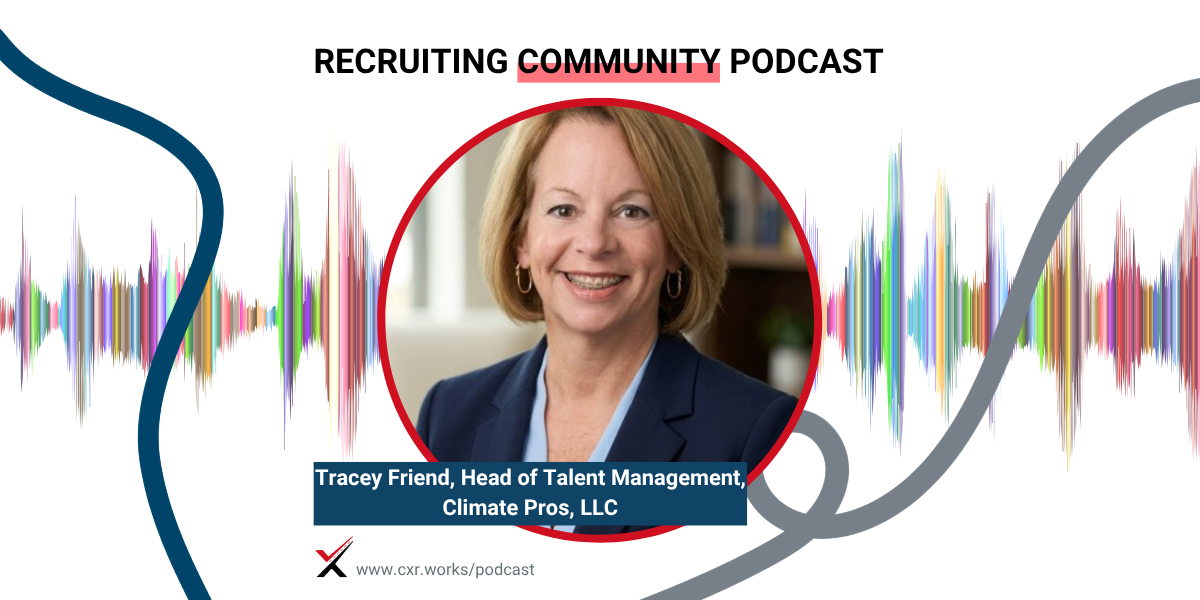
Tracey Friend, Head of Talent Management, ClimatePros
Hosts:
Chris Hoyt, President, CXR
Gerry Crispin, Co-founder, CareerXroads
Episode Overview:
Chris Hoyt and Gerry Crispin welcome back Tracey Friend, Head of Talent Management at ClimatePros, for a follow-up conversation building on her earlier CXR interview with Gerry. The episode opens with Gerry sharing an update on a CXR Foundation initiative around “applicant closure” — a baseline standard stating that every candidate who expresses serious interest in a role deserves to be told when the company is not moving forward with them. The discussion then turns to Tracey’s career path from early internet recruitment technology work through RPO leadership and global TA roles, and into her current focus on orchestrating hiring across contingent staff, RPO/BPO partners, and internal teams. Tracey walks through her framework for planning global hiring efforts — capacity modeling by country-specific rules, timelines, and holidays — and a “headwinds and tailwinds” mapping exercise covering mandate, HR/TA/compensation responsibilities, procurement, location selection, execution timeline, and knowledge transfer. The conversation covers manager education on CapEx versus OpEx headcount, the operational complexity of contractor hiring (statement of work, contract, then heads), internal SLA models for balancing recruiting cost and speed, and the growing importance of governance over contingent and RPO/BPO labor. The episode closes with Tracey’s advice for TA leaders building their first vendor mix, plus a lighthearted “book title” exchange.
Key Topics:
CXR Foundation’s “applicant closure” standard and industry endorsement effort (cxr.foundation)
Tracey Friend’s career path: internet recruitment innovation, RPO practice leadership, global TA leadership
Moving from a global payments company (offshoring/outsourcing model) to ClimatePros (HVAC/commercial refrigeration)
Orchestration vs. simple vendor management across RPO, BPO, contingent, and internal teams
Capacity modeling by country-specific hiring rules, timelines, and holidays
The “headwinds and tailwinds” planning framework: mandate, HR/TA/compensation ownership, procurement, location selection, execution timeline, knowledge transfer
Manager education on CapEx vs. OpEx headcount and contractor onboarding steps (statement of work → contract → heads)
Vendor sprawl and the limits of “just add more agencies”
Internal SLA models tying recruiting cost/guarantee levels to advance notice
Governance challenges around contingent and RPO/BPO labor visibility and accountability
Building data storytelling and business-case skills for TA leaders
Advice for TA leaders standing up their first vendor mix
Notable Quotes:
Gerry Crispin: “If every single person who expresses serious interest in your role deserves to be told when you’re not moving forward with them.”
Tracey Friend: “You have to build your capacity model based on the rules that govern that country.”
Tracey Friend: “That’s not a recruiting problem — that’s a manager capacity problem.”
Tracey Friend: “It’s rinse, recycle, repeat.”
Gerry Crispin: “We’ve grown to 17% of our entire workforce as contract labor, and we don’t even know where they are — they’re spread across 40 different budgets.”
Tracey Friend: “There’s no stupid question.”
Takeaways:
Successful vendor and workforce orchestration depends on upfront planning around capacity, country-specific rules, and ownership — not just adding more vendors when hiring gets hard. TA leaders should clearly separate what belongs to TA versus procurement, HR business partners, or line-of-business managers, and use internal SLAs and data storytelling to align cost and speed expectations with finance and stakeholders. Governance over contingent and RPO/BPO labor is an emerging priority as organizations struggle to track where contract workers sit and who owns accountability for them. Networks like CareerXroads offer TA leaders a way to benchmark and learn from peers who have already navigated these challenges.
Want more conversations like this?
Subscribe to the CXR podcast and explore how top talent leaders are shaping the future of recruiting. Learn more about the CareerXroads community at cxr.works.
Chris Hoyt: Welcome to the Recruiting Community Podcast. I am Chris Hoyt, president of CXR, and your host, along with my brother from another mother, Mr. Gerry Crispin, co-founder of CareerXroads. On this show we do our best to bring you industry insights and updates in the form of a fun and colorful conversation.
It’s brought to you by the CareerXroads community. There’s no money exchanging hands there — we do this as a labor of love. Gerry, we’ve got a really interesting guest today, and it’s actually the first time we’ve turned somebody around so quickly where they’ve done one show and they’re getting ready to do another one. There’s a reason for that, and we’ll dig into it. But before we do, you’ve got a little bit of news and something you want to share, since you’ve got an upcoming event, yeah?
Gerry Crispin: Yeah, I do. I’m a little bit obsessed with this, and we’re working it out of our foundation because it’s much more of a focus on how we can impact our industry and our profession in a positive way.
This year we’ve taken a closer look at what I’d describe as a baseline standard — drawing a line in the sand, above which you can go in a lot of different directions and create best practices, but below that line, you need to be called out. That’s unacceptable. We’re looking at a number of areas — pay transparency, AI transparency — but the first one we all agreed on as a group was applicant closure. If you narrow it down to a single line, it’s this: if every single person who expresses serious interest in your role deserves to be told when you’re not moving forward with them.
It’s as simple as that, and as hard to deal with as that. I’m concerned with everything from how we measure it — self-report could be a little flawed — to ghosting. But in the long run, we’ve got in excess of 100 people who have endorsed this publicly. I’m hoping to double, triple, quadruple that over time. We want to educate our peers and colleagues that this should be a fundamental part of hiring going forward in 2026 and beyond. That’s basically it. In the next few weeks I’ve got an opportunity to share that with a number of folks at the International Standards Organization, so we’ll see where that goes.
Chris Hoyt: I love it. If folks want to learn more, they can go to www.cxr.foundation — believe it or not, that’s an actual domain, .foundation. I think they can sign up and endorse or support the standards right there on the page. Super cool, I’m excited about this. A lot of work — apparently “do unto others” or “be a good recruiter” or “give feedback” isn’t enough, and I wish the bar were a little higher, but I love the work you’ve done here with dozens of other folks in the space. What’s really cool is you’ve got consultants, vendors, and practitioners involved. This wasn’t done in a small corner of TA.
Gerry Crispin: No, it’s got to be an industry agreement. We start small — here’s an idea, see if we can get a group to agree on where to go with this — and then put it out there and see where the industry is willing to support it.
Chris Hoyt: I love it. Okay, I think that’s a good place to pull folks in. Keep us updated — I know you’ve got that big trip coming up, so I’m excited to hear what comes out of that.
Gerry Crispin: Cool.
Chris Hoyt: So, today’s guest — I am excited. She was on a podcast interview with Gerry in one of our CareerXroads segments, and it was really interesting hearing about her journey, where she’s going, where she’s been. When I think about Tracey, most talent leaders talk about building the machine, and I think where Tracey leans in is she really thinks about who’s running it.
Because on any real hiring effort, the people getting it done aren’t necessarily all on the payroll. They’re contingent staff, which has become a really big push within TA over the last number of years. They could be an RPO, a BPO partner, or your own team. None of it works, I think, unless someone is orchestrating the whole thing, and Tracey’s kind of spent her career doing exactly that. She led a global TA team — if you happened to listen to the interview she did with Gerry — at a large payment company. Offshoring, outsourcing, contingent labor — those weren’t edge cases, that was just the operating model she was living in.
She’s now the head of talent management, fresh into role — the shiny new penny over at ClimatePros. This is a very different environment for her — commercial refrigeration, I believe an HVAC company. A very different world, where a lot of the work just can’t be sent anywhere. So she’s here today to walk us through how you align all the moving parts — RPO, contingent, internal team — to hit hiring outcomes, instead of just adding vendors to the mix.
Before we jump in, a couple of things. We’re streaming on the socials — YouTube, Facebook, LinkedIn. You can check us out at cxr.works/podcast, where you can catch future episodes. We do hundreds of these interviews with TA leaders and practitioners, much like our guest today, and I promise all of it will touch how we as TA leaders, practitioners, and people in this space attract and recruit talent, as well as manage larger global recruiting teams. Before I take a breath — you’ll find easy ways to like and subscribe, and let us know if you want to join the conversation. And lastly, this is an ad-free labor of love. Nobody pays to be on the show with Gerry or myself, and we don’t pay anybody to join us. Gerry, did I miss anything?
Gerry Crispin: No, you got it. Let’s talk with Tracey.
Announcer: Welcome to the Recruiting Community Podcast, the go-to channel for talent acquisition leaders and practitioners. This show is brought to you by CXR, a trusted community of thousands connecting the best minds in the industry to explore topics like attracting, engaging, and retaining top talent. Hosted by Chris Hoyt and Gerry Crispin, we’re thrilled to have you join the conversation.
Chris Hoyt: Tracey, welcome to the show again. Welcome back.
Tracey Friend: Thank you, I’m glad to be here.
Chris Hoyt: I did a rapid-fire overview of where you’re at now, which I do want us to talk about, but I probably didn’t do justice to your work and career path history. So for those, Tracey, who didn’t get the chance to listen to the interview you did earlier with Gerry, can you give us the elevator pitch of who Tracey Friend is, and why we should be paying attention to her today?
Tracey Friend: Let me give that a shot — gosh, you’re asking me a hard question this morning. I started down this path as a recruiter, and — I’m aging myself here — back in the day I started an internet recruitment company and helped innovate a lot of things that were really at the forefront: job posting aggregation, how to search and pull back websites. Lots of great stories, but it leapfrogged me into this really interesting space of recruitment solutions and product management, because that innovation, thinking about things from a technology, people, and operations perspective, seemed to follow me through the various job titles I’ve had.
As I evolved further, I ran and built an RPO practice globally, then went back and forth on the corporate side. Even there, I tended to lead with a solutions mindset — really understanding how to operate. It’s a good thing and a bad thing, but really looking at how we leverage vendors, how we leverage technology, how we leverage our people, and how we report on all of this so it makes sense. That’s really been the culmination of my career and the roles I’ve taken.
Chris Hoyt: I love it. You talk about terms like “orchestrate” or “conduct,” and I think that’s super interesting because you’ve run the gamut within TA — you’ve seen both sides of every argument. So you frame the work you do now as orchestration rather than just using vendors. When you take on a hiring effort, let’s start at the beginning — where do you begin, and why do you insist on a business outcome first, before anybody even talks about who’s going to staff it or do the work?
Tracey Friend: There are a few things I look at. What can we report on? What’s the capacity? You have to look at capacity by the roles we’re filling, the levels we’re filling, and where we’re filling them, because everybody has different hiring rules. In Poland, for example, you can only make hires once a month. So when you look at these things, you have to build your capacity model based on the rules that govern that country.
The next thing I look at is the timeframe we have to fill all of this, and build capacity modeling to figure out how many people it’s realistically going to take, and why. The simple side of this is educating managers in a straightforward way — here are the timelines you can expect in each of these countries — and just doing a lot of basic education. The other thing we spent a lot of time on is how you hire in each country, because it might be a different entity, a different set of rules. There might be workers’ councils, different background check processes that take longer or shorter, or they may not do them at all.
Chris Hoyt: Yeah, or culturally — in some cultures they don’t just give notice and walk out the door. It doesn’t quite work like that.
Tracey Friend: Right, and the things that matter to us in the U.S. may not matter elsewhere. It’s just a whole different set of requirements. And — you may laugh — holidays. What are the holidays in each of these countries? Honestly, I’d look at some of them and go, “Gosh, I want that time off.” But understanding the holidays and the time zones matters. You’d think people understand time zones, but they don’t. They schedule everything on their U.S. time zone, and that’s not fair to anybody else.
Chris Hoyt: I want to come back to the manager problem you were leaning into, but before that — once you’ve laid out what you’re trying to accomplish and started understanding the field, going in looking for stakeholders and the timeline — I think what you’d called in other conversations “headwinds and tailwinds.” Can you lay out what that map looks like in practice, and maybe highlight the thing people most often miss if they skip that exercise up front? Because it’s easy to want to jump right in and start doing the work.
Tracey Friend: Oh, it’s incredibly easy to just do that. In fact, can I share something? I wonder if I could share a visual that’s helped me stay organized along the way.
Chris Hoyt: Sure, yeah.
Tracey Friend: I’d love to share what I think is a really good visual. It’s funny, because I had to keep myself organized, and there are some foundations here — why are we doing this? At the end of the day, that’s the question. In my experience, we had consultants come in and we were told — that’s “activated under mandate,” in that far-right corner. That’s something people have to understand: sometimes you don’t have the luxury to plan. You’re, as some might say, “voluntold.”
Then there’s the HR activity piece — what is TA responsible for, versus the HR business partner, versus compensation? I’d say those are the triad, because if we’re doing something in a different country, do we have the right levels, the right comp structure, the right people, enough people? Then there’s procurement — in this case it was part procurement, part my group — what about the temp hiring? Temp hiring made up our contractor workforce, so there’s temp and there’s contractor. Contractors are the folks who come in for a fixed period of time.
Then there’s location selection. If I could tell you how many times locations were selected and the talent just wasn’t there. So really looking at the locations and being prepared — I loved having a project manager, because if the locations were off, you had to be bold enough to say, “These locations are not going to generate the outcomes you’re looking for. The talent’s not there, so you’re either going to develop it, or you’re going to go to another location where it exists.” Those are tough, uncomfortable discussions, because in my case we were activated under mandate, and there was a consulting firm fixated on everything going to these regions. You had to come with market research and explain why and how long it would take. Your data is super critical.
Then there’s the execution timeline and knowledge transfer — this piece, and the last few, are super important. It’s not only about how you fill positions, but whose responsibility that is. If there’s not enough manager time to interview, that’s not a recruiting problem — that’s a manager capacity problem. And that’s the data you need to show, so you can put ownership where it needs to exist and report on it weekly. That’s a big win — that’s a headwind and a tailwind.
The other one is knowledge transfer — you’re hiring all these people, but how are you going to onboard and train them? The likelihood is you’re reducing headcount in another country, and if there’s no way to receive that talent, that’s a tailwind. It’s going to cause an incredible amount of attrition if you don’t give people enough time to train. I really had to push on that, and I do bring in culture preservation too, because I think it’s critical — you have to understand the culture you’re working in, because it can frustrate the best of people if you don’t.
Chris Hoyt: So that was eight steps to move through. I’d argue that in a perfect world, TA gets to be part of all of those steps — part of the planning, helping to pick locations in some instances. But in reality it doesn’t work like that. Very rarely is TA brought in to talk about where a new call center should go — and there’s all kinds of weird stuff behind the scenes, incentives from local governments, and each one of those steps is going to have five different things that get in the way of that utopia.
Gerry Crispin: I think you’re adding a level of transparency that’s very different from the standard “find, fill, select” version everybody has. You’re really saying, “Here’s the expectations we should have and the pages we should agree on before we move forward.” I think that’s an interesting taxonomy you’ve set up for yourself, in terms of how you organize. I appreciate that — thank you.
Tracey Friend: Yeah, you’re right, Chris — TA doesn’t get brought in, they’re told: “You need to fill X number of positions in this country by X date.” And then you watch all of us panic because we may not have enough resources. You have to think about how you’re going to fulfill that headcount. Either the culture that exists lets it fail as it goes along, or you’re bold enough to work with the right people. I was very fortunate — I had a really good project manager, and I put this on the PM, because it’s their job to share what those risks are, so when the right group comes together to look at this, you can get funding for things.
I wound up getting funding after the fact, because it was thrust onto me and nobody thought to bring the right people in, or think about the extended touch points or the timelines it takes to get things done. Yeah, that’s the big one.
Chris Hoyt: Tracey, it occurs to me that’s a pretty honest admission — people who’ve done the work are having a “no duh” moment. But for people early in their leadership careers, or early into leading larger teams, I think it’s a pretty honest admission that not everything is known at kickoff. This dovetails nicely — let’s circle back to the manager problem. When we’re looking at this big challenge you’ve been given to solve, a lot of it depends on hiring managers who, in some instances, have maybe never worked with an RPO, or never run an offshore team before. Can you share how you prep a manager for something like that? Do you have a non-negotiable set of information right up front — what you tell them you’ll figure out together versus what they’d better know coming in?
Tracey Friend: So — a manager, or someone who’s orchestrating? I think you’ve got to look at where this starts. On the manager side, all they care about is: did I get my jobs filled? What I find is they’re pretty much told whether they have what I’ll call CapEx or OpEx headcount. OpEx headcount is likely full-time. CapEx, you’re probably going to be filling as contractors. So what worked was giving managers education on how to navigate those two processes. Where it failed was that the processes to get contracts in place took a lot longer than people could digest. And again, going back to — no, that’s a procurement issue, let that escalate to procurement. New TA leaders, don’t take that on as your problem. You have to own what you can own, but be very clear about where the gap is.
Chris Hoyt: Tracey, you’re going to laugh at this. I’m thinking of a meeting we had not too long ago with Melissa Thompson, head of TA over at Ford — we were talking about some internal things over the course of her career, not necessarily at Ford — but when things get brought to TA that aren’t TA’s problem, I have this crystal-clear memory of her saying, “How is that my problem?”
Tracey Friend: Yeah — what do you want me to do with this?
Chris Hoyt: TA leaders can’t solve everything, so being bold or confident enough to say, “How is that my problem to solve for you before it lands in my shop?” — I think that’s pretty incredible.
Tracey Friend: You know what’s crazy is I see some of the younger or newer TA leaders, or maybe leaders out of certain cultures, just ignore the emails — not even respond. I’d love to get your perspective on this. I always responded — maybe people didn’t like the answer, but I’d say, “Here’s the best way to go about it, but these are the people you have to work with.” I find there’s a group of leaders who just don’t answer at all, and I don’t know what’s better or worse.
Chris Hoyt: I think it probably comes from a couple of different camps. I’d say by and large, leaders just have bigger fires to put out. I’m sure there’s a little bit of “if I push this away long enough, it’ll self-solve,” but I’d bank more on “I’ve got fifteen fires burning thirty degrees hotter that I’ve got to deal with right now.” Maybe some of that stuff self-corrects, or somebody steps up and solves it until they can get to it. But the TA leader in me doesn’t want to think anybody’s just ignoring an email — it hurts my soul.
Tracey Friend: Yeah. I think you asked about the manager side of this — there’s also the TA leader side of it. On an RPO, people expect the RPO to be mind readers and don’t realize the level of training needed for an RPO to be successful, and the expectation management around what your expectations are, your ways of working, and continuing to have those meetings.
The other thing I’ve seen when I’ve gone in or just chatted with people is they don’t become part of the solution — they just push it off and blame the RPO. And again, I’ve sat on both sides. When you set up an RPO, it’s: how do you work in our environment, what’s the process, where do things typically go wrong in TA that you need to be aware of and escalate to us, and here’s when you escalate — so they’re working with us and not operating in a silo, because we know where the warts are.
Chris Hoyt: I think change management — and we’ve said this countless times — is the biggest Achilles’ heel for a strong TA leader. When you break that into subsets — picking the right partners, implementing those partnerships — we love to hate on our ATS, but I’d say the majority of the time an organization that’s really unsatisfied with its ATS, if it’s not a service issue, it’s an implementation issue they partially own but none of us want to own. Same for RPOs — if you’re going to an RPO to save money, that’s the wrong switch to flip. It’s a partnership, there’s homework to be done, and you have to set expectations up front. I just think that gets missed so broadly, it blows my mind.
Tracey Friend: Yeah, it gets missed, and then there’s the cost piece. Finance was driving a lot of this — finance has always driven a lot of decisions, so I don’t think I’m unique — but it was about understanding: if you want this in this timeframe, it’s going to take X number of heads, this is what it’s going to cost, and by the way, you have no brand in this country. You show them your career site traffic data and say, “We need X number of views to get this number of applies.” You have to break it down in numbers, logically, for finance to say, “Okay, I’ll give you the funding for this.”
I was talking with another TA leader who was doing a presentation on narrating your metrics — really being able to tell the story — and this is a big weakness right now: how do you narrate these metrics to build your business case? We have a lot of smart TA leaders, but I think this new crop has to build that muscle, and fast.
Chris Hoyt: So Tracey, what I hear — and Gerry’s laughing — telling the story with data was a big thing about ten years ago, remember “Moneyball for recruiting”? I swear I’d never say that phrase again. But the idea was being a data storyteller — jobs were created for people brought onto teams whose job was to be the data storyteller. What I hear you saying is that skill set, or that role, is largely missing now. Are you predicting a comeback of that, or just saying this is amiss and somebody needs to go take a course?
Tracey Friend: I think it’s both, because as we’re being asked to do more with less, that capacity planning and understanding capacity — you’ve got to articulate things in numbers in a way people can wrap their heads around.
Gerry Crispin: I love this conversation because it’s cyclical — every new crop basically goes through it. There isn’t formalized onboarding and recruiting-for-leaders training at some college somewhere — well, there’s probably a couple, but they’re off in some niche field. The reality of what we really need around workforce planning, capacity planning, some of these issues, is foundational. It seems to come back every three, five, seven years. And people — just think about “quality of hire.” How often do we hear that again? “I’m being pressured to increase my quality of hire” without any understanding of what’s gone before, how people have dealt with that from a context point of view. So we kind of relearn our industry and our space over and over again.
Tracey Friend: It’s rinse, recycle, repeat. Yeah.
Chris Hoyt: We’re talking about planning and orchestration — mapping this stuff out. But I want to talk about the breaking point — we mentioned this in the green room a little before we got started. Execution rarely, if ever, goes to plan. What I really want to hear more about is the gaps that appear. Where have you seen these arrangements and plans most often break down? Is there a point where adding another partner creates more overhead than it solves? I’m looking for the limits — vendor sprawl, accountability.
Tracey Friend: That piece, Chris, is a big one. You’ll get leaders who say, “Oh, you need to add more agencies,” and what that’s doing is adding more work, not adding efficiency — you just shake your head, because they’re of the mindset of just throwing stuff at it. I can’t tell you I’ve navigated through it perfectly, because I look at efficiency and how we’re going to get this done.
The other lesson learned is the cost is really built around the number of people in a short period of time — the shorter the timeframe, the higher the cost, because you need more people to get the work done, and more advertising spend to hit those numbers. The other big lesson I’ve learned — and people don’t listen to this until they get there — is the ability to digest that volume of resources. We did this big initiative where we had to hire 500 people over a very short period of time. Unreasonable. If you run basic time-and-motion numbers, your managers still had to drive sales performance, still had to do their training and onboarding, still had to manage their teams. They didn’t have the capacity to take on all these new people, until it blew up — that’s when people were ready to hear it.
So the lesson learned is: sometimes you can see it, you can say it, but until it blows up, depending on your company’s ways of working, that’s when you’ll address it.
Chris Hoyt: Till they feel it, yeah. There’s a concept — we did this ages ago, and you could do it in a call center type environment — an internal SLA. If you ask for headcount with a certain amount of advance notice, the organization would guarantee 100% of it and carry 100% of the cost to recruit and hire them. But if you asked for it with less time than the preferred amount — sorry, for people listening, they can’t see my hands moving around — the organization would guarantee 80% of it and cover 80% of the cost, and you’d pick up the other 20% as the line of business. If you asked for it in, say, 15 or 30 days, the organization would cover 40% of the cost and only guarantee 40% of the fills.
We’ve got a couple of hard-nosed TA leaders with similar handshake agreements in the works, I think, and I’d love to see more of that partnership internally — with finance, with corporate communications, with all the people who are supposed to play into this — more internal SLAs that say, “At this reasonable request, we’ll cover it and guarantee it, and if not, it’s a ding on us.” But when you ask outside that window, it’s 50/50 — you’ve got to share the cost, because there’s elevated headcount needed, elevated advertising needed, but it can’t come out of the TA budget, which is already shoestring and bubblegum.
Tracey Friend: And then add contractor hiring — that’s a whole beast, because we think we have a lot of steps for full-time hiring. Look at the steps for contractor hiring. A lot of people just go, “Oh, that’s temp hiring,” or “that’s contractor hiring.” Again, I was blessed to have a really good project manager who helped manage this, with weekly meetings holding people’s feet to the fire on where they were in the process of bringing on these consulting firms, and then the heads. The contract had to go first, then the heads — but before the contract, there was the statement of work. So: statement of work, contract, heads, all the onboarding requirements. That’s a lot of work, and it gets ugly, because you start hearing, “Oh, it’s stuck in legal,” or “it’s stuck in procurement,” or “they can’t get an Ariba PO number.” These are things that stop the timeline, and you can’t bring people on without a contract — you’re not going to bring people in without that protection, for safety reasons.
Gerry Crispin: You’re raising a key issue about the future of governance over all of recruiting, because that’s certainly an area that gets messed up — no one wants to own it 100%. And yet when they start looking into the details, they find, “Oh, we’ve grown to 17% of our entire workforce as contract labor, and we don’t even know where they are — they’re spread across 40 different budgets.” As we move toward a world where governance is becoming an increasingly critical component of HR and talent acquisition, I’m curious who has the mastery and expertise to actually do that.
Chris Hoyt: It took AI and candidate fraud to get this idea of decision governance — [uncertain name, sounds like “Master Burnett”] has a really great series on LinkedIn, writing about his book — but really got a spotlight thrown on it. A lot of us in TA who’ve been doing this for 30, 50, 100 years have always struggled with this issue and maybe haven’t given it a name, wrestled for control, label it however you want. But I think we’re in an era where there’s a whole new take on that decision-making process — who owns the final decision, who’s accountable for that workflow and those partnerships. I’m excited about it, excited about what it looks like.
Gerry Crispin: I think it’s fascinating — who’s working here, and what’s the status or class of worker? Where are they, who hired them, is this internal movement, is this succession planning? All of these things were fragmented or separated in terms of ownership.
Chris Hoyt: Or bullied — they were just bullied through, yeah.
Gerry Crispin: But now we’re seeing — you mess up on any of these and you’ve got a class-action suit on your hands really quick.
Tracey Friend: Governance is crazy — it’s true, such a needed area. And you’re right, it’s about who owns it, because TA’s scope changes depending on the chief HR officer leading, and it changes based on the organization and its capabilities. As I made transitions and looked at different jobs, the scope of what TA was responsible for was not the same across the jobs. It was crazy.
Chris Hoyt: Yeah, I’m sure. Well, Tracey — this is our Monday morning question — if TA leaders were about to stand up their first true vendor mix, with contingent, RPO, BPO, and their own team, what would be one or two lessons you’d hand them so they don’t have to learn it the hard way?
Tracey Friend: I’d say join one of these networks, like CareerXroads, and benchmark and ask a lot of questions. Honestly, if you don’t have these conversations, it doesn’t mean anything — you can write it down and it won’t resonate. It’s about sitting down and having the conversation with people who’ve lived through it and having them describe what the experience was. You won’t have the same experience, but mentally it’ll prepare you for what could be, or what’s possible.
Chris Hoyt: Well, can’t ask for a better endorsement than that.
Tracey Friend: Mm-hmm.
Chris Hoyt: That’s great — not even planned.
Tracey Friend: I know, right? But honestly, that’s the only way it resonates with people — just learning, and being able to ask questions without being afraid to. There’s no stupid question.
Chris Hoyt: Yeah, and if you’re not part of a CXR — or, you know, any of the other ones that clearly aren’t as good as we are, obviously — I think the vulnerability of being able to ask your own network is super powerful. Having a handful of leaders — not two, but a nice handful — that you can trust and ask, “What am I doing wrong here?” I think the trick is being vulnerable, asking the question in a way that admits you don’t have all the answers. I think that’s really key to figuring that stuff out.
Tracey Friend: Yeah.
Chris Hoyt: Tracey, it’s just a pleasure to talk to you. Before we let you go — you know we have to ask everybody this — if you were going to write a book, what would the title be on this subject?
Tracey Friend: I would call it TA Vendor Management for Dummies — going back to the “Dummies” series, because I think it just needs a little bit of humor to it. We watched SNL clips this weekend, and it’s amazing how all of us recall the humor. Whatever’s done, I think it’s got to be done with a little humor, because it’s the only way you get through it.
Chris Hoyt: I love that — you’re taking a page out of [uncertain name, sounds like “Lars”]’s book. He did an Employer Branding for Dummies, and I think we’ve got two or three “TA for Dummies” books somewhere in my office. This would be a great addition. Well, Tracey — present company excluded, of course — who would you give the first signed copy of your book to?
Tracey Friend: I would probably — okay, this sounds terrible — I’d probably give it to my kids, just so they know what I’ve done. “Here, here’s what I’ve done.” So, my family members.
Chris Hoyt: I love it — your own internal support system. That’s great. Well, Tracey, if people want to learn more about the work you do, or maybe get ahold of that slide, where can they reach out and connect with you? Where can they learn more?
Tracey Friend: Feel free to reach out on LinkedIn and send me a message — that’s probably the easiest way to get hold of me. I’m happy to share my work email too, if that’s the best way: Tracey, T-R-A-C-E-Y dot friend at climatepros dot com. Send me a LinkedIn message and refer to this so I know to respond.
Chris Hoyt: Well, we know as a TA leader you will respond — you respond to all the emails.
Tracey Friend: Mm-hmm, mm-hmm.
Chris Hoyt: I love it. Tracey, thank you — I know you’re super busy, so much gratitude. Thanks for making time for us today.
Tracey Friend: Oh, thank you. Thank you for having me again.
Chris Hoyt: Yeah — fun chat.
Gerry Crispin: You’ve been in two series now.
Chris Hoyt: Yeah.
Tracey Friend: I know — no kidding.
Chris Hoyt: Good stuff. Well, look — why wouldn’t you roll this back and listen to it again? There’s a lot of good nuggets in here. Check out the podcast site at cxr.works/podcast — you can see all the past episodes there, and what’s coming up. And I’ll remind you — if you want to be on the show, or you’ve got a TA leader or practitioner you think deserves a spotlight for the work they’re doing, or someone who’d make a great conversation for Gerry and me, send them our way. We’re happy to do it. With all that, we’ll see everybody next time.
Announcer: Thanks for listening to the Recruiting Community Podcast, where talent acquisition leaders connect, learn, and grow together. Be sure to visit cxr.works/podcast to explore past episodes, see what’s coming up next, and find out how you can join the conversation. Whether you’ve got insights to share or want to be a guest on the show, we’d love to hear from you. If you’re interested in learning more about becoming a member of the CXR community, visit us at www.cxr.works. We’ll catch you in the next episode.
Lou Carter on turning employer branding into a measurable strategy—from time-to-fill metrics to how AI engines judge your culture.