

Rethinking TA: Myths, Misalignment, and the AI Reality Check
Is entry-level hiring disappearing—or simply changing? This episode explores AI’s impact on recruiting, early careers strategy, and the growing noise in hiring pipelines.
 play_arrow
Built for Change: Tracey Friend’s Career Crossroads Cami Grace
 play_arrow
 play_arrow
 play_arrow
AI Hiring, On Trial Cami Grace
Featured Guests:
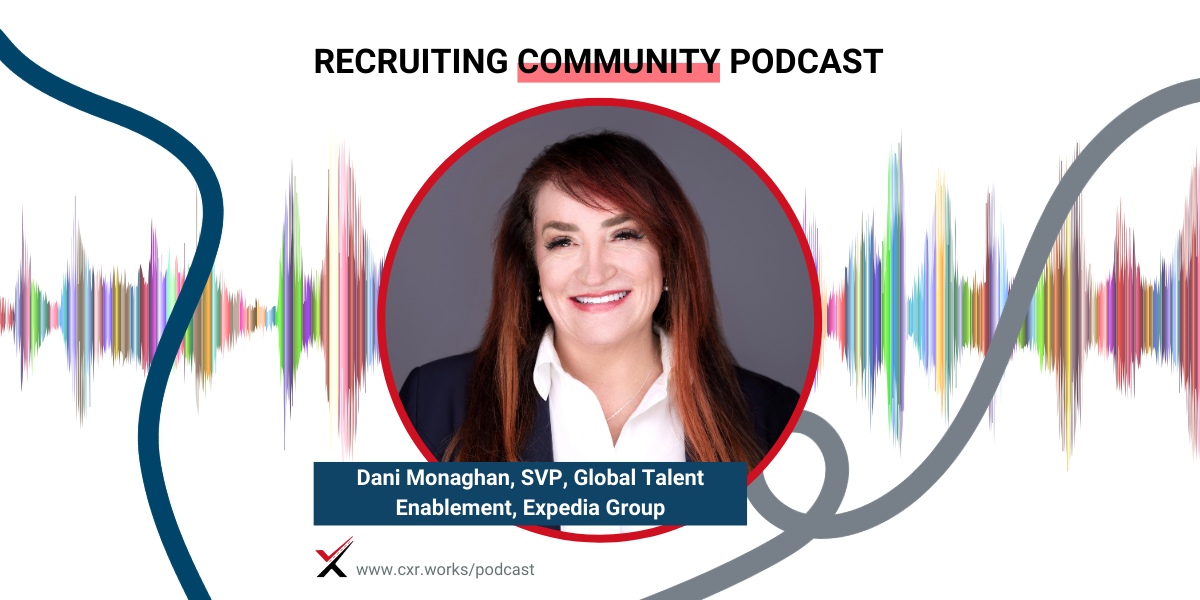
Dani Monaghan — SVP, Global Talent Enablement, Expedia Group
Hosts:
Chris Hoyt — President, CareerXroads (CXR)
Gerry Crispin — Co-founder, CareerXroads
Episode Overview:
Chris Hoyt and Gerry Crispin speak with Dani Monaghan of Expedia Group about how rapid automation, artificial intelligence, and global workforce mobility are reshaping talent acquisition and leadership. The conversation explores the evolving expectations of TA leaders, the growing role of AI experimentation in recruiting, challenges around candidate authentication and fraud, and how organizations are redefining leadership through learning agility, ethical clarity, and adaptive decision-making.
Key Topics:
The concept of “intelligent leadership” in an AI-driven workplace
How AI experimentation is shaping talent acquisition strategy
Shifting skill requirements and evolving role profiles in recruiting
The balance between data, metrics, and meaningful insights in TA
Ethical clarity and responsible AI use in hiring processes
Candidate fraud, identity verification, and collaboration with cybersecurity teams
Transparency with candidates about AI usage during recruiting
AI tools supporting sourcing, job design, and recruiter workflows
Global complexity in AI governance and regulatory differences across regions
The emerging reality of leaders managing both human and AI “direct reports”
Notable Quotes:
“Your advantage as a TA leader is not knowing more; it’s learning faster.” — Dani Monaghan
“We can measure everything. But the dilemma is: should we measure everything?” — Dani Monaghan
“If you’re not in the game, you’re out of the game.” — Dani Monaghan
“At the end of looking at the report, if you couldn’t answer ‘so what,’ then why are we doing this?” — Chris Hoyt
“Your direct reports are not all human. You will have AI direct reports.” — Dani Monaghan
Takeaways:
Talent acquisition leaders are navigating a rapidly evolving landscape shaped by AI, automation, and shifting workforce expectations. Success increasingly depends on learning agility, experimentation with emerging technologies, and strong ethical oversight in how those technologies are deployed. As AI becomes embedded in recruiting workflows and even organizational structures, leaders must balance innovation with transparency, governance, and human judgment.
Want more conversations like this?
Subscribe to the CXR podcast and explore how top talent leaders are shaping the future of recruiting. Learn more about the CareerXroads community at cxr.works.
Chris Hoyt: All right, everybody, welcome to the Recruiting Community Podcast. I am Chris Hoyt, president of CXR, and I am with Gerry Crispin, the co-founder of CareerXroads. Gerry, how are you?
Gerry Crispin: I’m wonderful.
Chris Hoyt: Just always wonderful. The man is always wonderful.
Gerry Crispin: It’s raining.
Chris Hoyt: Oh, it’s raining. Is that better than snowing?
Gerry Crispin: Yeah. Well, it’s getting rid of the snow, so I’m even looking at that as a positive.
Chris Hoyt: That works. All right. Well, Gerry and his rain house, and myself in a balmy 83 degrees, are your hosts today on the Recruiting Community Podcast. We like to think of this as bringing some industry insights and updates to you in the form of a fun 20-minute conversation.
The idea here is that this is all brought to you by the CareerXroads community, and today I’m pretty excited. We’re talking with Expedia Group’s Dani Monaghan, who joins us to explore how global mobility and rapid automation are reshaping the workforce.
I think today we’re going to take a shot at unpacking this term, “intelligent leadership,” how that’s evolving in what we’re calling the new age, and why what’s worked in the past isn’t going to work much longer. I think that’ll be a lot of fun.
Before we do that, though, really quickly, we do all the streaming on YouTube, Facebook, and LinkedIn, so be sure to check those out. You can also go to cxr.org/podcast, where you can see past and future episodes. There’s a new design that was put in late last year, and we’re very happy with it.
We’re coming up on 600 leadership interviews, where we’re talking with TA leaders, practitioners, and people doing interesting work, much like our guest. On the site, you’re also going to find easy ways to like and subscribe and make Gerry internet famous. Of course, let us know if you’d like to join the conversation.
Last thing I’ll say is this is an ad-free labor of love. Absolutely nobody paid to be on the show. They’re here because they’re doing cool stuff, and we want to talk to them. With all that, let’s go.
Announcer: Welcome to the Recruiting Community Podcast, the go-to channel for talent acquisition leaders and practitioners.
This show is brought to you by CXR, a trusted community of thousands connecting the best minds in the industry to explore topics like attracting, engaging, and retaining top talent.
Hosted by Chris Hoyt and Gerry Crispin, we are thrilled to have you join the conversation.
Chris Hoyt: All right, welcome, Dani. How are you?
Dani Monaghan: Oh, I’m doing very well, thank you. Also in rainy Seattle, but it’s still beautiful.
Chris Hoyt: I love it. I know when we started to set this up, you had this gorgeous view behind you, but the lighting wasn’t working.
Dani Monaghan: I know. Unfortunately.
Chris Hoyt: How long have you been in Seattle?
Dani Monaghan: I have lived in Seattle on and off since 1998, but I haven’t always lived here. I did a stint in China for eight years and lived in the Bay Area, but I’ve always had a base in Seattle. So it’s been a city near and dear to my heart since the late ’90s.
Chris Hoyt: It’s a beautiful part of the country, for sure.
For those who have not had the pleasure of meeting you before, and we’ve known you for what seems like a very long time in this space, can you give us an escalator pitch on who Dani is, what you do, and how long you’ve been doing it?
Dani Monaghan: I’ve been doing this for over 30 years. I was born and raised in South Africa and have lived in Africa, North America, and Asia, in Beijing.
Talent acquisition is probably what I’ve done most throughout my career, but I’ve also dabbled in HR business partnering. Currently, I have talent enablement at Expedia Group. Talent enablement is our global talent acquisition organization, our people operations organization, and employee relations, or what we call Geo HR.
These are global teams with the goal of enabling our employees and creating frictionless experiences so they can focus on their work and not on HR and people questions.
Chris Hoyt: I love it. Before we dive in, you rang a bell for me. Are you seeing other experts or leaders in this space being asked to take on other functions or spreading their wings into other functions? We see a little bit of this, but what’s your take?
Dani Monaghan: Yes, I am seeing that. I’ve seen some TA leaders take on people tech and other functions, but anything around enablement really makes good sense.
In my experience in corporations, you’re often working in silos, yet your work is so intertwined. There are multiple failure points when there are handoffs and finger-pointing, and the losers are the employees. We’re trying to ensure that doesn’t happen here.
I also have a day job and an evening job. My evening job is that I lead our People and Places AI Council, and I also serve on Expedia Group’s AI Council.
Gerry Crispin: I think the TA function has, over the last 15 or 20 years, become more measurable if you have those skills and do those kinds of things. It connects better to the performance of the organization, and leaders who do that are often now asked to take on new functions.
Obviously, the most dangerous one is to take on HR, get promoted to head of HR, and then discover how unmeasurable that is and want to get back as quickly as possible.
Dani Monaghan: Yes, and you’re right about measurement. We can, and we do, measure everything. But the dilemma is: should we measure everything? How do you measure what’s really meaningful?
Chris Hoyt: We were part of an interesting debate the other day that talked about this wave of “Moneyball” for recruiting. If you remember all of that, about 15 years ago, right when it hit. I think there are two camps on this. We got too data-focused, and that began to take a little bit of the art out of what we do. It gets us into compliance issues and ties our hands a little bit in how we build.
I still love the data, but part of me wonders whether we’re sometimes tracking too much to our own detriment.
Dani Monaghan: Yeah, and I think we do love the data. I actually had a data review with my team this morning, and we just love metrics and insights. But then when I sit back, I ask, is that really meaningful? How do we pick what’s actually meaningful, both looking back and looking forward?
Because you can get distracted when you have so many data points, and you can’t always find insights around them.
Chris Hoyt: There used to be a test my team used. We called it the “so what?” test. You’d get a dashboard back, and at the end of looking at the report, if you couldn’t answer “so what,” if there was nothing that was going to move the needle, then it was kind of like, why are we doing this?
Dani Monaghan: I love it. I’m writing that down. I love it.
Chris Hoyt: My job is done.
Dani Monaghan: Job done. I got my value for money in this podcast. Thank you. Goodbye.
Gerry Crispin: The “so what?” test.
Chris Hoyt: Everyone should be reminded, it’s free. Totally free.
I want to talk about mobility and kind of work our way into automation, but you mentioned you’re on some AI councils and boards and helping to drive some of this decision-making. Can we jump ahead and talk a little bit about the speed of automation that’s coming and this tension around automation?
I think Gerry and I were talking about this the other day. When we talk about rapid automation, there’s usually a gap between what leaders are saying publicly and what they’re actually dealing with or wrestling with inside the organization. I’m not asking specifically about Expedia, but I’d love your take on the honest version of that conversation happening inside organizations right now, broadly within TA.
Dani Monaghan: What I’m seeing, and I’m on quite a few TA councils and groups, is that it is top of mind for all TA leaders. It is an imperative, but people are at various stages of comfort level and adoption.
If you look at actual adoption and rollout, it’s still very low. I don’t think that’s necessarily a bad thing until it is. The companies that sit back and just wait are going to fall behind more rapidly than ever before.
I feel really strongly, and we do this at Expedia, that we’re very AI-forward as a company and as a People and Places team. You’ve got to experiment. You don’t have to do anything big. You don’t have to do anything life-changing right now. But if you’re not in the game, you’re out of the game, and that’s going to be to your detriment.
Chris Hoyt: I’d agree with that. What’s really interesting is that, even with the lawsuits going on around how AI is being used within TA, with some very big players in the space, many of whom have customers within our membership and outside of it, we haven’t had a single leader say they no longer want to do AI or that they’re no longer bullish about the possibilities of AI. Not a single one has lost their interest or momentum, which I find really interesting, especially given all the risk that’s been thrown out there.
Gerry Crispin: I think that’s true, and I think that’s changed from just a year ago.
But I do agree with the comment that Dani made, that it may not be bad until it is, because there are still unanswered questions that help you develop the focus. What occurs to me, and it was something I was writing today, is that 100 years ago we were totally immersed in the second industrial revolution. We were building measurements for mechanical tasks and deciding how to design the interface between machines and people.
Today, we’re rethinking those tasks, not because they’re different, but because what we did was mechanical. Now we’re talking about cognitive tasks. We’re talking about a whole different set of how we go to work. I don’t think the framework for that has yet been set, but when it is, all of these cognitive tasks lead to judgments and decisions. Then we’ve got to decide where the humans sit. We don’t know that yet, and it’s also a moving target.
There’s a complexity there. You can’t wait too long, but you need to be paying attention to it and at least learning. If you’re not ready to embrace experimentation and breaking stuff, and a lot of people are, then you should be spending your time learning.
Dani Monaghan: I 100 percent agree. What I truly believe is that your advantage as a TA leader is not knowing more; it’s learning faster. That ties in with what you just said, Gerry.
Chris Hoyt: There’s also an interesting conversation happening around how our roles change as humans in the workforce, certainly in recruiting, as these systems come up and AI gets more powerful and more robust in organizations.
Do we become just the connector between the agents? Everything from physical labor all the way through to decision-making is changing. Somebody likened it to humans becoming the API between agentic systems, and that’s a pretty scary argument, but it’s kind of interesting.
Dani Monaghan: It’s a very interesting argument.
I wanted to take a step back on something you talked about with lawsuits going on. Nobody wants to be in a lawsuit, but it is the natural evolution. I don’t know if you remember when we first started looking at how we could recruit over the internet, around 1996, 1997, 1998.
Gerry Crispin: The internet.
Dani Monaghan: Exactly. What’s a candidate? How can you reach out? Can you reach out? What’s an applicant?
Gerry Crispin: What’s an applicant on the internet? Without a doubt. That was a huge discussion for two or three years.
Chris Hoyt: Huge. I’m going to argue, too, that that’s also part of the government’s involvement in compliance, the whole OFCCP issue of what defines an applicant. I also think that’s a little bit of the demise of the art of what we do. I get that it has a place, and I get that there was a need for some of that.
Gerry Crispin: But at least then we had a say in it because the government had to come with what they were thinking, we supplied a response, and they adjusted to that reality of the day. Obviously, it continues to evolve, and we continue to have difficulty evolving with it.
Dani Monaghan: Yeah, and I think with AI it’s going to be the same.
Interestingly, especially if you’re a global company and you recruit globally and your workforce is global, but your teams aren’t necessarily regional and really are global teams, the way governments deal with AI in different regions of the world and in different countries brings a whole new level of complexity.
We have an agent that we built internally that we use very heavily, and we have people sitting on the same team in different countries doing similar work. Can they use the agent in that way? The answer is probably no, but we’re learning as we go. It’s a whole other level of complexity.
Gerry Crispin: The standards on a global basis are way different from the individual standards within those countries, and that’s something we have to constantly keep on top of if we really want to find common ground.
Chris Hoyt: Are you seeing a change, Dani, in how you’re recruiting talent that you know is going to be neck-deep in AI, regardless of the function they’re in? And where does that change show up on the front end of recruiting?
Dani Monaghan: For us, it’s actually shown up much earlier in the funnel. It’s sitting with leaders and saying, what is the talent that we need in the future? What do we have today? What don’t we have? What can we train, and what do we need to bring in from the outside?
Our role profiles and job descriptions look very different than they did a year ago, literally. Starting there is where we see changes. The skills, knowledge, and experiences are very different.
Then our recruiters have access to our agent, which we call RIN, which of course is “Nirvana” backward. We also use other tools. We use LinkedIn Hiring Assistant and other AI tools to move through the process and discover candidates we haven’t been able to discover before.
I’d say right at the top of the funnel is where we’re seeing the change.
Chris Hoyt: A lot of the other leaders we’re talking to are struggling with what the top of that funnel actually looks like, and there are a lot of concerns about bad actors and candidate fraud with AI being implemented there. Is there a lot of that discussion going on with your teams?
Dani Monaghan: Yes. I actually met with our cybersecurity team last week, and yes, absolutely, bad actors are part of the conversation.
I have a lot of colleagues where they’ve hired some of these folks. North Korea is probably the most prevalent example, but it’s not just bad actors. They also have cohorts within the United States that help facilitate things. They get into companies, and it can be for money laundering or data fraud, those types of things.
We are working more closely with our cybersecurity teams. They’re working very closely with the FBI. Again, it’s a whole new world for us.
Gerry Crispin: It’s a whole new world for everybody. In fact, I think right after sourcing or finding, we’re going to say there’s a thing called authenticating before we even get into anything else. It seems like a lot of companies are starting to build new tools just to do that.
Chris Hoyt: For like 30 bucks, we did a digital twin to kind of see what that might look like. It’s quite accurate and a little bit unnerving.
Then we talked about a scenario where these are now getting applied like filters on top of somebody. The big validation right now for candidate fraud is to take a picture during the interview, take a picture during onboarding, run it through a third-party system, and make sure it matches.
But now what we’re looking at is, if I can put on a filter like a Snap filter and look like anybody, why couldn’t the customer pay me whatever amount of money, wear my face, go through the complete interview, and still show up on the first day of work having never actually done the interview while passing all of that photographic background check?
Dani Monaghan: It’s a real thing.
I can only hope that our authenticators move, and our background check companies move, fast enough. We also have a pretty low-tech checklist, which is surprisingly accurate, around where people are asking for their laptops to be shipped. If they’re insisting on working remote, that might be a red flag. If they’re not turning cameras on, that might be a red flag.
There are a few low-tech ways, but our authenticators need to move faster than the bad actors.
Chris Hoyt: On our last leadership call, they were talking about a couple of organizations trying to come up with a quarter-million-dollar travel budget because they’ve got to bring people back in for interviews.
Dani Monaghan: Yes, we’ve talked about that too.
Chris Hoyt: For those final rounds, in person. Old-school recruitment, back to face-to-face time.
Is there a stance? We’ve got organizations like Thoughtworks and CarMax, who are members of ours, with a really aggressive stance about telling candidates how they’re using AI in the process and that they actually expect them to use some level of AI. It’s kind of shifted how they recruit. Is Expedia doing the same thing?
Dani Monaghan: We’re doing the same thing. We’re pretty clear about where you can, and where we want you to, use AI. Then we’re also pretty clear about where we don’t want you to use AI because we really want to know you and understand your thought process.
So yes, we do.
Gerry Crispin: How about sharing the degree to which you’re using AI and the degree to which that makes your selection fairer?
Dani Monaghan: We are always candid about it if somebody asks the question.
If we are transcribing interviews, which I really want to do more of, and getting an interview summary and then having the interviewer stand behind it, we tell candidates ahead of time that we are using AI transcription, what that’s going to look like, and how we’re going to use it.
We also talked earlier, just before we went live, about candidates bringing their own AI to interviews, and we see that a lot too. We’re okay with that.
Chris Hoyt: Maybe this is a little bit of a gear shift, but I want to talk about the phrase we mentioned at the beginning: intelligent leadership and how that’s evolving.
Before we talk about what it looks like in practice, can you share what intelligent leadership looks like to you? What’s your take on that?
Dani Monaghan: The way I think of it, and the way I think it’s evolving, is that in the past it used to be very IQ-based. Smart people, deep expertise, deep experience—those were the leaders.
But I don’t think that’s the case anymore. As I said before, it’s not that you know everything; it’s that you’re really fast to learn. I think that’s part of it.
I think intelligent leadership is also the integration of human judgment, tech leverage, and adaptive capability, and adaptive capacity, because we’re in an environment that is volatile, with constant automation, a high level of scrutiny, and more change than we’ve ever seen before.
For me, leadership has evolved so significantly since when I was a recruiter striving to be a manager.
Chris Hoyt: It’s funny because for years we’ve talked about learning agility and trying to find candidates who had that level of agility. Then we shifted back toward skills-based hiring.
I think now, within the last year, the evolution is that we’re leaning back toward soft skills, and toward this ability to learn quickly, adapt, and pivot. I don’t remember a time when that, to your point, Dani, has been so important in a TA leader—to be able to pivot, to not have all the eggs in one basket, and to be okay taking the business with them when the market says it’s time to change how we do things.
Dani Monaghan: Yeah, I agree with that.
Chris Hoyt: It’s fun work, if you can get it.
Dani Monaghan: It is fun work.
The other thing, and this is something we’ve always spoken about, is that ethical clarity is also now more important than ever before. If you don’t have ethical clarity and you’re doing a lot in the world of AI, that becomes a matter of strategic risk management.
We always say, of course, we want to hire somebody who is ethical, but this is next-level ethical clarity. Thinking about decision rights, oversight, and responsible deployment—that’s every day for new leaders.
Gerry Crispin: “Trust, but verify” is becoming a big catchphrase, for sure.
Chris Hoyt: Coming back big.
What a week to have that come up, when you’ve got OpenAI and the challenge it’s having with the U.S. government. We don’t have to disparage either company one way or the other, but Anthropic said, “We’re not doing that. We’ve got a moral compass,” and then OpenAI said, “We’ll take that,” within like six hours.
Sam Altman did this long post in the last couple of days around why they took it and how they’re going to make sure ethics are still there. But from an optics standpoint alone, making a pivot like that when you’re looking for moral clarity just underscores how sensitive the moment is.
Dani Monaghan: Agree. Fascinating.
Chris Hoyt: It is. Well, it’s not boring. We’re definitely not bored.
Gerry Crispin: No, that’s true.
Chris Hoyt: Dani, as we get ready to wrap up, is there something you think really worked well in TA or workforce strategy five years ago that now just kind of gets in the way? Something you’d put in the category of needing to be done differently today for a younger leader?
Dani Monaghan: There are actually a few things.
One of them, and again this isn’t an original thought, but I do see it becoming reality, is the level of comfort needed with the idea that your direct reports are not all human. You will have AI direct reports, and the question becomes, how do you manage your AI direct reports along with your human direct reports?
I think that is a huge opportunity and super interesting. Younger leaders need to start thinking about these things because it is going to happen. I’m already seeing it pop up on people’s org charts.
Chris Hoyt: We laughed about that a number of months ago. We asked, are people really putting AI on their org charts? But we did one the other day for us.
We have a small knowledge bot that’s been built, and it’s getting really great feedback and usage within the community. It’s trained on our community content, and I’ll be darned if we didn’t put it on our little org chart, reporting into the community manager. I felt a little dirty when I did it, like it shouldn’t count, but there it was.
Dani Monaghan: I love it.
If your agent does something wrong, though, who’s accountable? Because your agent isn’t going to get in front of a lawyer.
Chris Hoyt: Yeah.
Dani Monaghan: But I love it.
Chris Hoyt: There’s an interesting question around that.
What’s the job board—I’m going to get it wrong—but it’s where agents are hiring humans. Have you seen this yet?
Dani Monaghan: Yes, I saw that.
Chris Hoyt: Then what are they accountable to in terms of legal requirements for hiring? What about the AI’s hiring decisions to hire humans? Who do the humans go after if they feel like they’ve been treated unfairly?
“I’m sorry, you’re not a good fit, Chris.”
Dani Monaghan: “You’re not a good culture fit.”
Chris Hoyt: Beep beep, boop boop. Who would I even work with? I just find it fascinating. It’s such an interesting time.
Gerry Crispin: I do too.
Chris Hoyt: Well, Dani, if you were going to write a book—and we ask everybody before we let them off the hook—about the state of things and the work that you are so good at and clearly enjoy doing, what would you title that book?
Dani Monaghan: I’m going to give you two serious titles that I think are very much in the now, and then I’m going to give you what I really want to title my book.
The serious one would be When Machines Decide. The second one is Who’s Really in Charge? And then what I really want to title my book is What the Hell Just Happened?
Chris Hoyt: Oh my. That one gets my vote completely.
Dani Monaghan: That might be my memoir. What the Hell Just Happened? That’s the story of my life.
Chris Hoyt: I love that.
Last curveball for you: present company excluded, who gets the first signed copy of the book?
Dani Monaghan: I can’t exclude present company. I can’t.
But seriously, I think I would give it to my children. My children are so unimpressed with my work and with what I feel has been a really fun 30 years, some of the things we’ve done and the places I’ve been. They are so unimpressed. Maybe that will impress them a little bit.
Chris Hoyt: A book might do it.
I have to say, for anybody who bothers to go look it up, you have one of the most impressive track records in talent acquisition and have done some of the coolest TA leadership jobs.
Gerry Crispin: Tell your kids to call me.
Dani Monaghan: Thank you.
Chris Hoyt: I love it.
Well, Dani, it’s so good to see your face. It’s great to catch up, because it’s been a minute. We’re just so grateful that, even with how busy you are, you gave us and the listeners some time. Thank you so much.
Dani Monaghan: Thank you. Thank you so much for inviting me. This has been fun, and I always like talking to you. You guys are such thought leaders in the industry, and you’ve made such a difference. Thank you for letting me talk to you.
Chris Hoyt: Always appreciate it. Always carve time out for you. It’s good stuff, and hopefully we get to catch up with you. I know we’re headed to Seattle soon and seeing some of the teams, so that’ll be exciting.
Dani Monaghan: Awesome.
Chris Hoyt: Good stuff.
Dani Monaghan: Thank you.
Chris Hoyt: All right, everybody else who dialed in, it’s cxr.org/podcast for past and future episodes. Let us know if you want to be on, or if you’ve got somebody you think we should reach out to and talk to.
Until then, we’ll see everybody next week.
Announcer: Thanks for listening to the Recruiting Community Podcast, where talent acquisition leaders connect, learn, and grow together.
Be sure to visit cxr.org/podcast to explore past episodes, see what’s coming up next, and find out how you can join the conversation. Whether you’ve got insights to share or want to be a guest on the show, we’d love to hear from you.
If you’re interested in learning more about becoming a member of the CXR community, visit us at cxrworks.com. We’ll catch you in the next episode.
Is entry-level hiring disappearing—or simply changing? This episode explores AI’s impact on recruiting, early careers strategy, and the growing noise in hiring pipelines.