
Where You Work Matters
What if employer ratings were built on real outcomes—not surveys? Rajiv Chandrasekaran unpacks data on 12M workers across 1,750 companies.
 play_arrow
Built for Change: Tracey Friend’s Career Crossroads Cami Grace
 play_arrow
 play_arrow
 play_arrow
AI Hiring, On Trial Cami Grace
Featured Guests:
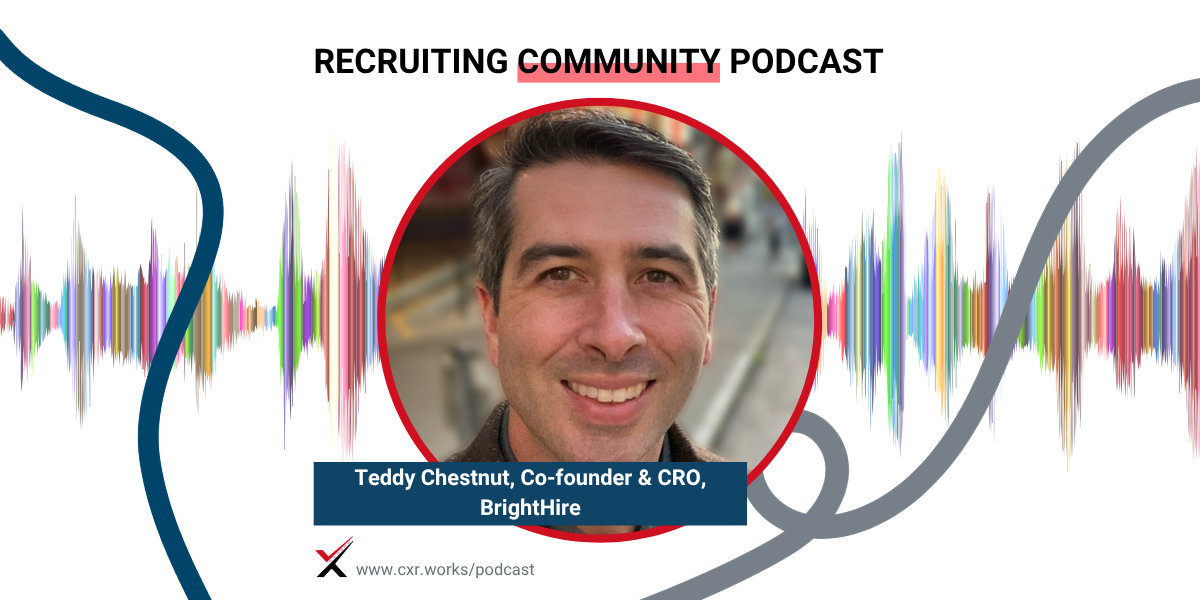
Teddy Chestnut, Co-Founder, BrightHire
Hosts:
Chris Hoyt, President, CareerXroads
Gerry Crispin, Co-Founder, CareerXroads
Episode Overview:
Chris Hoyt and Gerry Crispin speak with Teddy Chestnut about the growing threat of candidate fraud in talent acquisition. The conversation covers the evolution of fraud tactics — from AI-assisted interview answers to deepfake video filters to state-sponsored infiltration — and how recording technology, fraud-detection signals, and transparent AI policies are emerging as key responses. The episode also examines where TA’s responsibility begins and ends, and how AI agents representing candidates may soon reshape the interview process entirely.
Key Topics:
How candidate fraud evolved from fringe concern to mainstream TA risk over the past 18–20 months
The anatomy of a sophisticated fraud attempt, including North Korean state-sponsored IT workers obtaining employment to install malware
Real-world examples: a candidate using a “cockpit” of 12+ browser windows during a live interview, including deepfake technology
How interview recording technology became an unintended fraud detection tool
Signals used to flag potential fraud: IP address mismatches, deepfake detection, comparison of candidate answers against LLM-generated responses
The importance of human-in-the-loop judgment when interpreting fraud signals
Employer and candidate AI use policies, including publishing expectations on careers pages
Bright Hire’s AI interviewer product and the integrity signal layer built into it
The emerging scenario of a candidate’s AI agent interviewing a company’s AI interviewer
Gerry Crispin’s argument for allowing AI agents to represent candidates more accurately than recall-based interviews allow
The CXR Recruiting Awards and Marketplace Live event (deadline: April 24; event: June 10)
Notable Quotes:
“You just don’t think about hiring as a vector of risk for companies.” — Teddy Chestnut
“When you’re up against bad actors, you’re in an arms race — this is the best it will ever be, because it’s only going to get more sophisticated from here.” — Teddy Chestnut
“The goal is never to say ‘Chris is a fake candidate,’ but to bring a mosaic of signals together and help someone say, ‘I might want to give this a second look.'” — Teddy Chestnut
“I want to understand the full capacity of the individuals I’m moving forward with, because only then can I do a fair assessment and give meaningful feedback.” — Gerry Crispin
“We haven’t seen many people make that shift and then say, ‘I think we should go back to the way we used to do it.'” — Teddy Chestnut
“There’s nothing new under the sun — until maybe there is.” — Teddy Chestnut
Takeaways:
Candidate fraud has moved well beyond resume embellishment — TA teams now face deepfakes, IP spoofing, and coordinated state-sponsored schemes. Recording interviews, even using existing tools like Zoom or Teams, is an immediate, low-barrier step that creates both a deterrent and a verifiable record. Building trust with candidates requires organizations to clearly communicate how they use AI in hiring — and what they expect from candidates in return. As AI agents increasingly participate on both sides of the interview, the function’s responsibility to candidate outcomes, not just employer fit, becomes more important than ever.
Want more conversations like this?
Subscribe to the CXR podcast and explore how top talent leaders are shaping the future of recruiting. Learn more about the CareerXroads community at cxr.works.
Chris Hoyt: Welcome, everybody, to the Recruiting Community Podcast. My name is Chris Hoyt. I’m the president of CXR. I’m joined by Gerry Crispin, co-founder of CareerXroads. Gerry, how are you on this lovely day?
Gerry Crispin: It is a beautiful day, and I’m enjoying every moment of it. You’re getting a good run of weather where you are.
Chris Hoyt: Yes, I am.
Gerry Crispin: We gotta enjoy it while we got it.
Chris Hoyt: And you’re using the new Airstream — have you picked it up? Are you going out to take advantage of all this good weather?
Gerry Crispin: Tomorrow I’ll finish preparation, and Saturday morning I’ll be headed towards Chicago.
Chris Hoyt: That’s exciting. This is like your 17th Airstream, right?
Gerry Crispin: Fourth. But who’s counting — my dear actually is counting. She goes, “You did what?”
Chris Hoyt: I love it. Are they just stacking up, or are you trading them in?
Gerry Crispin: I trade them in. I have no room for cars, let alone Airstreams.
Chris Hoyt: Oh man. Well, if anybody hasn’t figured it out yet, we are the hosts of this podcast. What we’re trying to do is bring you industry insights — and Airstream updates — in the form of a fun conversation, all brought to you by the CXR CareerXroads community.
I’m excited because today we’re talking with Teddy Chestnut of BrightHire. We’re going to dig into TA’s wildest new challenge: candidate fraud. That comes in a couple of different flavors — from AI-crafted personas to deepfake interviews to some pretty unbelievable real-world stories. We’re going to talk about how fraudsters are getting creative and how TA teams can stay one step ahead.
A few quick things: we are streaming on the socials — Facebook, YouTube, LinkedIn. You can check out all of our past episodes and see what’s coming up at cxr.works/podcast. We’ve got about 500-some-odd episodes there — we’ve been doing this a little while. We’re interviewing leaders, practitioners, and people doing interesting work, much like Teddy today. On the site you’ll find easy ways to like and subscribe and let us know if you want to join the conversation.
One more thing before we bring Teddy in — Gerry, I think we should talk about the Marketplace Live event and the CXR Recruiting Awards. Can you give us an overview?
Gerry Crispin: What we’re really trying to do is focus on what practitioners are doing on their own. The long-term issue is going to be how people are upskilling themselves, and we know it’s happening. There are folks in the TA arena working on things as simple as a prompt and as complex as a sophisticated agent that’s going to help them interview. We want to know about it because we want to acknowledge it. Every single person who tells us what they’re doing will be on a wall of fame. And then — how many finalists are we taking?
Chris Hoyt: Three finalists.
Gerry Crispin: There we go.
Chris Hoyt: To your point, it could be a killer prompt the TA team is using and that’s fantastic, all the way up to some sort of reimagining or reorganization of how the function works. We’ve seen some pretty interesting submissions come in already. The deadline is April 24th. We’re asking for a demo video of 15 minutes or less. Anything shown or discussed in the video must be anonymized — no real-world data. We’ll pick three finalists and host them at Marketplace Live on June 10th, where they’ll get a VIP dinner and be part of the award presentation. Everyone can get details at cxrrecruitingawards.com.
Gerry Crispin: Cool.
Chris Hoyt: I’m really pumped. A lot of people are doing cool stuff that I don’t think they realize will be as interesting as we think it is. People are underestimating the impact they’re having. Alright — ready to bring Teddy in?
Gerry Crispin: Yep.
Chris Hoyt: Let’s do it.
[Announcer: Welcome to the Recruiting Community Podcast, the go-to channel for talent acquisition leaders and practitioners. This show is brought to you by CXR, a trusted community connecting the best minds in the industry to explore topics like attracting, engaging, and retaining top talent. Hosted by Chris Hoyt and Gerry Crispin. We are thrilled to have you join the conversation.]
Chris Hoyt: Alright, Teddy — welcome.
Teddy Chestnut: Thanks, Chris. Good to see you, Gerry. Good to see you. I’m on Airstream zero, so getting to four would be an achievement. Getting to one would be an achievement. That’s a life goal — that’s a topic for a different conversation.
Chris Hoyt: He’s just on another level for all things. I’m taking hybrid work to a whole new level.
Teddy Chestnut: There you go.
Chris Hoyt: Teddy, for those who haven’t met you or maybe haven’t come across your organization yet, give us the escalator pitch — who is Teddy, and why are we dialing in and paying attention to you today?
Teddy Chestnut: Sure. Thanks for having me on. My name’s Teddy Chestnut. I’m one of the co-founders of BrightHire, acquired by Zoom back in December of last year. Since 2019, we’ve been building technology for the interview process with a mission to give everyone the hiring experience they deserve. We think about how important interviews are to everyone involved — candidates, recruiters, hiring managers — and we bring objectivity, transparency, and now AI-enabled workflows into the interview process, including around the topic we’re talking about today: candidate fraud. No recruiter or hiring manager deserves to be on the receiving end of a fraudulent candidate, so it’s a big area of focus for us.
I’ve been in and around the industry for quite some time — six and a half years at LinkedIn before that, and CEB back in the day. Very passionate about the space, and glad to be part of the conversation.
Chris Hoyt: When we say candidate fraud, I think it means different things to different people. We’ve seen everything from a digital twin — we actually did one of me for about 30 bucks and nobody can tell the difference; I’m not sure what that says more about, the technology or me — applied as a Snapchat-style filter during an interview, all the way to TA leaders getting impersonated and spoofed online, with candidates getting ripped off in the process. There’s this wild spectrum. Some of it feels like it’s been going on for years but is just elevated now, and then there’s this whole new level of crazy on top of that.
My question for you, Teddy: when do you think candidate fraud stopped being a fringe problem and became a real TA problem that deserves real attention?
Teddy Chestnut: There’s nothing new under the sun — until sometimes there is. At LinkedIn, there was always the challenge of the integrity of the application process: fraud schemes trying to get people to pay to apply, that sort of thing. That’s escalated, but it’s been around a long time.
What I remember is getting a text from one of our customers about 18 to 20 months ago saying, “I think we have a new use case for your technology.” We recorded and transcribed interviews, and she described a situation where they had hired somebody — an insurance company — and were onboarding them as a remote employee. The recruiter saw the person in Slack and thought, “I don’t think that’s the same person I interviewed.” She went back to the BrightHire interview recording, confirmed it wasn’t the same person, and had to terminate that employee — who had just requested access to a bunch of sensitive information.
I felt like I was taking the red pill in The Matrix. You just don’t think about hiring as a vector of risk for companies. That was about 18 months ago. Fast forward to today, and we hear a story like this every day — in software engineering, remote companies, customer service, financial services. It doesn’t matter the industry or the function; we’re seeing it across the board.
And there’s a big range. On one end, someone is using AI to generate better interview answers to land a job. On the other end, you have North Korean agents working with a contact inside the US to acquire a driver’s license and get hired — we’ve spoken with a CISO who was coordinating with the FBI on exactly that. It’s gotten to the big leagues.
Chris Hoyt: We actually had a member company that caught it two days before sending a laptop out to someone who turned out to be a North Korean bad actor — and this was a government contractor. So it’s a very real concern at multiple levels. It’s funny — some organizations are neck-deep in this, actively trying to address and prevent it, while others are saying, “Look, maybe three percent of our applications are fraudulent, but we’re not worried about bad actors getting through — we’re just trying to sift through the front end of the process.” This really runs the gamut of the recruiting process.
Teddy Chestnut: You’re right. And when you’re up against bad actors, you’re in an arms race — this is the best it will ever be, because it’s only going to get more sophisticated from here. Nobody was worried about a candidate using a deepfake 18 months ago because the technology wasn’t close. But that was the worst that technology was ever going to be.
I remember seeing a screenshot from a customer who was interviewing a candidate for a technical role. The guy was on a Mac and accidentally hit F3, which showed every window he had open. They took a screenshot, and I kid you not — there were a dozen windows open: a map of San Francisco with the weather so he knew the local geography, ChatGPT for answers, a Discord page with information about the company. It was literally a cockpit for candidate fraud. And on top of all of that, he was also using a deepfake.
The level of sophistication in certain cases has gone to a completely different level than most heads of TA or Chief People Officers would have anticipated even a year ago.
Chris Hoyt: Yeah. Let’s do a level set — sorry, my brain is just spinning thinking about this cockpit of 15 windows open. From a meat-and-potatoes standpoint, can you walk us through the anatomy of a modern fraud attempt? What does a sophisticated attack actually look like, from first application through interview?
Teddy Chestnut: A truly sophisticated attack looks like a North Korean agent working with an actual US citizen to apply for a job, interview for it, get it, then take the laptop once it arrives and send it back to North Korea. That person logs in, installs malware, and ransoms back information. What makes it so hard to spot is that the candidate is the same person throughout the entire visible process — the US contact shows up to interview and onboards, then ships the laptop. That’s the leading edge, and you don’t see a lot of it.
What you see more commonly is someone showing up for all the interviews and a different person showing up to work. Or different people cycling through the interview process because they can’t pass the technical screen, so they pull someone else in. I hate to say it, but that’s the less sophisticated, easier-to-spot version.
Chris Hoyt: It’s interesting — we’ve heard from leaders where a hiring manager calls and says, “I’m not sure this is who I interviewed,” and the person’s been on the job for two weeks. And then there are a couple of Mission Impossible-level deepfake situations, which are really scary. TA leaders are now talking about allocating considerable budget to bring final-round interviews back in person, or to capture ID images during onboarding for comparison. But even those methods are essentially out the window if someone can put on a Snapchat-style filter and walk into any interview.
Teddy Chestnut: People were saying, “Put your hand in front of your face,” or “Show me the outlets,” or “Open the blind so I can see what time it is outside” — all of these workarounds. But if the deepfake technology gets good enough, which it will, those tricks start to go away. It’s an arms race. It’s going to keep getting harder.
Chris Hoyt: And I don’t want to fearmongering here — that level of deepfake isn’t rampant everywhere. But it is a real concern, certainly for government contractors and similar organizations.
Teddy Chestnut: That’s right.
Chris Hoyt: Teddy, your organization’s whole foundation is about capturing what actually happens inside an interview. How does that same technology become a fraud detection tool? Are there signals you’re training people to look for?
Teddy Chestnut: At the outset, we became a fraud detection tool simply because the ability to go back and review the video is very instructive — and the fact that you’re recording is itself a deterrent. If someone knows they’re going to be on camera for multiple interviews, they’ll often turn their camera off or not show up, and those become signals. Or you can simply validate: “There were different people in this interview process,” and confirm it with certainty.
That’s actually where this started — teams were flagging fraud without any purpose-built features in the product at all. We had elements where interviewers could take notes and flag moments, and teams started using that to mark suspicious points: “It sounds like they’re using AI to answer” or “That might be a deepfake.”
From there, you get into more sophisticated capabilities — that’s where our roadmap is going. Matching the location on someone’s resume to where their IP address is coming from, for example. If someone says they’re based in Denver and their IP is coming from Colombia or Azerbaijan, that’s a flag, not a certainty. We’re also looking at deepfake detection technology and, with our AI interview product, comparing candidates’ answers against LLM-generated responses to the same questions. If someone’s answers consistently match what an AI would say, that’s a signal.
The goal is never to say “Chris is a fake candidate,” but to bring a mosaic of signals together and help someone say, “I might want to give this a second look.”
Chris Hoyt: So it’s a summary of all those signals coming together to raise the temperature? Because individually, any one of them could be innocent — I look over to the side constantly in this studio because I’ve got a wide screen and Gerry’s on one side and you’re on the other. That could be a flag. Stuttering could be a flag. How does that get addressed so that TA leaders aren’t getting false positives?
Teddy Chestnut: The same principle applies here as in any hiring decision: you have to have a human in the loop. Ultimately, it’s a human reviewing the evidence and making the judgment call. Technology is helpful for surfacing signals you can’t see on your own — I can’t see your IP address, so let’s give you better information to inform that call. But at the end of the day, it’s a human judgment.
Chris Hoyt: I think that human-in-the-loop piece sometimes gets lost in all the chatter, and I think it’s critical.
Teddy Chestnut: Really critical.
Chris Hoyt: Yeah. We did an exercise not too long ago with a group of about 30 people where we mapped out the entire TA workflow on big boards and asked at every stage: all human, all automation, or some hybrid? Not one single stage in that room was all AI, all automation. Every single one had some human touch element to it. And I think there’s real power in that.
Gerry Crispin: We really need to make sure we’re clear not just on what the candidate is using for automation, but whether the candidate has expectations set about how we’re going to use automation in our role. That becomes a trust issue — if the candidate doesn’t trust that we’re operating transparently, they feel more comfortable not doing so themselves.
Teddy Chestnut: Around the same time as that first fraud story, I started hearing TA leaders make commitments around their expectations for candidates’ use of AI and what candidates could expect from the company’s use of AI — and starting to publish that on their careers pages, like a Trust tab. That communication is really important. And the world is changing so fast that having the conversation is as important as posting something on your careers site.
Gerry Crispin: That’s almost becoming a baseline standard.
Chris Hoyt: I think so. And I think we should take a look at that — it’s one of the things on our list. But it’s going to become more critical if we want to build trust with the candidate population.
Teddy Chestnut: That’s right. We’re thinking a lot about this right now because we launched an AI interviewer — so some of our customers now have candidates speaking directly with an AI agent. There were always earlier versions of that, top-of-funnel screening tools, but it’s a different dynamic when it’s a voice conversation with an AI agent. Questions about human in the loop, how the candidate is being evaluated, and how transparent it all is — those become really important. And the fraud piece comes in there too, because it’s one thing to spot fraud when a human is in the interview, and another when an AI is conducting it and a human reviews it afterward. In fact, our AI interview product is actually the first place where we’re introducing that mosaic of integrity signals, because it’s so critical when there’s no human in the conversation.
Chris Hoyt: I love to reference ThoughtWorks and CarMax as great examples here — both are members. If you go to their careers pages, they’re really clear that they use AI at work daily and they expect candidates to use AI to some degree, but here’s where they’ll accept it in the interview process and here’s where they won’t. And Gerry, I think you’re moving toward this — what I think is so important is that it’s not just about figuring out who’s using AI and who isn’t. It’s about completely changing how we do assessments and what questions we ask. “We know you’re going to use a prompt for this — share your screen, walk me through it. I want to see how you get to this answer and understand the logic behind it.” That’s a really fascinating pivot we’re seeing in this space.
There’s a spectrum here. On one end, we don’t care if a candidate uses AI to update their resume, as long as it’s factual. On the other end, you’ve got deepfakes and state-sponsored IT workers infiltrating companies. I’d love both of your takes: where do you think TA’s responsibility actually begins and ends on this topic?
Teddy Chestnut: I think it comes back to why people are interviewing for jobs in the first place — there’s a career on the other side of that. A change in their life and their trajectory. The job of TA is ultimately to orchestrate a process that consistently puts people in the right opportunities. That’s the right lens: am I using AI in a way that gives us confidence I’ll end up in the right opportunity, one where I can thrive and deliver? Or am I using AI in a way that puts me in a role I’m not actually set up to succeed in?
There’s an interesting thought experiment we’re now seeing play out with the AI interviewer: what if a candidate sends an AI agent to interview with our AI interviewer? Now they’re talking to each other. Should they be able to do that?
Chris Hoyt: That’s a fair argument.
Gerry Crispin: It is fair. At some point, I’ve got an agent that knows me better than I know myself — it remembers projects and work assignments from the last 15 years better than I ever could. If you’re asking about my adaptability and capabilities, my agent can make a better representation of what I’m capable of than I can if I’m trying to randomly recall one or two projects under pressure. If you really want to understand my background and whether I can compete for this job, I want my agent as part of this process — either representing me directly or as an assist that helps me remember what I need to in the moment.
Chris Hoyt: There’s a missed opportunity somewhere in blockchain that never quite materialized, but Gerry, you’ve made me think of something interesting. Maybe I’m not great in a 45-minute interview. Maybe I’m not going to recall all the times I successfully implemented something in a way that fits the interview format. But if I had a locked-in, verified digital version of me — an assistant that can reference my work more quickly in that 45-minute window — maybe that’s fair game.
Gerry Crispin: Yes, because the goal shouldn’t be this artificial exercise of “what can I figure out in 30 minutes to decide if you’re the person I’m going to hire?” I want to understand the full capacity of the individuals I’m moving forward with, because only then can I do a fair assessment and give meaningful feedback — including to those I’m not moving forward. I can tell them something useful about why, and what might make them more competitive for future roles, at this company or others.
That expands how we think about our responsibility in recruiting — not just to the employer and hiring manager, but to the candidate’s future success. If we do that well, we can start treating the candidate more like a customer. We’re creating an environment where someone who doesn’t get the job leaves feeling like they gained something from the journey. That’s powerful, and it might help reduce the friction in how we recruit going forward.
Chris Hoyt: You just added a new coat of paint to candidate experience.
Teddy Chestnut: Like I said, there’s nothing new under the sun — until maybe there is.
Chris Hoyt: Teddy, if a recruiter or TA leader listening today is going back to their desk tomorrow — what’s one change or consideration you think they should make right now, before any new technology comes into place?
Teddy Chestnut: If you haven’t experimented with recording your interviews, you should. You don’t need to buy any technology to do it — you’re probably already using Zoom, Teams, or Google Meet. Get candidate consent and flip on recording. The aha moment, across a whole range of dimensions, is pretty immediate. Whether you’re thinking about fraud, efficiency, or candidate experience, a lot changes when you go from being distracted trying to take notes, remember your questions, and pay attention all at once — to just being present. We haven’t seen many people make that shift and then say, “I think we should go back to the way we used to do it.”
Chris Hoyt: That’s better than “things are scary, good luck.”
Teddy Chestnut: That’s right.
Chris Hoyt: Teddy, given the state of things, everything going on, the work you’re doing — if you were going to write a book, what would you call it?
Teddy Chestnut: I think it would be called Trajectory Change. I keep coming back to our mission — give everyone the hiring experience they deserve — and a lot of that is about how hiring changes individual trajectories. You can probably think of interviews you either conducted or were on the receiving end of that genuinely changed someone’s life. But it also feels like we’re in a moment where the trajectory of the entire talent function is changing dramatically, powered by AI. It feels like an interesting confluence of those two themes — macro and individual, put together. I don’t know exactly what I’d say inside the book, but that would be the title.
Chris Hoyt: You’ve got the thesis. You’ve got the front end.
Teddy Chestnut: That’s right.
Chris Hoyt: Present company excluded — who would you give the first signed copy to?
Teddy Chestnut: You have to give it to your mom, right?
Chris Hoyt: You want to give it to my mom?
Teddy Chestnut: No — to my mom. My mom. Actually, both my parents were in HR for 30 years. My dad met my mom when she was a recruiter — I was born into this. My dad ran HR for a unionized manufacturing shop in Union, New Jersey. My mom was a senior HR leader for a city for over 20 years. I grew up with comp conversations, union negotiations, and 401k talk at the dinner table. So if I’m writing a book about the state of HR, I’m giving it back to them — they bore me into this.
Chris Hoyt: That’s fantastic. I feel like that should be a whole other show.
Teddy Chestnut: That’s a different show.
Chris Hoyt: Teddy, I know you’re a busy guy. Thanks so much for joining Gerry and me today — we really appreciate your perspective and the expertise you bring. It’s been incredibly valuable.
Teddy Chestnut: Thanks for having me. It’s been fun.
Chris Hoyt: Good stuff. A few reminders for everybody: cxrrecruitingawards.com — you’ve got just a couple of weeks left to get your submissions in. If you’re interested in Marketplace Live, check it out at cxr.works/marketplacelive. And if you want more information on the podcast, upcoming shows, or if you’d like to be on the show — or if you know someone we should ring up — let us know at cxr.org/podcast. Till next time, everybody.
[Announcer: Thanks for listening to the Recruiting Community Podcast, where talent acquisition leaders connect, learn, and grow together. Be sure to visit cxr.works/podcast to explore past episodes, see what’s coming up next, and find out how you can join the conversation. Whether you’ve got insights to share or want to be a guest on the show, we’d love to hear from you. If you’re interested in learning more about becoming a member of the CXR community, visit cxr.works. We’ll catch you in the next episode.]
What if employer ratings were built on real outcomes—not surveys? Rajiv Chandrasekaran unpacks data on 12M workers across 1,750 companies.