


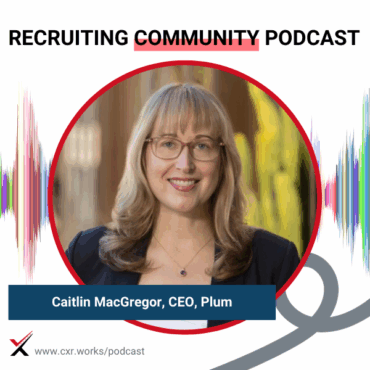
Mapping Durable Skills Across North America
How do regional strengths in durable skills impact hiring? Caitlin MacGregor joins to discuss Plum’s new index and why it matters for future-ready talent strategies.
 play_arrow
The Global Recruiting Puzzle: Influence, Credibility & Complexity Cami Grace
 play_arrow
How Curiosity Shaped a Career in TA: Carmen Hudson’s Career Crossroads Cami Grace
 play_arrow
Proving TA’s Value: Sourcing’s Role in Revenue Growth Cami Grace
 play_arrow
Talent Chooses You: Reframing the Role of TA in Driving Growth Cami Grace
Featured Guests:
Peter Cappelli, Professor, Wharton School
Ranya Nehmeh, Talent Management Practitioner
Hosts:
Chris Hoyt, President, CareerXroads
Gerry Crispin, Co-founder, CareerXroads
Episode Overview:
This episode features a discussion with Peter Cappelli and Ranya Nehmeh, co-authors of In Praise of the Office. They explore the organizational impact of remote and hybrid work, drawing on academic research and practical experience. The conversation addresses challenges with managing distributed teams, the loss of informal office dynamics, and strategies for fostering connection and fairness in hybrid models.
Key Topics:
Origins and collaboration behind In Praise of the Office
Organizational costs of remote and hybrid work
Proximity bias and career development disparities
Meeting overload and the inefficiencies of virtual meetings
Challenges of managing remote teams
BOND framework for improving in-office engagement
Tactical steps for talent leaders in hybrid environments
Notable Quotes:
“Much of the book is about hybrid work and why it’s not working well—largely because employers assume it’s just like being there full-time. But it’s really not.” – Peter Cappelli
“One big challenge is losing informal interactions—the spontaneous moments in the office that solve problems, create innovation, and support mentoring.” – Ranya Nehmeh
“You might be doing great work from home, but if your colleague is in the office daily and interacting with the manager, they’re more likely to get noticed when it counts.” – Ranya Nehmeh
“Once social interaction drops off, you have to structure and support it.” – Peter Cappelli
Takeaways:
Peter Cappelli and Ranya Nehmeh provide a nuanced look at the post-pandemic workplace, emphasizing that while remote work offers personal benefits, it creates new organizational challenges. Their book offers a data-driven perspective on why hybrid models often fall short and proposes frameworks like BOND to improve engagement and equity. Talent leaders can apply these insights to manage their teams more effectively, even without sweeping organizational change.
Want more conversations like this?
Subscribe to the CXR podcast and explore how top talent leaders are shaping the future of recruiting. Learn more about the CareerXroads community at cxr.works.
Book Link: In Praise of the Office: The Limits to Hybrid and Remote Work by Peter Cappelli and Ranya Nehmeh
Chris Hoyt: And Rania, where are you exactly?
Ranya Nehmeh: I’m in Vienna, in Austria.
Chris Hoyt: Okay. So you probably have the better view out of all four of us, I imagine. Except it’s dark.
Ranya Nehmeh: Yes, it’s dark. Seven-thirty in the evening.
Chris Hoyt: Do you get to the States very often or just no interest? I wouldn’t blame you right now if you had zero interest.
Ranya Nehmeh: No, I wouldn’t. I used to go quite a bit before, but I haven’t been in a few years now. But sure, I hope to go next year.
Chris Hoyt: Yeah. Well, hang in there. Our tourism isn’t exactly at an all-time high, but you know…
Ranya Nehmeh: We’ll get there.
Chris Hoyt: Nice. Well, you’ve got some fun stuff to talk about today. I’m pretty excited to dive in. There’s a book—I hear there’s a book—so we’re gonna give that a little bit of chatter time. Are you guys ready to go?
Announcer: Welcome to the Recruiting Community Podcast, the go-to channel for talent acquisition leaders and practitioners. This show is brought to you by CXR, a trusted community of thousands connecting the best minds in the industry to explore topics like attracting, engaging, and retaining top talent. Hosted by Chris Hoyt and Gerry Crispin, we are thrilled to have you join the conversation.
Chris Hoyt: Alright, welcome everybody to the Recruiting Community Podcast. I’m Chris Hoyt, president of CXR. I’m here with my co-host and co-founder at CareerXroads, Gerry Crispin. Gerry, say hello.
Gerry Crispin: Hello!
Chris Hoyt: That’s the easy job. We like to think we’re bringing you industry insights and updates in the form of a conversation—all brought to you by the CXR community. Today, we’re going to talk with our guests about a new book, In Praise of the Office. We’ll dig into what that means, who’s getting praised, and all that good stuff.
Quick reminder: we’re streaming on YouTube, Facebook, and LinkedIn. You can check out all our past and upcoming episode info at cxr.works/podcast. We’ve got over 500 interviews with heads of talent and folks doing really cool stuff in the space. You’ll also find easy ways to like, subscribe, and make Gerry and me internet famous. Tell us if you like what we’re doing.
Lastly, this is a labor of love. We’re not making any money, nobody pays to be on, and we don’t pay any guests. We’re just having fun conversations. Gerry, did I miss anything?
Gerry Crispin: Not a thing.
Chris Hoyt: Crushed it. My job here is done. Gerry, why don’t you set the stage for our guests and let them give a little escalator pitch for themselves. Why do we have Rania and Peter on today?
Gerry Crispin: One of our obsessions is really our industry and the profession of hiring. We know that over the last few years, there’s been a lot of conversation about where the work gets done. I was really fascinated that Peter and Rania have tackled this interesting issue—remote versus hybrid versus whatever—from a data and academic point of view. In our industry, a lot of biases exist about whether you should be back in the office or not, and it’s nice to have a different viewpoint.
Chris Hoyt: Peter, why don’t you set us up? Give us a little pitch and some background—you’ve been doing this for a while. Why should folks listen to what you have to say?
Peter Cappelli: Maybe I could begin by reminding your listeners, if they don’t know, that CXR and Gerry were the people who really first explained how the world of hiring—and then employment—was changing in a radical way. It took us a long time to understand just how important outside hiring is and the whole industry around it, which is now enormous.
So yes, I’ve been doing this a long time. I told my undergrads this past year that I’ve been at Wharton for 40 years, and they just started applauding—like, “Wow, he’s still standing!”
I got interested in this topic at the beginning of the pandemic when people were asking, “What do we know about remote work?” It turned out that a lot of studies had been done—usually on individuals working remotely, or companies that tried to go without offices—and the story was never particularly great.
So my publisher at Wharton let me write a little book about it, which got some attention. They wanted to update it. In the meantime, I had talked to Rania about a book chapter someone asked for, and I figured she was ideal: a practitioner with a PhD, although she hides that part. I asked if she wanted to co-write. She said yes. Then this book came along, and I really didn’t want to do it alone. Rania was ideally positioned, so we did it together.
And yes, we’re remote—me in Philadelphia, Rania in Vienna. We’ve seen each other in person only twice in the last three years. So yes, we’re familiar with remote work.
Chris Hoyt: I’d say that’s solidly remote. Rania, how about yourself?
Ranya Nehmeh: Sure. I have about 20 years of work experience in international organizations, based in Vienna and Frankfurt. I’ve always worked in talent management, leadership, and HR. Peter and I met some years ago and shared interests. When the pandemic hit, I worked remotely for the first time ever and completely fell in love with it. I couldn’t believe how well the work was getting done.
But years later, as Peter and I kept talking, I also saw the challenges—especially with hybrid work. That made it easy to dive into the book, since we had experienced those challenges firsthand.
Peter Cappelli: Just to follow up and introduce the book—we understand most employees are like us. They appreciate the big personal benefits of working remotely. The question is: What does it do to the organization? That part got very little attention.
This became a natural experiment. We’ve studied office and white-collar work for decades, but we never really understood how much of it was due to the physical office. During the pandemic, the assumption was: “Hey, looks like the office doesn’t matter.” But things got done partly because we were desperate. You could lose your job or risk your life by going in.
So it took a while to see what we lost—and now, with more people never having been in an office, it’s easier to see the problems.
Much of the book is about hybrid work and why it’s not working well—largely because employers assume it’s just like being there full-time. But it’s really not.
Gerry Crispin: One thing that occurs to me, Peter, is there’s a lot of literature about how to manage people in the office—but not much about managing remote workers. Did you look at successful examples of remote management or some of the differences there?
Peter Cappelli: Let me start and then Rania can share her in-person observations.
If you look at fully remote companies, there aren’t many—and most are small tech firms that were always remote. They’ve got tons of rules: transparency, documentation, shared drives, availability expectations. All things we don’t do in offices.
We knew from earlier studies that it’s a lot of work to manage remote employees. You have to fill them in on everything they’d normally pick up just being around—gossip, stakeholder shifts, what to worry about. That’s time-consuming.
Now, with hybrid, managers are expected to manage both in-office and remote folks fairly, but differently. That’s a big lift. We already struggle to get managers not to scream at people—this is much more nuanced.
Gerry Crispin: That hyper-personalization is a difficult level to achieve. Rania, you were living it. What did you see?
Ranya Nehmeh: Yes, I lived it daily. One big challenge is losing informal interactions—the spontaneous moments in the office that solve problems, create innovation, and support mentoring. That’s hard to replicate online.
Also, for new employees, it’s difficult. You don’t know who’s who or how things work. That’s even harder for younger employees who don’t have guidance. They really struggle in hybrid environments.
Chris Hoyt: It seems like a lot of nonverbal cues get lost, especially for early-career professionals. I remember during the pandemic, one of the first big concerns was managing interns remotely. A lot of organizations don’t even manage interns well in person, so there was a scramble.
Managing those young professionals thoughtfully—making sure their in-office time is meaningful—is crucial. They shouldn’t be coming in just to sit on Zoom all day. I assume those topics are addressed in the book?
Peter Cappelli: Yes, and there’s an interesting example from PwC. When their interns were remote, their supervisors were required to spend 15 minutes at the end of each day just checking in—open-ended conversations.
Great idea, but if you have seven interns, that’s a lot of extra work. Maybe you should’ve done that in-person too—but now it’s necessary. It changes the job, and we haven’t adjusted.
Gerry Crispin: That reminds me of meetings in Brazil—you never start on time. First, everyone shares how they’re feeling, what’s going on in their personal life. It takes half an hour. A huge social component to how they manage.
Peter Cappelli: Let’s talk about meetings—that’s one of the big issues.
With remote work, the time spent in meetings has jumped—about an hour more per day. Even in hybrid setups, it’s mostly remote meetings. Why? Because anchor days aren’t enforced. People show up and find no one else there, so they stop coming in.
Remote meetings have real drawbacks. You miss the post-meeting hallway chats—the gossip, the clarification, the real talk. Some companies leave the Zoom open after meetings to simulate that, but no one gossips on a public channel.
Meetings are bigger—easy to add people. Cameras are often off. People aren’t even there—sometimes they send AI agents to attend and record for them.
People multitask during meetings because they’re too busy—because they’re in too many meetings. It’s a cycle.
There are rarely any rules about meetings—no agendas, no structure, nothing. So they just chew up time.
Chris Hoyt: I saw that new Zoom feature where it asks if I want to “attend later” and have it record and take notes. I’m like, what’s the point of the meeting then?
Peter Cappelli: Exactly. And are we even sure it’s us on this call and not our avatars?
(Everyone laughs)
Chris Hoyt: Rania, was there one big takeaway or aha moment for you in working on this book?
Ranya Nehmeh: Yes—something I also experienced myself: career development and promotions in hybrid setups. There’s a real proximity bias. You might be doing great work from home, but if your colleague is in the office daily and interacting with the manager, they’re more likely to get noticed when it counts.
Chris Hoyt: Is there a magic formula here, Peter? Like three days in-office per week?
Peter Cappelli: Rania has a great acronym that helps—I’ll let her explain it.
Ranya Nehmeh: It’s the BOND framework—how to make in-office work more about connection than compliance.
Build the narrative—explain the “why.”
Own the expectations—be clear and enforce them.
Normalize engagement—give people something to come in for.
Demonstrate inclusion—make it an inclusive experience.
Chris Hoyt: That’s clever. It normalizes connection—it’s not an exception anymore, it’s just how we work.
Peter Cappelli: Exactly. It’s about formalizing what used to happen informally. Once social interaction drops off, you have to structure and support it.
Chris Hoyt: If I’m the head of TA and not running the whole org, what can I realistically do with all of this?
Peter Cappelli: You can apply it to your team. It’ll be harder, but possible. Think of it as change management—explain the why, handle resistance, and lead by example. It takes guts.
Ranya Nehmeh: And on a smaller scale, you can still run better meetings, have consistent one-on-ones, and be intentional about inclusion and career development. There’s a lot you can do without an org-wide policy.
Chris Hoyt: Before we let you go—where’s the best place to get the book?
Ranya Nehmeh: It’s available on Amazon, the Penn Press website, and Barnes & Noble.
Chris Hoyt: Great. Congratulations on the book and this collaboration. I’m excited to dig in. Thanks so much for your time.
Peter Cappelli: Thank you!
Ranya Nehmeh: Thank you!
Chris Hoyt: That’s it for today. Head to cxr.works/podcast for past and future episodes. Like and subscribe to help make Gerry and me internet famous. 2026, here we come!
Announcer: Thanks for listening to the Recruiting Community Podcast, where talent acquisition leaders connect, learn, and grow together. Be sure to visit cxr.works/podcast to explore past episodes, see what’s coming up next, and find out how you can join the conversation. Whether you’ve got insights to share or want to be a guest, we’d love to hear from you. Interested in becoming a CXR community member? Visit www.cxr.works. See you next time!
How do regional strengths in durable skills impact hiring? Caitlin MacGregor joins to discuss Plum’s new index and why it matters for future-ready talent strategies.



Post comments (0)