
How Identity Fraud Hits TA
Is your hiring funnel a national security risk? ID.me’s Taylor Liggett breaks down workforce identity fraud—and what TA teams can do now.
 play_arrow
Empathy, AI, and the Business of People Alessa Rivera Badillo
 play_arrow
Building the TA Machine Alessa Rivera Badillo
 play_arrow
The AI Talent Race Alessa Rivera Badillo
 play_arrow
Built for Change: Tracey Friend’s Career Crossroads Alessa Rivera Badillo
Featured Guests:
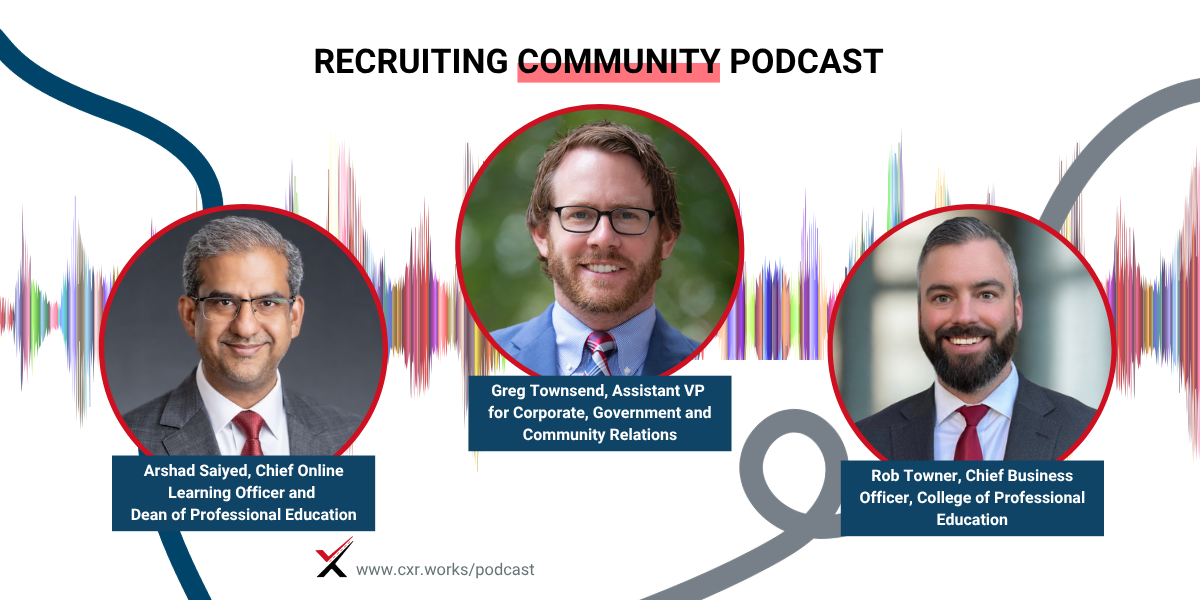
Rob Towner, Chief Business Officer, College of Professional Education, Stevens Institute of Technology
Arshad Saiyed, Chief Online Learning Officer and Dean, College of Professional Education, Stevens Institute of Technology
Greg Townsend, Assistant Vice President for Corporate, Government, and Community Relations, Stevens Institute of Technology
Hosts:
Chris Hoyt, President, CareerXroads
Gerry Crispin, Co-Founder, CareerXroads
Episode Overview:
Chris Hoyt and Gerry Crispin sit down with three leaders from Stevens Institute of Technology to examine whether colleges and organizations are genuinely prepared for an AI-first workforce. The conversation spans corporate upskilling, undergraduate curriculum redesign, the evolving employer-university partnership model, and how educational institutions can serve as true talent management partners rather than traditional degree providers.
Key Topics:
The 2025 early career hiring slowdown and its connection to AI-driven role uncertainty
Why large employers are reconsidering the value of entry-level and internship hiring—and the counterargument
Stevens’ Stevens Institute for Artificial Intelligence (established 2017) and its new “Frontiers of Technology” core curriculum requirement
The launch of a new undergraduate degree in AI at Stevens, among roughly 20 institutions nationally offering one
The workforce talent funnel shifting from a pyramid to a diamond shape, with a choke point at entry level
Why short-form, role-based credentials are replacing multi-year master’s degrees for working professionals
Corporate upskilling at speed: 12-week programs for role transitions (e.g., software engineer to AI-first software engineer)
The concept of “stackable” credentials and its limitations—and what comes next
Extending AI readiness pipelines into high school districts
What Fortune 500 college recruiting leaders should look for in institutional partners
Stevens’ internal use of AI engineers and forward-deployed AI specialists within the university itself
Notable Quotes:
“Companies need to move fast. They need talent that is capable and ready to contribute from essentially day zero.”
— Arshad Saiyed
“The talent funnel used to look like a pyramid — lots of people at the entry level, fewer roles as you moved up. That shape is now becoming a diamond.”
— Rob Towner
“I think the master’s degree market is dying, if not already dead in many areas.”
— Rob Towner
“Nobody can tell me what the AI landscape will look like three and a half years from now — which is the average time a working professional takes to complete a master’s degree.”
— Rob Towner
“If any institution comes to you with a fixed menu — ‘this is what we do, take it or leave it’ — walk away.”
— Arshad Saiyed
“Find the schools that are preparing students to succeed from day one — but also five years down the line.”
— Greg Townsend
“The days of showing up to a career fair and hiring from a general pool are fading. As a corporate partner, you have more control over what these partnerships look like than you may realize.”
— Rob Towner
“Talent readiness isn’t just an upskilling conversation at the company level — it’s a pipeline that has to connect all the way from high school through college and into the workforce.”
— Arshad Saiyed
Takeaways:
The traditional employer-university relationship is no longer sufficient for the pace of AI-driven workforce change. Educational institutions that are willing to co-create customized, role-based learning programs—at speed—are becoming preferred talent partners over those offering fixed curricula. For talent leaders evaluating campus partnerships, the signal to look for is adaptability: schools embedding technology readiness into their core identity and willing to tailor programs to specific organizational needs are the ones worth engaging.
Want more conversations like this? Subscribe to the CXR podcast and explore how top talent leaders are shaping the future of recruiting. Learn more about the CareerXroads community at cxr.works.
Chris Hoyt: This is a fun topic, and something that’s come up quite a bit lately. Before we dive in, I want to welcome everyone to The Recruiting Community podcast. My name is Chris Hoyt — I’m the president of CXR — and I’m joined by Gerry Crispin, co-founder of CareerXroads. Gerry, how are you on this glorious day?
Gerry Crispin: It’s another beautiful day. What can I say?
Chris Hoyt: On the right side of the dirt. Exactly. Gerry and I are your hosts today, and as always, we’re bringing you industry insights and intelligence in the form of a fun water cooler conversation. This is brought to you by the CXR CareerXroads community.
What we’re talking about today is super interesting. Most organizations are racing to adopt AI — we hear phrases like “AI forward,” “AI first,” and so on. But few are asking what we think is one of the harder questions: is the workforce actually ready for that? Today, Gerry and I are going to sit down and talk about what real AI readiness looks like across every level of an organization.
We’re covering corporate training rooms, college campuses, and trying to unpack what the traditional education model looks like, what seems broken about it, and what it means to be an actual talent management partner. And specifically, we’re looking at what the Stevens Institute of Technology — Gerry, is it Go Ducks?
Gerry Crispin: Go Ducks. Yeah. There’s a whole story there — that’s for another time.
Chris Hoyt: Gerry’s alma mater. We’ve got some guests joining us today who are reimagining what the student experience looks like in order to produce candidates who are AI-savvy and genuinely ready for a workforce being reshaped.
A few things first, as we always do. We are streaming on YouTube, Facebook, and LinkedIn, among a few other places. You can check out this show, browse previous episodes, and see what’s coming up at cxr.works/podcast. We’re pushing toward 600 interviews with leaders, practitioners, and guests like the ones we have today — people doing really interesting, impactful work. On the site, you’ll find an easy way to like and subscribe, and you can let us know if you want to be part of the conversation — whether as a guest or to suggest someone doing cool things in the space.
And lastly, a reminder: this is an ad-free labor of love. Nobody paid to be on here, and nobody’s paying us. Oh, and one more thing — Gerry, we need to talk about Marketplace Live.
Gerry Crispin: Yes.
Chris Hoyt: I’ll set it up and you can tell everyone what you love about it.
Gerry Crispin: Perfect.
Chris Hoyt: For folks who haven’t heard yet, we have an upcoming event that’s actually open to non-members as well, which is pretty rare for us. It’s called Marketplace Live, and you can find it at cxr.works/marketplacelive. We’re doing this in June — it’s a two-day event, and we’re really proud of what we’ve put together. It’s unlike anything else out in the space right now. Our community growth advisors helped shape what this should look like.
There’s a Shark Tank-style environment, cocktail networking, a great dinner, and an awards show spotlighting AI work in the field. Gerry, do you know how many submissions we got for the AI awards?
Gerry Crispin: 21? 25?
Chris Hoyt: We got 25 submissions. A few came in right at the deadline.
Gerry Crispin: You let a couple in at the end, I think.
Chris Hoyt: Right at the wire, yeah. So we’ve got an awards show, some cool prizes, private tours, a lot going on. I could talk about it for 25 minutes — but Gerry, what’s your favorite aspect of Marketplace Live?
Gerry Crispin: I think talent acquisition leaders, especially those at large companies, are under enormous pressure to rethink how their technology is put together in relation to hiring tens of thousands of people each year. With issues like candidate fraud and rethinking how we collect data at the top of the funnel, there’s a lot of pressure on TA teams to rethink their tech stack. I think it’s time.
Chris Hoyt: I’d agree. This is going to be a lot of fun. We’ve got 15 vendors locked in across three umbrella topics that our membership identified as top of mind. We have about 70 registered attendees — decision-makers, organizational leaders — coming for two days of networking and collaboration. We’ve got a fantastic keynote speaker coming in from across the pond, and a handful of spots still available. If you’re interested, head to cxr.works/marketplacelive.
All right — are we ready to dive in?
Gerry Crispin: Let’s do it.
[Announcer: Welcome to the Recruiting Community podcast, the go-to channel for talent acquisition leaders and practitioners. This show is brought to you by CXR, a trusted community of thousands connecting the best minds in the industry to explore topics like attracting, engaging, and retaining top talent. Hosted by Chris Hoyt and Gerry Crispin, we’re thrilled to have you join the conversation.]
Chris Hoyt: All right, Gerry — before we bring our guests in, let’s set the stage. We’ve been talking with early career leaders — people who run college recruiting, campus recruiting, and early hiring programs — and many of them are looking to turn the way they hire upside down. A big part of that conversation is around finding talent that is AI-savvy: students who get it, who can hit the ground running. It’s changing how they look at student resumes and how they engage with students overall.
Before we introduce our guests — have you seen anything else that really tips the scales toward saying colleges need to be leaning in differently?
Gerry Crispin: What triggered this for me was the slowdown in early career hiring in 2025. Part of it came down to a lack of solid relationships between large companies and many of the colleges they rely on for early talent. Companies weren’t paying close enough attention to what was happening on campuses — especially at more progressive institutions that recognized AI would significantly shift how they educate students, not just at the undergraduate level, but at the graduate level and with alumni as well.
There are a whole host of new models people are looking at. As I stayed connected to various institutions, including my own alma mater, I realized Stevens was making incredible progress in reimagining how they educate their entire community — alumni, employer partners, undergraduates, and graduate students. So I started talking to Rob, and then to Arshad and Greg, who are at the faculty and professional levels at Stevens Institute of Technology. I’d love for each of you to take a minute and introduce yourselves and your roles. Rob, why don’t we start with you?
Rob Towner: Thanks, Gerry. Great to be here. My name is Rob Towner. I’m Chief Business Officer within the College of Professional Education at Stevens, where I oversee our digital corporate partnerships, our corporate learning programs broadly, and revenue generation for the college.
Arshad Saiyed: I’m Arshad Saiyed, Chief Online Learning Officer at Stevens and Dean of the College of Professional Education. A big part of my work here is looking at how we can transform an institution like Stevens into a genuine talent partner for our industry partners — approaching it from a workforce management perspective rather than purely as an educational provider. That’s really the lens I bring to this conversation.
Gerry Crispin: I love that the language sounds a lot more like what we hear day to day in talent acquisition. Thank you. Greg, how about you?
Greg Townsend: Sure. I’m Greg Townsend, Assistant Vice President for Corporate, Government, and Community Relations at Stevens. My focus is on large strategic collaborations with industry. I listen closely to what industry needs and try to identify where Stevens can provide support and solutions. I hear a lot of the same themes you mentioned at the top — next-generation workforce readiness, upskilling, AI — so this is a really timely conversation for me.
Gerry Crispin: Let me ask the first question, which really comes out of conversations I’ve had with heads of talent acquisition at large corporations. What many of them have concluded — maybe incorrectly — is that early career candidates coming out of college are vulnerable because AI could heavily impact the quality of their roles. That contributed to the hiring slowdown in 2025. It’s shifted a bit in 2026, things have come back somewhat, but the concern was real: are internships and early career hiring still going to make sense for large employers?
The counterargument is that these graduates actually have the capability to help transform companies — not on their own, but through the right partnerships and programs. Stevens seemed to be actively engaging with these questions, and honestly, just looking at your three titles, it’s clear this is something we wouldn’t have seen at a university 20 or 30 years ago. Arshad, what are you seeing on the ground, and can you give us an example?
Arshad Saiyed: Sure, Gerry — and I’ll just note, what I share here is my own perspective, not necessarily the institution’s official position.
From a university standpoint, we’ve historically focused heavily on degrees, courses, and credentials. But in our conversations with corporate partners, they’re not framing this as a content problem or a knowledge gap anymore — it’s a capability issue. Companies need to move fast. They need talent that is capable and ready to contribute from essentially day zero. So the question becomes: how do educational institutions partner with companies to align on those capability needs? If we first understand what capabilities are needed, we can build the learning component around that and credential it appropriately later. But the speed and the gap we need to close is significant, and that’s what we’re focused on.
Gerry Crispin: Can you give a specific example? I think you mentioned Siemens.
Arshad Saiyed: Rob, you may want to jump in on Siemens Healthineers. But I’ll share one example — it’s actually from a partner in the insurance industry. They’re looking to rapidly transform existing roles. If you’re a software engineer today, your next role will be as an AI-first software engineer. If you’re a data scientist today, you’re becoming an AI scientist. So how do we align with them on that transition? We’ve built learning programs that can make that transformation happen within a 12-week span. That’s the speed they’re asking for, and the question is whether education can deliver at that pace. That’s one real-world example.
Gerry Crispin: And it tells me that educational institutions are becoming much more involved in the consultative side — helping design unique, customized learning processes. I really like that. Greg, how about you?
Greg Townsend: I’ll defer to Arshad and Rob on the graduate-level upskilling and certifications for working professionals — they know that work far better than I do. But I can speak to the undergraduate experience and how we’re positioning students for success in the short, medium, and long term.
One thing I think Stevens has done well is staying a little ahead of the curve. We established the Stevens Institute for Artificial Intelligence back in 2017 — several years before AI became the dominant conversation it is today. That institute now convenes about 150 faculty who work on AI in various capacities.
Another example: we recently introduced a new core curriculum at Stevens. As part of that, every student is required to take a set of courses we’re calling “Frontiers of Technology.” The intention is for every graduate to leave with some level of understanding or competence in the areas we see as major growth drivers — including artificial intelligence, but also biomedical engineering, data science, and quantum computing.
The idea is that whether they’re a year out of school or five years out, if the ground shifts beneath them, they’re able to pivot — because they have that baseline understanding. They’re not afraid to engage with these topics because they’ve encountered them before. And despite the perception that AI can do certain things better or faster, we’re still at a point where people need to know how to use it effectively. Our graduates leave with that capability.
Most of our students also complete some form of internship, co-op, or experiential learning as part of their time at Stevens, so they’re not just theoretically prepared — they’ve put it into practice. I think our undergraduates are very well equipped, even today, and increasingly so going forward. We’re always listening and adapting rather than assuming we know best.
Gerry Crispin: I’ve had plenty of opportunity to meet students on campus, and I’m just blown away — not only by the diversity of the student body, but by the diversity of thinking and the kinds of projects and collaborations they’re involved in. It’s pretty remarkable.
Chris Hoyt: Greg, I want to bring up a term I only learned a few months ago — the “dark factory.” The concept, as I understand it, is a level of automation where everything runs without human involvement: no lights needed, everything just works. And I think that phrase is slowly creeping into HR and talent acquisition, where people talk about dark factory functions or departments — fully automated, no humans required.
So when you talk about setting a baseline for undergraduates around AI, what does that actually look like in practice? Because these students are all getting their hands on different models, experimenting every day. When you say they walk out with a baseline understanding of AI, can you give us even a rough sense of what that means? Is it six hours of AI history and origin story? An overview of where AI is heading? What does it look like at a high level?
Greg Townsend: I can’t speak to the specific curriculum details, but what I can say is that the intention of our new core curriculum — and our recently announced School of Computing — is not to teach AI and computing as purely technical skill sets. It’s to teach students how to leverage them with a purpose. To understand how AI, computing, and coding can empower the finance industry, the energy sector, healthcare, and beyond.
I don’t think we’re teaching students to code just to say they can do it. Anyone can be taught to code. But if you can teach someone to code and also help them understand how that work matters — how it can address real societal issues, how it applies across industries — you’re empowering them to be more nimble in the workforce. More of an asset. And something that is, for lack of a better term, harder to replace.
Chris Hoyt: I love that — the concept and context traveling with them, so they can apply it no matter where they land. There’s real power in that.
Greg Townsend: Exactly. Rob, what’s your perspective?
Rob Towner: Sure. And just to echo Arshad — this is my own perspective, not necessarily the institution’s.
I spent some time down in Austin about two weeks ago talking with CLOs and CHROs, and there’s a broad consensus around something you touched on earlier, Gerry. The talent funnel used to look like a pyramid — lots of people at the entry level, fewer roles as you moved up. That shape is now becoming a diamond. There’s a real choke point at the entry level because of AI automation, but if you get in with the right AI skills, your growth trajectory is much steeper. Those mid-career roles open up much faster than before.
What that means practically is that entry-level professionals need role-based AI training — not broad, multi-year degrees. I’ll be direct: I think the master’s degree market is dying, if not already dead in many areas. The tuition reimbursement policies at most companies aren’t keeping pace with the rate of change, because they’re not covering shorter credentials and certificates — which is increasingly how working professionals actually need to build their skill sets.
What I hear from partners like the Hartford is: “I need AI training as a software engineer today so I can grow in my current role. I don’t need a broad AI master’s degree that takes two to three years to finish. I need 12 weeks of training that makes me a better AI engineer tomorrow.” Education has to pivot to meet that, just as industry is actively pivoting. Nobody can tell me what the AI landscape will look like three and a half years from now — which is the average time a working professional takes to complete a master’s degree. That learning risks being irrelevant by the time you apply it.
We have to move toward shorter, role-based learning. If you make it through the choke point of that diamond and position yourself to grow, you should be able to pick up targeted credentials along the way and build toward the top. That’s the model education needs to support.
Gerry Crispin: And that’s where the professional education component fits in, Arshad?
Arshad Saiyed: Yes — and I want to add something to what Rob just described. From a credentialing standpoint, you’ll hear a lot in the market right now about “stackability” — take a degree, unbundle it, rebuild it in smaller pieces. Honestly, that model is already passé. It’s the old conversation. The Apple metaphor — selling individual songs instead of albums, then applying that logic to education — that’s been done.
The new question is how you take upskilling and short-form learning and structure it into credentialing that allows individuals to progressively build toward a more substantial academic credential over time. Can institutions actually do that? I believe we can — working in partnership with companies and corporate partners — and give working professionals the opportunity to stitch that together on their own timeline.
And this doesn’t stop at graduate education. It goes all the way into undergraduate education. I also want to mention something we haven’t touched on: high school students. If there’s a readiness gap at the college level for what companies are looking for, imagine the gap for a high school student who is still in the process of discovering career options. We’re taking what we’re learning from corporate partners and pushing it into high school districts as well. Talent readiness isn’t just an upskilling conversation at the company level — it’s a pipeline that has to connect all the way from high school through college and into the workforce. If educational institutions can’t connect that value chain end to end, it will create an enormous long-term problem for the economy.
Chris Hoyt: I don’t often get to talk with university faculty, so when Gerry brought this up, I found it genuinely fascinating. Let me ask you all something: given how progressive and forward-looking what you’re describing sounds — where do you think Stevens sits relative to peer institutions? Are you at the front of the pack? Somewhere in the middle? Still chasing in some areas? Arshad, I’ll start with you — well, actually let’s start with Rob.
Rob Towner: It depends on the area. In some areas, we’re absolutely at the front. For example, I currently have an AI engineer on my team building AI solutions internally — that role doesn’t exist at most higher ed institutions. I’ve also recently hired two forward-deployed AI specialists. When I talk to peers at other schools, I tell them, “You need an AI engineer. I would cut other roles to hire one and start building internal capacity.” So in terms of how we’re staffing, how we’re working with fractional executives, and how we’re engaging with corporate partners — we’re ahead.
That said, higher ed has a reputation for being slow and bureaucratic, and Stevens isn’t entirely immune to that. There are areas where we need to move more nimbly to serve our corporate partners and be more adaptive to where the market is going. So yes — there are areas where we’re leading, areas where we’re mid-pack, and areas where we’re still catching up.
The conversations Arshad and I have constantly are about how we put our foot on the gas in the areas where we’re already ahead. Trying to catch up in areas where you’re behind burns enormous energy and often doesn’t close the gap. I’d rather lean hard into what we’re doing better than others right now — and for us, that’s the corporate partnership space and AI.
Gerry Crispin: And the employers — the check writers, whether it’s IT, finance, HR, or elsewhere — are all going somewhere to learn about available resources and partners. It seems to me that one advantage for Stevens, and for any university trying to move the needle, is to be more present at those industry conferences — so that from a keynote or panel perspective, people start recognizing that a real pivot is happening in education. One they can actually engage with, either consultatively or as a full partner. That’s pretty compelling.
Greg Townsend: As an institution, I think we’re already ahead in terms of workforce readiness and return on investment for students. If you look at any ranking of undergraduate ROI upon entering the workforce, Stevens is almost always in the top 20 nationally. I mention that not just to brag, but because there’s a reason for it — and that reason is the intentional way these students are prepared.
But we don’t rest on our laurels. We’re always adapting and trying to identify the next trend before it peaks. A great example: this fall, we’re launching a brand-new undergraduate degree in artificial intelligence. I believe we’re one of only about 20 schools in the country currently offering an undergraduate AI degree. Our students are still very much finding jobs — 93% of our graduates attained their desired post-graduation outcome last year. We’re working hard to stay ahead of that and to make sure Stevens isn’t the “hidden gem” people always call us. We want to be known.
Chris Hoyt: I love that. Especially now, when the employment gap between those with and without a secondary degree is so stark — this kind of pivot matters enormously. Normally at this point we ask our guests what book they’d write, but I think we’re going to throw you a curveball. Go ahead, Gerry.
Gerry Crispin: I was going to ask the book question, but you go ahead.
Chris Hoyt: So here’s the pivot: setting aside the answer of “come to Stevens” — if you were in a room full of Fortune 500 heads of college recruiting, and they asked you how to think about which educational institutions to partner with, what would you tell them? Rob, let’s start with you.
Rob Towner: I would tell them the traditional way of partnering with higher ed has changed, and it’s not going back. What they need to lean into is customization. Higher education should be a talent management partner — and your needs are different from everyone else’s. The days of showing up to a career fair and hiring from a general pool are fading. As a corporate partner, you have more control over what these partnerships look like than you may realize. Step forward, take control of them, and have in-depth conversations with universities about what you actually need. Because if a school isn’t willing to have that conversation, there are plenty that will. You can take your business elsewhere.
Chris Hoyt: Diamond Rob is not messing around.
Gerry Crispin: Love it.
Chris Hoyt: Greg, same room of leaders — what’s your advice?
Greg Townsend: I would say: identify schools that have intentionally embedded technology into their identity and into how they prepare students. The classic liberal arts college experience, as much as people love it, isn’t sufficient on its own anymore. You need institutions that have deliberately built in technology readiness and, maybe more importantly, the capacity and the mindset for lifelong learning. Find the schools that are preparing students to succeed from day one — but also five years down the line. Those are the schools you want to be talking to right now.
Arshad Saiyed: I’ll add to what Rob said. Don’t rely on traditional signals when evaluating higher education partners. If any institution comes to you with a fixed menu — “this is what we do, take it or leave it” — walk away. There are plenty of institutions willing to partner with you and tailor programs to your specific needs. And think beyond just recruiting. We have examples where companies are working with us to co-create company-specific courses that also serve as a talent pipeline and a talent studio. Embed yourselves within an educational institution. Go beyond the career fair. But if anyone tells you it’s their way or the highway — move on.
Chris Hoyt: Gerry, what a great panel. Full credit to you for bringing these guys together — this topic is fantastic.
Gerry Crispin: I’m just a pain in the neck at Stevens, so I’m happy I managed to connect with them. But this is genuinely important. Some of our members are actively looking for exactly this kind of opportunity — they recognize the challenges ahead, and conversations like this are really encouraging.
Chris Hoyt: I love it. Greg, Arshad, Diamond Rob — thank you so much for joining us. We really appreciate your time and know you’re all very busy. With much gratitude, thanks for showing up today.
Rob Towner: Of course. Thanks for having us.
Chris Hoyt: All right, everyone — if you missed it at the top, head to cxr.works/marketplacelive. We’ve got an amazing event coming up in Louisville in June. The Shark Tank format, the awards show, the tours — it’s going to be a really unique, really fun experience, and we’re very excited about it. Check it out and see if you qualify to attend. And if you want to catch other episodes, or honestly just want to listen to this one again on the treadmill — and I think it’s worth at least one replay — head to cxr.works/podcast. Thanks, everyone, and we’ll see you next time.
Is your hiring funnel a national security risk? ID.me’s Taylor Liggett breaks down workforce identity fraud—and what TA teams can do now.