

Inside the Cox Career Site Redesign: Data, AI & Candidate Experience
How did Cox Enterprises reimagine their career site using data, AI, and social-first content? Adam Glassman shares lessons from their ground-up rebuild.
 play_arrow
Built for Change: Tracey Friend’s Career Crossroads Cami Grace
 play_arrow
 play_arrow
 play_arrow
AI Hiring, On Trial Cami Grace
Featured Guests:
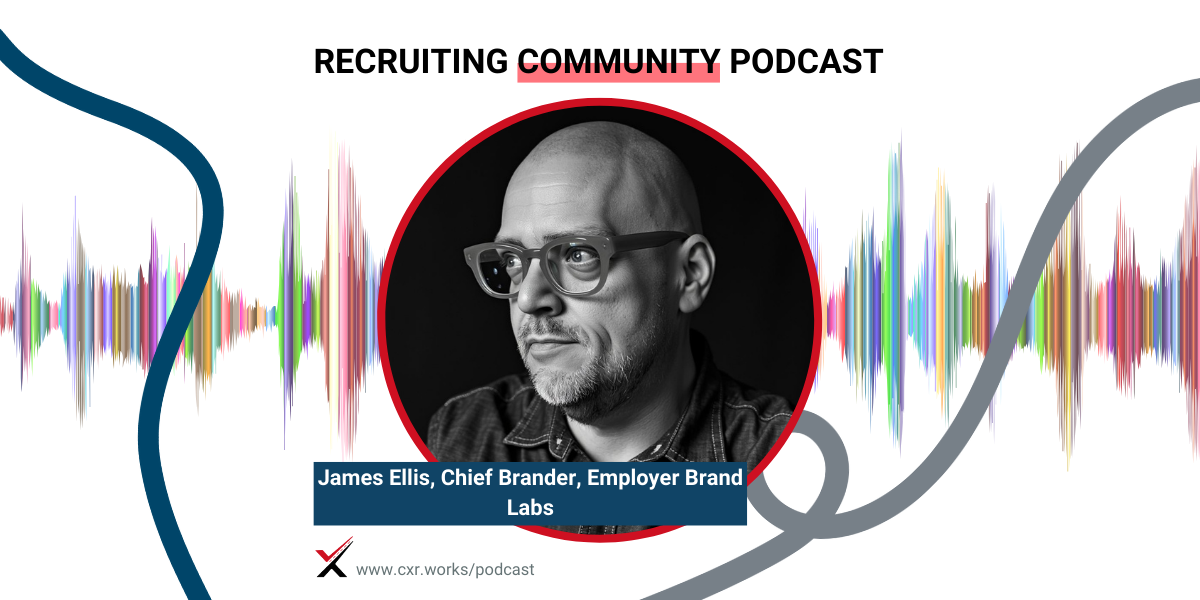
James Ellis, Author of Becoming Chewable
Hosts:
Chris Hoyt, President, CareerXroads
Gerry Crispin, Co-founder, CareerXroads
Episode Overview:
In this episode, James Ellis joins Chris Hoyt and Gerry Crispin to discuss his new book, Becoming Chewable. The conversation explores how employer branding can shift from superficial tactics to strategic influence. James outlines the importance of leveraging talent acquisition as a growth engine rather than treating it as a cost center. The discussion includes reflections on leadership mindset, recruiting inefficiencies, and how TA leaders can assert their value at the executive table.
Key Topics:
Misconceptions around employer branding and TA’s role
The difference between activity and influence in recruiting
The impact of cost center thinking on TA functions
Building leverage through a Talent P&L mindset
Collaboration between TA, marketing, HR, and branding teams
The writing process and goals behind Becoming Chewable
Notable Quotes:
“Growth starts with TA. I want TA leaders to embrace that.” – James Ellis
“I’ve never met a lazy recruiter. There are good and bad recruiters, but never lazy ones.” – James Ellis
“If business sees you as a cost center… your job is to be squeezed.” – James Ellis
“I want them to invoice the table for their time.” – James Ellis
“This is about how I move the needle of the business.” – Chris Hoyt
Takeaways:
James Ellis advocates for a fundamental shift in how talent acquisition leaders approach their work—from checking tactical boxes to building strategic leverage. His book Becoming Chewable offers a blueprint for aligning recruiting with business outcomes and influencing leadership perception. TA leaders are encouraged to challenge cost center constraints and embrace their role as drivers of business growth.
Want more conversations like this?
Subscribe to the CXR podcast and explore how top talent leaders are shaping the future of recruiting. Learn more about the CareerXroads community at cxr.works.
Chris Hoyt: I love food. I just say that as someone who’s, you know, at the beginning of the year, always trying to lose a little bit of weight here and there. I carry this extra… I was doing great pre-pandemic, and then the pandemic hit and I got stuck in Carmel for a number of months. I use the word “stuck” loosely.
I put on this 10 pounds and I’m like, “What am I gonna do with this?” And then Jerry rolls in and says, “Oh, I’m going on a James Beard road show,” where he’s cranking out as many award-winning restaurants as possible. And I’m like, you know what? Fat people look really happy. I could be a really happy fat person.
Gerry Crispin: Exactly. I’m telling you, people—Oprah has decided that overweight is a disease and it just happens. People have a certain weight they go for. And I need, you know, I need an extra 20 pounds always. So, it’s what it is.
Chris Hoyt: I have two things to that. I can’t wait for James, ’cause he is making the faces. But one, I don’t even like Oprah anymore. Can’t she just go back to her island or whatever she was doing? And two, I agree. We all have, I think, an idle weight that we don’t really have to manage. Getting comfortable with that is harder as you get older.
Gerry Crispin: You’ve gotta accept it. And the point is, the experience of life is probably the most important thing. So yeah, in three days I’ll be going to New Orleans for four days. About four or five folks are coming with me, including a couple of our members and my daughter.
I gave my daughter—who’s 47 and has never been to New Orleans—this trip. There are 22 James Beard Award-winning restaurants in New Orleans, and that’s all we’re going to.
Chris Hoyt: James, have you been to a—your brother from another mother—the other James, have you been to any of his restaurants before?
James Ellis: Not too many. But honestly, you cannot swing a dead cat without hitting delicious food in New Orleans. The sandwich shops are to die for. You don’t even need to worry about Michelin Stars or James Beard’s order. Anybody saying “bam.”
Chris Hoyt: Oh yeah. And I’m going to transition smoothly from award-winning beignets to dead cats.
James, I had this conversation with my wife just like a week ago. She said, “You can’t swing a cat without hitting anything.” And I said, “No, it’s a dead cat.” We got into this big debate and she went real quiet when I said, “Have you ever tried to swing a cat by its tail? Nobody can swing a live cat by the tail. Dead cat? Anybody can swing that.” Is your stance dead cat?
James Ellis: See, first off, you’ve done the research yourself, and I appreciate that level of dedication—to try and swing cats, and then to try and find a dead cat to swing. So, sir, hats off to you. This is going to be a heck of a podcast for anybody listening. Just welcome to the Dead Cat Podcast.
Chris Hoyt: I like that. James Ellis Talks Dead Cats—a new book.
James Ellis: What a headline! Smash that button, kids. It’s time to talk dead cats.
Chris Hoyt: Like and subscribe. At least we’re not talking about skinning cats.
James Ellis: Oh goodness. It’s biology class all over again.
Chris Hoyt: Apparently there’s a thousand different ways, but all right, so let’s jump in. You guys ready?
Announcer: We haven’t already?
Chris Hoyt: I think we’re ready. Let’s run the bumper.
Announcer: Welcome to the Recruiting Community Podcast, the go-to channel for talent acquisition leaders and practitioners. This show is brought to you by CXR, a trusted community of thousands connecting the best minds in the industry to explore topics like attracting, engaging, and retaining top talent. Hosted by Chris Hoyt and Jerry Crispin, we are thrilled to have you join the conversation.
Chris Hoyt: Welcome to the Recruiting Community Podcast. I’m Chris Hoyt, President of CXR. I’m here with Jerry Crispin, co-founder of CareerXroads. Hello, Jerry.
Gerry Crispin: Hello.
Chris Hoyt: We are the hosts of this podcast. Ideally, we think we’re bringing you industry insights and updates in the form of fun conversations. You may not crack a smile—most of the laughs are just for us anyway. But the idea here is that it’s all brought to you by the CareerXroads, the CXR community. We’re pulling together people who are doing really cool work.
We’re streaming on YouTube, Facebook, LinkedIn, and a couple of other places. You can check us out at cxr.works/podcast. You’re going to be able to see past and future episodes and check out the new design that went in late last year. We’ve got well over 500 interviews with TA leaders, practitioners, and, like our guest today, folks who are doing really interesting work and having an impact on the space.
You’ll also find easy ways to like and subscribe—help make us internet famous. And one last reminder: this is an ad-free labor of love. Nobody paid to be on this show or to be interviewed. We’re calling people in because they’re doing really good work.
Which brings us to today’s conversation. Jerry and I were just talking about this a couple days ago. Today’s guest is James Ellis, author of a new book called Becoming Chewable. I know we’re going to talk a little bit about the book, but what I want to drive home right out of the gate is—Jerry, tell me if you agree—this is not a book about employer branding tactics or career site upgrades.
This is more like wiping the cobwebs away and taking a real look at how people actually decide where to work, and why most companies struggle to influence those decisions in meaningful ways. Repelling is a good strategy too, obviously.
James, I think, is going to challenge TA leaders to stop optimizing motion and start building real leverage by understanding trade-offs and alignment. It’s going to be really exciting to talk to him today.
James, why don’t you say hello and give us an escalator pitch of what you’ve got going on?
James Ellis: You did all the work for me. This is the best podcast ever. I just show up, bring my pretty face—such as it is—and Chris and Jerry talk for me. It’s like magic. You don’t even see my lips move.
Chris Hoyt: It’s a gift. Truly.
James Ellis: Thanks, guys. This isn’t my first time on this podcast, but I’ll quickly reintroduce myself. I’m James Ellis. I do employer branding, primarily for businesses that are generally considered too small, too boring, too dull, or too regulated to do employer branding. I’m trying to show everyone that employer branding is for everybody—because it helps people understand how to choose you. That’s what it’s all about.
Thanks for starting with the book. We can talk about that. We can talk about whatever—dead cats—it’s really up to you. This is your podcast. I am not in charge.
Chris Hoyt: That’s a sweet-looking cover. The book was a pleasure to read, by the way. I think you make a case—and we’ll dig in—but you’re saying TA teams don’t lack effort, they lack leverage.
So my first question is, where do you see leaders confusing activity and influence? And is there a mindset shift they need to make to move past that?
James Ellis: Look, to be perfectly clear, I’ve never met a lazy recruiter. There are good and bad recruiters, but never lazy ones. They’re always working—LinkedIn on one eye, Netflix on the other.
Recruiters often learn their skills from someone else who learned it from someone else—there’s no real curriculum or “these are the five books every recruiter must read” sort of structure.
So I said, what if we started fresh and thought first about what candidates want, how they think, how they perceive things? What would change?
Chris Hoyt: Well, and that’s one of the reasons why I enjoyed reading the book that you wrote. This really wasn’t about republishing work you’ve already done or reminders. There are some of those in there, but I think they serve a purpose.
From a TA leader’s perspective, this is about how I move the needle of the business—not just “how do I come up with a new EVP?” or “should I run another survey?” Those things are important, and we have to do them, but I loved reading this with a TA leader’s mindset. This gets me more mic time at the table. This gets me into those bigger conversations around how my function influenced the stock price, how my function moved JVs forward—that sort of thing. I think that’s a really huge and powerful takeaway.
Gerry Crispin: I assume you’re open to talking about your book to individual companies and helping to upskill their recruiters—so they’re using the book to actually do some of these things?
James Ellis: I mean, it is a leap. It’s tough to say, “Hey, we’ve been taught to stay in this box, to stay in this lane, to be boring, to load 17,000 bullets on a job posting and run it through ChatGPT,” or whatever tool of the day. We’ve been told to stay in our lane because leadership has repeatedly told us we’re an administrative function. We’re a cost center.
I can’t believe we made it this far into the conversation before saying “cost center.” That’s a record.
Chris Hoyt: Four minutes before somebody said “AI.”
James Ellis: Yeah! Lots of records being broken here. But look—if business sees you as a cost center—and I have an MBA, which I’m not necessarily proud of, but I’ve got it—I know the job of a cost center is to be squeezed. Leadership asks, “How do I meet the basic threshold at the smallest possible price?”
And that’s what TA leaders have been feeling every single day—when you ask for budget and get 80% back. When the place is on fire and you don’t get the support. When you’re the last to know that a new office is opening in Tulsa and you’ve got to hire 27 salespeople tomorrow.
That’s because you’re a cost center. This book was written with the belief that all business growth starts with talent acquisition. If you don’t hire them, if you didn’t attract them, if you didn’t tell them the right story, then the people inventing features, selling services, doing the marketing—none of them would be there. They’d be somewhere else.
Growth starts with TA. I want TA leaders to embrace that. I don’t want them to just have a seat at the table. I want them to invoice the table for their time.
I want them to say, “I am a business grower. This is what I do. I brought these people in. Without me, you just have seat fillers.”
And that’s where TA needs to be. And as an employer brander, I’m not supposed to say that. I’m supposed to stay in my box—make pretty little career sites, polish up taglines, write job posts.
But all of this—TA, HR, employer brand, marketing, comms, social—should work together. There’s only one company. Let’s work together to do amazing things. Let’s not get squeezed into cost center boxes.
Chris Hoyt: I love it. Well, James, where do we send everybody for the book? Do we send them to your website? To Amazon?
James Ellis: Let’s not send them up the Amazon. That’s a whole different thing—and a higher price tag. Just go to Amazon. It’s available in paperback or ebook. Thanks, Jerry, for showing that cover.
This one was a labor of love. I worked on it for two years. I had the title two years ago, but I wanted to make sure it was presented in a way where people would go, “Oh, that’s a whole different way of thinking.” I want TA leaders to get their seat at the table. I want them to grow the company. And if I can help with that, that’s what I’m going to do.
Chris Hoyt: I think the timing is just right, given the leaders we’ve been talking to and what they’ve got ahead of them this year. I think it’s perfect timing. It’s a must-read in your recruiting library—especially at the head of TA level.
We usually ask everybody at the end: if you were going to write a book, what would the title be? I think we know your answer, but I’ll let you choose.
James Ellis: No, I can answer that. Because here’s the broken part of my brain—and anyone who knows me will go, “Oh, there are many of those.”
I’m always coming up with book titles and ideas. If I had to write another book right now, it would be called Talent P&L.
Everybody needs to build a Talent P&L. Every TA leader, every recruiter needs to think in terms of a talent profit and loss—because that is where the lever is that’s going to open the doors we want to open.
Chris Hoyt: I love it. All right. James, thank you. I know you’re super busy and this is your virtual book tour. We really appreciate you being here.
James Ellis: Thrilled to be here.
Chris Hoyt: Thanks again for writing the book.
James Ellis: No, thank you for writing the preface. I was thrilled when you agreed—like a sucker—and you said some nice things, which I know you had to work extra hard to figure out. I appreciate it. So if you don’t want to read it for me, read it for Chris. He wrote something nice.
Chris Hoyt: I think it’s worth a read. Like I said, I think it’s a must-have—especially at the leadership level.
All right. That’s going to do it for the show. Quick reminder: visit cxr.works/podcast to check out past and future episodes, and where you can like, subscribe, and do all the things.
James, thanks again, and we’ll see everybody next week.
Announcer: Thanks for listening to the Recruiting Community Podcast, where talent acquisition leaders connect, learn, and grow together.
Be sure to visit cxr.works/podcast to explore past episodes, see what’s coming up next, and find out how you can join the conversation. Whether you’ve got insights to share or want to be a guest on the show—we’d love to hear from you.
If you’re interested in learning more about becoming a member of the CXR community, visit us at www.cxr.works
.
We’ll catch you in the next episode.
How did Cox Enterprises reimagine their career site using data, AI, and social-first content? Adam Glassman shares lessons from their ground-up rebuild.