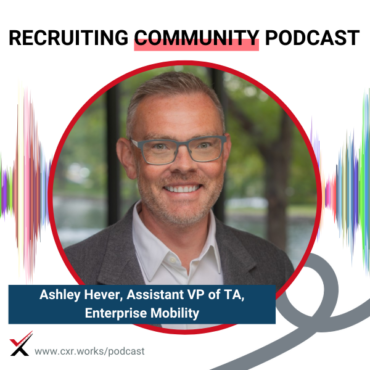
Embedding Mobility and Mentorship at Enterprise
How does Enterprise Mobility turn entry-level roles into long-term careers? Ashley Hever shares how mentorship, mobility, and values drive retention and growth.
 play_arrow
The Global Recruiting Puzzle: Influence, Credibility & Complexity Cami Grace
 play_arrow
How Curiosity Shaped a Career in TA: Carmen Hudson’s Career Crossroads Cami Grace
 play_arrow
Proving TA’s Value: Sourcing’s Role in Revenue Growth Cami Grace
 play_arrow
Talent Chooses You: Reframing the Role of TA in Driving Growth Cami Grace
Featured Guests:
Koos Wurzer, Head of the Center of Expertise for Talent Acquisition and Employer Branding, Danone
Hosts:
Gerry Crispin, Co-Founder, CareerXroads
Episode Overview:
Koos Wurzer of Danone joins Gerry Crispin to discuss how his global TA team launched “Talent Acquisition Week,” a company-wide initiative designed to boost recruiter engagement and drive strategic talent practices. Koos shares his journey from staffing to in-house leadership and reflects on balancing global tech implementation with local needs. The conversation also touches on challenges in candidate experience, proactive recruiting, and strategic workforce alignment.
Key Topics:
Launch and impact of Danone’s Talent Acquisition Week
Building TA strategy and transitioning from reactive to proactive hiring
Implementing tools like CRM and iCIMS globally
Enhancing candidate experience with hiring manager-led communication
Career pathways in TA versus HR business partnerships
Global workforce challenges, including high-volume hiring and internal mobility
Aligning recruitment tech with broader HR and business goals
Notable Quotes:
“TA often operates from the back foot—reactively filling roles. We’re working on shifting to the front foot.” — Koos Wurzer
“The hiring manager has the biggest impact on candidate satisfaction.” — Koos Wurzer
“TA brings the outside view that’s essential.” — Gerry Crispin
“Speed matters for frontline roles, but for executive hires, you need time.” — Koos Wurzer
Takeaways:
Danone is advancing global TA by aligning tools, training, and strategy through initiatives like Talent Acquisition Week. Koos emphasizes the importance of giving recruiters exposure to new ideas and building proactive systems that reflect both business needs and candidate expectations. A key focus is empowering hiring managers to improve candidate interactions and support better hiring outcomes.
Want more conversations like this?
Subscribe to the CXR podcast and explore how top talent leaders are shaping the future of recruiting. Learn more about the CareerXroads community at cxr.works.
Announcer: Welcome to the Recruiting Community Podcast, the go-to channel for talent acquisition leaders and practitioners. This show is brought to you by CXR, a trusted community of thousands connecting the best minds in the industry to explore topics like attracting, engaging, and retaining top talent. Hosted by Chris Hoyt and Jerry Crispin.
We are thrilled to have you join the conversation.
Gerry Crispin: It’s a beautiful sunny day at breakfast. We’ve got circus tents everywhere. We’ve had a good time so far. This is the second and last day. I’m Jerry Crispin, CareerXroads, and I have the pleasure of speaking with Koos Wurzer from Danone.
How close was that? Close enough?
Koos Wurzer: Close enough. It’s Koos—not “Coast”—Koos.
Gerry Crispin: Got it. Nailed it. So tell me a little bit about your role. You came in from Europe for this, and tell us a bit about Danone.
Koos Wurzer: I head up the Center of Expertise for Talent Acquisition and Employer Branding at Danone. In the U.S., it’s better known as the Dannon Company. We have three major business lines: Essential Dairy and Plant-Based, Specialized Nutrition—which includes medical and baby nutrition—and our Water and Beverages division.
Globally, we have about 90,000 employees, and our products are sold in 120 countries. Our headquarters are in Paris, with a second headquarters in Amsterdam.
Gerry Crispin: Okay.
Koos Wurzer: Due to our specialized business structure. And yes, that’s where I’m based—not just because I live there.
Gerry Crispin: So what brings you to this event in Nashville?
Koos Wurzer: I was invited to speak about our Talent Acquisition Week. This is the second year we’ve done it. You were actually one of our guests this year!
Gerry Crispin: I remember—it was so much fun.
Koos Wurzer: With our recruiting function scattered globally and a small but ambitious COE, we’re really passionate about our field and driving TA forward. This year, we had several big initiatives: a new career site, a refreshed employer brand, a new content studio, and CRM implementation—all launching around the same time. It was a bit overwhelming.
We wanted to create more impact and engagement, so we launched TA Week in 2024. We hosted daily sessions with morning and afternoon time slots to accommodate global time zones. We provided training, introduced new tools, and brought in outside speakers for fresh perspectives.
In year one, we had speakers from LinkedIn and Universum. This year, we had you, Chris from CXR, and Hung Lee. Hung actually offered to do it for free on the condition that I return the favor—so I ended up on Brainfood. Now I’m here. It’s all about helping each other out.
Gerry Crispin: I love that. One of the biggest issues for most companies is developing the people on the front lines. Heads of TA often have travel budgets and access to resources, but it’s sketchier for those in the trenches. They’re busy, doing repeatable work, and need exposure to their peers and new ideas.
That’s what I love about events like this. They’re celebrations where recruiters can come together and enjoy themselves, learn, and grow. It’s not necessarily something the C-suite attends, but it’s incredibly valuable for recruiters.
Koos Wurzer: Absolutely. In many companies, including Danone, TA is seen as an entry-level HR function. Recruiters often move on to become HR business partners, which I think is a shame. There’s so much depth in TA—employer branding, recruitment marketing, sourcing—it’s a rich field.
When I started going to conferences, it opened up a whole new world. I still love attending events like Sourcing Summit because they dive so deeply into sourcing. I wanted our whole community to experience that potential and get as inspired as I do.
Gerry Crispin: You’ve been in this space for a while. I’m always curious—how did you get into TA?
Koos Wurzer: I needed a part-time job during my bachelor’s. My girlfriend, now wife, already had a job, and we were living together. I wanted a serious, well-paying job where I could grow.
I went to one of the biggest staffing agencies near my house and said I wanted a real job, not just a summer gig. The manager misunderstood and kept suggesting summer jobs. I left thinking, “If this guy can be a branch manager, maybe I can do this too.”
Eventually, Timing, a Dutch staffing agency, had an opening. They needed someone to cover for maternity leave and float between branches. As a student, I had free public transport, so I became a plug-and-play recruiter for offices all over the Netherlands. I did that for two and a half years.
After graduation, they offered me a business development role. I never took a break—graduated on Tuesday, started working full-time on Wednesday.
Gerry Crispin: So you spent several years in staffing. When did you transition to in-house recruiting?
Koos Wurzer: After the business development role, I joined a smaller recruiting firm started by former colleagues. I opened a branch in Amsterdam from scratch, which was very entrepreneurial. As the team grew, I missed the hands-on setup work.
We had a client—Specsavers—where I built a sourcing model that worked really well. That experience, getting close to the operations and building strategy, sparked my interest in going in-house. Once I made the move, I never looked back.
Gerry Crispin: What’s one of the biggest challenges in leading TA?
Koos Wurzer: Right now, we’re overwhelmed with recruitment needs—90,000 employees globally means constant hiring. In some countries, like Mexico, we face high turnover due to seasonal work. We also have high internal mobility, so roles change frequently.
The biggest challenge is that TA often operates from the back foot—reactively filling roles. We’re working on shifting to the front foot. We’ve just developed our three-year TA strategy, which includes proactive sourcing, recruitment marketing, and always-on campaigns—while also streamlining and automating high-volume roles.
Gerry Crispin: I love the “back foot to front foot” metaphor. It’s going to stick with me.
Koos Wurzer: We’re also aligning with broader HR strategies like strategic workforce planning. TA needs to play where the business needs us most.
Gerry Crispin: Absolutely. Workforce planning should be business-owned, but TA must be at the center. You can’t build plans for scarce talent without knowing what’s actually possible. TA brings the outside view that’s essential.
Koos Wurzer: And culturally, different regions have very different expectations. You need local expertise to get it right.
Gerry Crispin: Balancing a global recruiting force must be like a magic trick.
Koos Wurzer: It is. When we implemented iCIMS, we created a global process adaptable to all kinds of recruitment. But automation affects people differently. Speed matters for frontline roles, but for executive hires, you need time.
Gerry Crispin: The key is aligning tech with strategy—don’t let tools drive a flawed process. Ask what “good” looks like, then find the right tech to support that.
Koos Wurzer: And consider the candidate’s experience too. It’s easy to focus on what AI can do for us, but we have to think about what candidates want. AI video interviews might be great for us, but if candidates won’t complete them, we lose.
Gerry Crispin: Speaking of candidate experience—you’re passionate about it. If you had a magic wand, what would you do to elevate it?
Koos Wurzer: We relaunched our candidate experience this year. A few years ago, we found that the hiring manager has the biggest impact on candidate satisfaction. So, if I had a magic wand, I’d create a scalable way to connect hiring managers with candidates early—maybe short videos introducing the role and asking candidates for feedback.
This kind of exchange would give both sides deeper context and help candidates self-select out if it’s not a fit. It saves time for everyone.
Gerry Crispin: I love that. I wish I could put an earpiece in hiring managers during interviews—like that old Steve Martin movie—prompting them to ask better questions.
Koos Wurzer: That sounds like a good movie plot! We should write that script.
Gerry Crispin: Let’s do it. Thanks, Koos. It’s been a real pleasure.
Koos Wurzer: Thanks for having me. I really enjoyed it.
Announcer: Thanks for listening to the Recruiting Community Podcast, where talent acquisition leaders connect, learn, and grow together. Be sure to visit cxr.works/podcast to explore past episodes, see what’s coming up next, and find out how you can join the conversation.
Whether you’ve got insights to share or want to be a guest on the show, we’d love to hear from you. If you’re interested in learning more about becoming a member of the CXR community, visit us at www.cxr.works. We’ll catch you in the next episode.
How does Enterprise Mobility turn entry-level roles into long-term careers? Ashley Hever shares how mentorship, mobility, and values drive retention and growth.