
CXR Recruiting Awards Finalist: Assurant
Excerpt for WordPress: How did a TA team build a six-figure AI recruiting suite for under $500? Assurant’s VP of Global TA shares how they saved thousands of hours—and reinvested […]
 play_arrow
The AI Talent Race Cami Grace
 play_arrow
Built for Change: Tracey Friend’s Career Crossroads Cami Grace
 play_arrow
 play_arrow
Featured Guests:
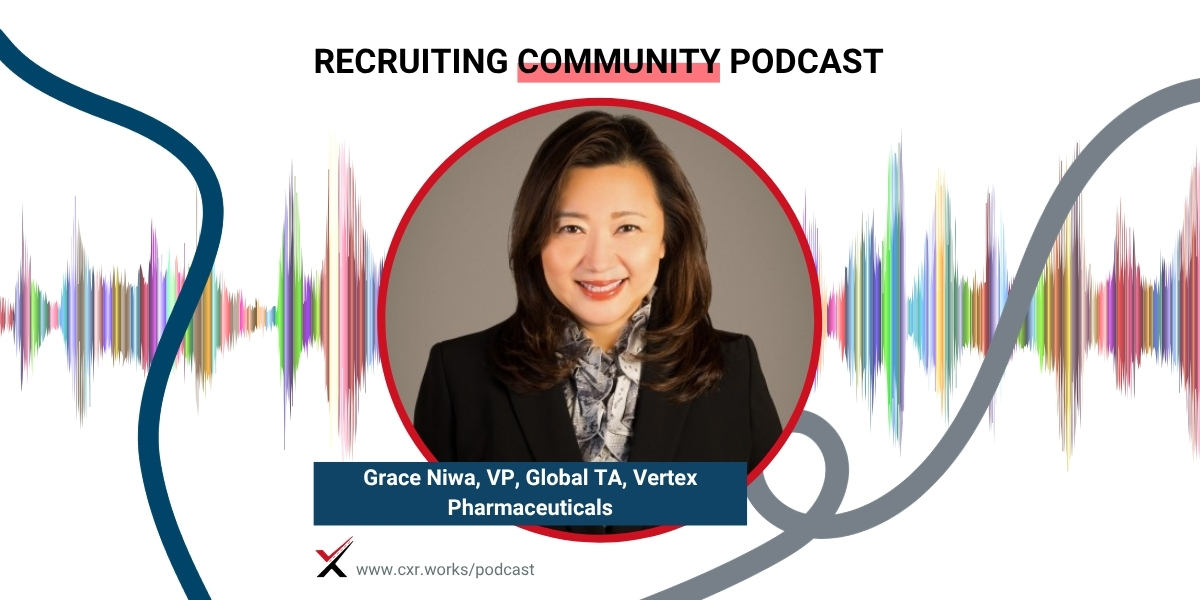
Grace Niwa, Global Talent Acquisition Leader, Vertex Pharmaceuticals
Hosts:
Chris Hoyt, President, CXR
Gerry Crispin, Co-founder, Career Crossroads
Episode Overview:
Chris Hoyt and Gerry Crispin talk with Grace Niwa, who leads global talent acquisition at Vertex Pharmaceuticals, about scaling executive hiring from roughly 12 to 40 VP-plus hires per year with a lean team of two to three recruiters. Niwa describes her career path from Juilliard-trained pianist to nonprofit founder to executive search to biotech TA leadership at Biogen and now Vertex. The conversation covers how Vertex restructured executive recruiting into a portfolio-management approach as the company expanded from cystic fibrosis into new disease areas, the rigorous intake and alignment process she built, the role of talent intelligence and succession planning, the “a maybe is a no” philosophy, calibration across simultaneous searches, and the skills she looks for in recruiters, including adaptability and learning agility.
Key Topics:
Grace Niwa’s career path: piano performance at Juilliard, nonprofit founder, executive search at Heidrick & Struggles, private equity with Warburg Pincus, Biogen, and now Vertex
Vertex’s scale: $120 billion market cap with about 6,700 employees, compared to larger competitors with similar market caps
Expansion beyond cystic fibrosis into non-opioid pain and kidney disease, requiring new commercial and research infrastructure
Shift from one-off executive searches to a “portfolio approach” to recruitment
Partnering closely with an external executive search firm embedded in the process
Creating a rigorous intake process, described as a “needs assessment form on steroids,” to solve misalignment between hiring panels and final decision-makers
The philosophy that “a maybe is a no”
Leaders expected to act as advocates and ambassadors for candidates throughout the process
Building an internal SharePoint-based talent intelligence agent for competitive and regulatory landscape data
Treating open roles like succession planning, including tracking retirement risk and capability gaps
Vertex’s time to fill for executives (126 days) versus industry standard (168 days)
Requirement that VP-plus scientists work on-site five days a week, and relocation/flexibility as ongoing challenges
Policy of hiring only sitting VPs into VP roles, not promoting EDs
Weekly team meetings and rigorous six-person interview panels, case studies, and reference checks
Prioritization of CEO-critical Executive Committee hires tied to board presentations and company bonus
Skills Niwa looks for in recruiters: adaptability, learning agility, data orientation, and comfort using AI tools
The evolving skill set for recruiters managing AI/agentic tools while remaining human-in-the-loop
Notable Quotes:
“Every hire counts for us.” — Grace Niwa
“Misalignment is the root of all evil.” — Grace Niwa
“A maybe is a no.” — Grace Niwa
“For me, that’s when I realized recruiting is leadership.” — Grace Niwa
“We are no longer recruiting — we are competing.” — Grace Niwa
“I don’t see human-in-the-loop coming out of recruiting anytime in the foreseeable future — it’s just a new delivery of our craft.” — Chris Hoyt
Takeaways:
Vertex Pharmaceuticals scaled executive hiring dramatically by shifting from one-off searches to a portfolio-management model, anchored by a rigorous upfront alignment process and close partnership with an external search firm. Grace Niwa emphasized that recruiting success at the executive level depends on leader advocacy, disciplined calibration across simultaneous searches, and treating every open role as part of ongoing succession planning. She pointed to adaptability and learning agility as the most important traits for recruiters navigating a landscape increasingly shaped by AI tools and competitive, offer-heavy candidate markets.
Want more conversations like this?
Subscribe to the CXR podcast and explore how top talent leaders are shaping the future of recruiting. Learn more about the CareerXroads community at cxr.works.
Chris Hoyt: We’re back, we’re back, we’re back. Welcome to the Recruiting Community Podcast. I am Chris Hoyt, president of CXR and your host of this podcast, along with my brother from another mother, Gerry Crispin, co-founder of Career Crossroads. Gerry, how are you today?
Gerry Crispin: I’m really good, actually. It’s a lovely day, the sun is out, it’s got a lot of promise, so I’m good.
Chris Hoyt: A high-potential day.
Gerry Crispin: Yep.
Chris Hoyt: For those who haven’t dialed in before, we do our best here to bring you industry insights and updates in the form of a fun conversation. It’ll at least be fun for us and our guest, but ideally all of this is brought to you by the CXR Career Crossroads community.
Today I’m pretty excited. We’re talking to one of our members, Grace Niwa, who leads the global talent acquisition team over at Vertex Pharmaceuticals. I’m not trying to be overly excited about this, but this is kind of a really cool thing. You’re talking about a lean team here today — two or three recruiters that have scaled VP-plus hiring from something like 12 a year up to as many as 40. We’ll get the numbers from Grace to verify. I’m not a math guy, but that’s like 100 senior hires in a handful of years.
What I love is that they’re running executive recruiting as though it’s a portfolio function, not this “pile of reqs” approach that a lot of people seem stuck in. Fun fact: she’s a former Juilliard-trained pianist — I bet you didn’t know that, Gerry — and a Flagship Pioneering and Biogen alum. I think she’s probably one of the sharpest thinkers on talent intelligence in the industry, and she’s certainly a kindred spirit for me when it comes to rockstar hire requests. Hopefully we’ll get to that. But we’re going to welcome her in just a second.
A few things before we jump in: we’re streaming on LinkedIn, YouTube, and Facebook. Actually, I don’t know why we’re on Facebook — that’s not my favorite platform, Gerry.
Gerry Crispin: I like it.
Chris Hoyt: You like it? I’ll tell you what — if you’re listening to us on Facebook, tell us, and if people don’t tell us, we’re just going to stop being on Facebook. We’ll see where that goes.
But regardless of where you’re listening, you can check us out at cxr.works/podcast. You’ll find hundreds of interviews we’ve done with wildly impressive TA leaders and practitioners, both on the vendor side and the practitioner side, all doing really interesting work that touches how we attract and recruit talent, as well as how we manage and lead global recruiting teams. You’ll also find an easy way to like and subscribe, and let us know if you want to be part of the conversation or if there’s someone you think we should invite.
The last thing I’ll say before we jump in: this is an ad-free labor of love. Nobody pays to be on the show, you’re not going to get 20 minutes of ads with five minutes of conversation, and we certainly don’t pay anybody to be on the show.
With all that, I’m ready to jump in. Gerry, are you ready?
Gerry Crispin: Let’s do it.
Announcer: Welcome to the Recruiting Community Podcast, the go-to channel for talent acquisition leaders and practitioners. This show is brought to you by CXR, a trusted community of thousands connecting the best minds in the industry to explore topics like attracting, engaging, and retaining top talent. Hosted by Chris Hoyt and Gerry Crispin, we’re thrilled to have you join the conversation.
Chris Hoyt: Grace, welcome.
Grace Niwa: Thank you so much. Thank you, Chris and Gerry, for inviting me. I really appreciate it.
Chris Hoyt: I’m happy to have you. It’s your first time on the show.
Grace Niwa: Yes, very much so. And you should get off Facebook.
Chris Hoyt: I should? Are you off Facebook?
Grace Niwa: I am off Facebook. I don’t look at it anymore.
Chris Hoyt: Oh, I can’t. That’s a whole other conversation.
Grace, for those who haven’t had the pleasure of meeting you — I put a couple of teasers in our intro, some fun facts folks may not know about you if they don’t follow you or keep up with you on Unleash or the other podcasts you’ve been on. For anybody who hasn’t met Grace, give us the elevator pitch. Who is Grace? What does she do? Why should we be listening?
Grace Niwa: Sure, thank you so much. I’d say I’m in the third part of my career. I started as a pianist since age four, was very serious about it, and ended up doing my master’s in piano performance at Juilliard. After some life circumstances, I figured out I probably wasn’t going to make much money doing that, so I decided to pivot.
One thing I did was create a nonprofit. I went to a mentor’s friend, who introduced me to a guy at Anheuser-Busch, and I asked him for $2,000 and some free beer for an after party. He gave me a project — a health mobile that parked outside a supermarket to invite nurses and doctors to give free cholesterol and blood sugar screenings. That one project became a client for 13 years. So I went from piano to beer, got that one client, and then picked up others like Disney, Wells Fargo, and more. The lesson learned was: you do scary things, and after you’ve performed in front of 3,000 people, nothing else seems as scary. So I went bullish on creating my own company with that one anchor client.
After 13 years of that, I asked my mentor, “What should I do next? How do I transfer my skills?” She said, “You should talk to my sister,” who turned out to be the vice chairman of Heidrick & Struggles. That introduced me to executive search. Pitching stories to the Today Show or the Wall Street Journal is very similar to pitching stories to candidates — the skills transferred. My first search was finding a chief philanthropy officer for the Nature Conservancy. I did that in three months, and it launched a whole new career.
I worked with her, then moved into private equity with Warburg Pincus, and since I was in Boston, biotech and pharma were in my neighborhood. I got a job at Biogen, and that started my career in biotech — I never left, because for me the marriage of really working for the patient with the mission of getting the right talent in to help patients at the end of the day was very meaningful. I’ve been in this industry for about 12 years now, leading TA, and it’s been an incredible experience. That’s how I ended up at Vertex doing very similar work.
Gerry Crispin: Great story.
Grace Niwa: You never know where you’re going to end up.
Chris Hoyt: Nobody starts out saying, “I want to be a recruiter.”
Grace Niwa: No, nobody does.
Chris Hoyt: Let’s talk about Vertex. I want to find the moment everything sort of changed. At some point you looked at executive hiring and decided it couldn’t keep running as these one-off searches. What did you see, and what was the pitch — not just to leadership, but to your peers — to do something different?
Grace Niwa: Vertex is $120 billion in market cap, but we only have about 6,700 people. If you look at BMS or GSK, they have a similar market cap but 33,000 people. So every hire counts for us. Executive hiring is a different animal, and it required us to do more.
Thinking about the talent we have to bring in is different, and how they have to do their work is also different. We’re known for cystic fibrosis — we meet 90% of that patient market — but we’re now moving into competitive diseases we’d never dealt with before, and very different diseases too. For cystic fibrosis, you only needed 16 salespeople. Now we’re going into non-opioid pain, which means mass market — hundreds of salespeople to hire. Then kidney disease, also hundreds of people. So the infrastructure we had to build to meet that demand was a whole other challenge.
We didn’t have that skill set internally, so we had to hire people from outside who’d already seen that movie. It looked like we were hiring 10 executives in the commercial space alone, plus new EC members — a new chief commercial officer, a new chief scientific officer — who then had to rebuild their own leadership teams. So we needed 10 here in research, 10 there in commercial. It became more of a portfolio approach to recruitment, and honestly, we didn’t know what was coming. It was almost just-in-time recruiting with no time to plan.
Part of the solution was bringing in an external firm deeply rooted in those areas, who’d done this with other companies. We anchored in with one for research, built a very close relationship with them, and embedded my team in that process. Operations also had to be precise and pristine — we had to move so quickly that if we talked to a candidate, they were often on-site within two to three weeks. We couldn’t wait a month or two; the need was too dire. So candidate experience and operations had to be exceptional.
We had to get the right firms in place and make sure alignment was upfront — the rigor had to be there. I created an intake form I call a “needs assessment form on steroids,” because misalignment is the root of all evil, as John Vaselica would say. It was a problem for us: we’d go through the entire process, the panel would say yes, and then the CEO — who does the final interview for all our hires — would say no. I’d think, “What’s happening? Why isn’t this aligned?”
So I said, “I’m going to create something so rigorous at the beginning that it causes pain, but we have to get it right up front — slow to go fast.” We built a role analysis and candidate profile analysis. It was painful, but if we hadn’t done that at the beginning, we wouldn’t have gotten it right at the end.
The other part was that leaders had to become more involved and act as advocates. If they weren’t willing to advocate for a candidate, I said, “Then they’re wrong — we’re not moving forward.” For me, that’s when I realized recruiting is leadership. Leaders have to make decisions on people, and they also have to become ambassadors of the company. No matter whether the person is right or wrong for the role, every candidate should leave those interviews feeling like they want to come to Vertex. That wasn’t always the case — some interviewers were at a different maturity level, and we sometimes lost candidates because of it. There was a lot of coaching, and a lot of my own participation, pushing on decisions when I could tell there was hemming and hawing over someone I already knew was the right person.
Chris Hoyt: What I hear woven into that is this stance of “a maybe is a no.”
Grace Niwa: Yes, absolutely. A maybe is a no. We have to help them make these decisions — why are they hemming and hawing? When that’s happening, it’s a no. Let’s move on.
Chris Hoyt: I mentioned the portfolio management stance in the intro. Can you share what that actually means day to day for your team? When a VP role opens up tomorrow, what’s already been done before that req even exists?
Grace Niwa: We do a lot of what you were talking about earlier — talent intelligence. That was my first hire when I got here. I come from a research-based approach to recruiting; I don’t understand how to recruit unless I understand the supply and demand of talent and the environment I’m recruiting in. I believe that’s true not just for exec search, but for how all of TA should operate — and with AI, that’s how they should all be operating anyway, as talent advisors.
We’ve created an agent you can go into on our SharePoint site and ask, “I need to understand the competitive regulatory landscape,” and it’ll give you all the data from the work we’ve done in that space. We work closely with our competitive intelligence function within commercial — they understand the companies from one standpoint, we understand talent from another. You need to understand what the talent looks like on the ground, what they care about, who they are, because that’s the value you bring to the business.
We try to treat every open role almost like succession planning: knowing, with HR business partners and talent management, what the critical roles are, where retirement potential lies in the next year or two, where the capability gaps are from an exec search standpoint, and having those conversations. Whenever we see talent come through, or look at a pipeline from a search firm, we keep all of that in the back of our heads — thinking, “Our leader should be having coffee with that person now, because we know they might retire in a year or two.”
Chris Hoyt: I love that. You’ve mentioned three to four times the hires with the same handful of recruiters — that’s a ratio that’s going to make some people’s eyes water.
Grace Niwa: I know, and I realize that, but I’ve always operated this way. It’s not for the weak, I’ll tell you that — I’m very intense when it comes to this work. Most people run this kind of volume with eight or nine people. But I think if you work this way, you can get things done faster — though the operations have to be tight, and you have to be really organized to pull it off. It’s pretty intense the way we run.
Chris Hoyt: I think that’s admirable. I’m curious what you had to standardize — and maybe more interesting, where you drew a line and refused to standardize.
Grace Niwa: For us, the biggest challenge is around relocation and flexibility. That sits at the executive level — if we had more flexibility there, this would be easier. All scientists at the VP-plus level have to be here five days a week because they’re in the lab; that’s our culture. If we didn’t have that requirement, we could hire even faster.
Our time to fill for executives is 126 days; the industry standard is 168. So we’re already faster, but the business wants it even faster because we’re at a pace of launch after launch — commercial launches driving urgency. I keep saying, “Then loosen up the flexibility, loosen up the relocation requirement, or open an office where they already live.” Moving people to Boston is difficult.
Gerry Crispin: Grace, are you using external sources like executive search firms?
Grace Niwa: Yes, we are, and we ask for their take too, because here’s another challenge — we hire people laterally. You have to be a sitting VP to come here; we don’t hire EDs into VP roles, because we need people who’ve seen the movie before. You wouldn’t be able to handle our environment otherwise. So we need sitting VPs, honestly, and that’s unusual.
Gerry Crispin: That’s a piece of succession planning — movement toward leadership in a variety of places. That’s fascinating from my perspective.
Grace Niwa: It is. The search firms say the same thing — that it’s not typically what they see.
Chris Hoyt: I want to come back to succession planning, but first I want to double down on calibration. When you’re hiring, say, a VP of research and a VP of commercial in the same month or quarter, how is your team keeping the bar consistent? How are you keeping hiring managers and lines of business honest against the framework you’ve built?
Grace Niwa: We meet weekly — the search firms want to do biweekly, but we don’t. We’re in the market constantly, pipelining and bringing people through the door; people pick up the phone with us all the time. The attraction part isn’t really the issue. It’s more the relocation and flexibility piece, and then fit. Fit is the issue — you can check every other box, but will they actually make it here, given the rigor and intensity of this place? We’ll have 13 launches by 2030. That’s the real challenge, and all of our leaders know it. So to me, that’s the bigger question, versus attraction — we have enough people wanting to come here.
Chris Hoyt: There’s an interesting piece in there. You’ve got standardization and a framework built out, which begs the question: where does human judgment sit within that framework? Does the calibration ever flatten out the ability to spot an unconventional hire? I think we’ve heard you on the record talking about chasing “rockstar” hires.
Grace Niwa: Makes sense. After the interview panel — which has up to six people — we have a debrief that everybody has to attend. We’re very rigorous in our process. We don’t skip anything external, and we do case studies, which are a big deal for us because they show whether someone has the intellectual horsepower and scientific prowess we’re looking for. Sometimes the CSO or chief commercial officer will even attend, and those are the things that help us with the assessment. We also do references — our leaders take at least two, I do a couple myself, and other leaders do as well. There’s rigor around all of it, and the search firm does some references too if we have one engaged.
Chris Hoyt: Let’s go back a bit. You’re carrying succession planning at the VP-and-up level, but building a bench for roles that don’t even exist yet, all while ad hoc reqs keep stacking up. How is this small, mighty team protecting that long-horizon work when the short-term requests never stop?
Grace Niwa: That’s the challenge. We don’t take on everything — we can’t, given the size of the team. It has to be truly critical, and they have to give us time. Right now, at this time of year, we’ve focused on the EC hires — the CEO-critical hires that matter to the board. The CEO chooses about 12 of them at the start of the year, and we have to get those done by year end. They actually affect our company bonus, so, no pressure. Those are the ones she presents to the board.
For the others, we do our best, but those are the priority. Then there are roles where we have more room — where we know a retirement may be coming, or the CHRO and EC tell us to start looking, and give us a timeline. We’re constantly reprioritizing based on that.
Chris Hoyt: You never rest — it’s always in motion.
Grace Niwa: It’s always in motion because of where we are in the business. Every week I hear, “Okay, here’s something else coming in — reprioritize.” That’s how we know.
Chris Hoyt: It seems like “more with less” has become a TA mantra for many — there ought to be T-shirts and coffee mugs handed out when you enter this industry. So, same question: at 100-plus VP hires, what do you know now that you didn’t at hire number 10? For a TA leader listening who has one recruiter and a mandate to do more with less, where should they double down starting Monday morning?
Grace Niwa: The type of recruiter you need is one who’s very adaptable and agile — operational, data-oriented, and able to use AI or any of the ChatGPTs to work faster and tell a story. I have two recruiters like that right now, and they’re very adaptable. They come to me for advice constantly. The biggest challenge is that sometimes they don’t trust their own judgment — and I never give them the answer, because I want them to learn to trust it, especially since they’re new to the industry and to their roles. I hired them because I knew they could do it; I saw the agility.
Agility, I think, is the most important thing. They’ll learn the rest — they’ve been able to get up to speed very quickly and understand what it’s like to work in-house. I can teach the rest, but if the agility isn’t there, it’s hard.
Chris Hoyt: We used to talk about learning agility for candidates all the time, and I think in just the last year, with the idea of managing agents and being the orchestrator — the ultimate sign-off on a lot of this work — it’s become a different skill set for recruiters that we haven’t traditionally looked for. I think it’s a new era of recruiting. You see all these takes on “here’s what happens to recruiting in five years, you won’t need this anymore,” and I’d argue 99% of the people saying that have it completely wrong. It’s a different skill set, and I don’t see human-in-the-loop coming out of recruiting anytime in the foreseeable future — it’s just a new delivery of our craft.
Grace Niwa: It’s learning agility and adaptability. If you have those two things, I see a really promising future, because every day I watch them learn from their mistakes and pivot, and it’s amazing how much they’re learning. If you have those two things, you’ve got somebody really good.
Chris Hoyt: Gerry and I have said for years there’s never really been a barrier to entry into recruiting — you don’t need a specific degree or background. But I’d argue this new skill set is becoming a soft barrier to entry for the recruiter of tomorrow: being able to manage and prove you’ve used the technology available today to make bigger, still human-focused decisions. It’s going to be really interesting over the next five years.
Gerry Crispin: They have to demonstrate a level of confidence to project to others — “I’m totally invested in the success of this operation, and I know I can learn whatever’s necessary for us to succeed.” Not everybody can display that, and then obviously has to walk the walk.
Chris Hoyt: A lot of arrogance gets bluffed as confidence over the years, but I think those days are winding down.
Gerry Crispin: Yeah, I see that too.
Chris Hoyt: Well, Grace, we round up the show every time by asking a question, and you don’t get off the hook: if you were going to write a book about the work you’ve done and some of the impressive stuff we’ve talked about, what would the title be?
Grace Niwa: For me, right now: we are no longer recruiting — we are competing. This isn’t about recruiting anymore. We are competing.
Chris Hoyt: Competement.
Grace Niwa: Yes.
Chris Hoyt: I like it — might also make a nice coffee mug or T-shirt.
Grace Niwa: I’m serious. That’s one of the reasons we have two candidates coming to the end now instead of just one — they’re all coming in with two to three offers.
Chris Hoyt: Yeah. Who would you give the first signed copy to? Present company excluded.
Grace Niwa: My team.
Chris Hoyt: I love it. Grace, it’s always a joy to talk to you. I know you’re insanely busy, so we’re grateful you gave us the time to catch up and share your wisdom and experience with your colleagues and peers. Thank you.
Grace Niwa: Thank you so much for inviting me. Appreciate it.
Chris Hoyt: Always. We’re looking forward to seeing your leadership in October — excited about that.
Grace Niwa: Yes, looking forward to it.
Chris Hoyt: Going to be fun. For those who missed it, go back to the start and listen — there are some really good nuggets in here. I’d encourage you to check out this and future episodes at cxr.works/podcast. Like I said earlier, hundreds of interviews with folks doing really cool work, like Grace today. Check that out, and hit subscribe so you don’t miss another episode. With that, we’ll say goodbye, and we’ll see everybody next time.
Announcer: Thanks for listening to the Recruiting Community Podcast, where talent acquisition leaders connect, learn, and grow together. Be sure to visit cxr.works/podcast to explore past episodes, see what’s coming up next, and find out how you can join the conversation. Whether you’ve got insights to share or want to be a guest on the show, we’d love to hear from you. If you’re interested in learning more about becoming a member of the CXR community, visit us at www.cxr.works. We’ll catch you in the next episode.
Excerpt for WordPress: How did a TA team build a six-figure AI recruiting suite for under $500? Assurant’s VP of Global TA shares how they saved thousands of hours—and reinvested […]