
AI, Agents, and the Future of Talent
As agents start acting—not just recommending—in hiring, Zurich’s Jessica Aguilar breaks down governance, accountability, and where AI truly delivers value.
 play_arrow
Built for Change: Tracey Friend’s Career Crossroads Cami Grace
 play_arrow
 play_arrow
 play_arrow
AI Hiring, On Trial Cami Grace
Title:
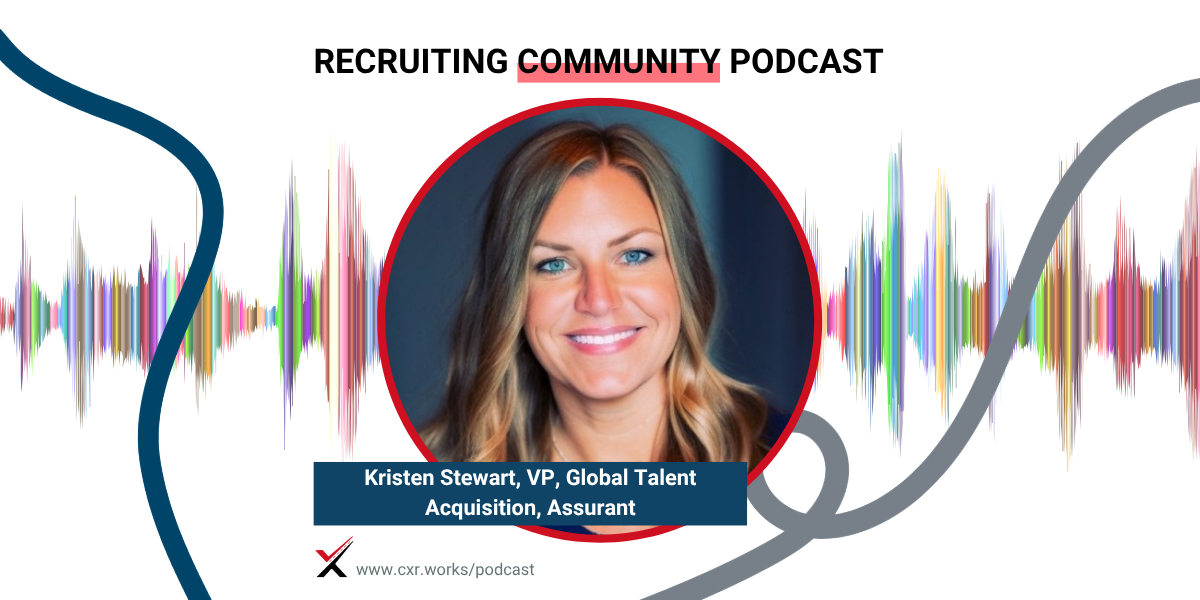
Assurant’s AI Copilot Suite Saves 3,200 Recruiting Hours
Featured Guests:
Kristen Stewart, Vice President of Global Talent Acquisition, Assurant
Hosts:
Chris Hoyt, President of CXR
Gerry Crispin, Co-founder of Career Crossroads
Episode Overview:
Chris Hoyt and Gerry Crispin speak with Kristen Stewart of Assurant, a finalist in the AI edition of the CXR Recruiting Awards, about her team’s Recruiting Co-Pilot Agent Suite. The conversation covers the origins of the project in Assurant’s “Brilliant Basics” consistency initiative, how a recruiter and an intern-turned-coordinator built the first agents in Copilot, how the tools were reviewed by Assurant’s AI governance board and legal team, and the reported time savings and downstream impact on sourcing.
Key Topics:
CXR Recruiting Awards AI edition: 23 teams submitted, three finalists presented at Marketplace Live in Louisville
Assurant’s “Brilliant Basics” program to standardize intake calls, candidate summaries, and hiring leader updates
Origin story: an intern-turned-coordinator suggested building a Copilot agent; a recruiter built it
Suite components: intake call formatting agent, candidate summary agent, candidate comparison grid agent
Built-in prompts ensuring recruiters ask future-readiness questions (e.g., technology/AI needs) during intake
Review and approval process with Assurant’s AI governance board and legal team
Human-in-the-loop principle for all hiring decisions
Budget: built for between $0–$500
Time savings: candidate summaries reduced from ~25 minutes to ~5 minutes; candidate grids reduced from ~30 minutes to ~5 minutes
Estimated 3,200–4,700 hours saved annually across the global organization
Reinvestment of saved time into direct sourcing, correlating with higher Q3 direct-sourced hires
Company-wide encouragement for employees to build their own AI solutions to team-identified problems
Future plans: usage data tracking, a LinkedIn sourcing bot in testing, and interest in recruitment marketing and offer letter bots
Notable Quotes:
“The one thing I love about all of these is the extent to which recruiting professionals are upskilling themselves in the use of AI and applying that to how we improve recruiting.” — Gerry Crispin
“This was created for recruiters, by recruiters.” — Kristen Stewart
“We will always have a human in the loop when making a hiring decision.” — Kristen Stewart
“It’s so easy that if you’re not doing this, you’re wasting time.” — Kristen Stewart
Takeaways:
Assurant’s talent acquisition team built a suite of Copilot-based recruiting agents in-house, on a near-zero budget, addressing inconsistency in intake calls, candidate summaries, and hiring leader communication. The tools were developed by frontline recruiters and reviewed by the company’s AI governance board and legal team, with a stated commitment to keeping humans in the loop for hiring decisions. The team estimates 3,200–4,700 hours saved annually, time that has been redirected toward candidate sourcing.
Want more conversations like this?
Subscribe to the CXR podcast and explore how top talent leaders are shaping the future of recruiting. Learn more about the CareerXroads community at cxr.works.
Chris Hoyt: Welcome, everybody. This is the Recruiting Community Podcast. I am Chris Hoyt, president of CXR, and I am your host of the podcast, along with Gerry Crispin, co-founder of Career Crossroads. Gerry, how are you on this glorious day?
Gerry Crispin: It’s a lovely day, actually.
Chris Hoyt: It is a lovely day. For those who have not tuned in before, shame on you — we’re awesome. On this show, we do our best to bring you industry insights and updates in the form of a fun conversation, and the idea is that all of this is brought to you from within the CXR Career Crossroads community.
Let me give a little context. This year’s CXR Recruiting Awards were the AI edition, and we were recognizing teams who used AI to measurably improve recruiting. These were not vendor products — these were original things built in-house by people actually doing the recruiting. We had about 23 teams submit, and from that group only three were named finalists and earned the chance to present live at our Marketplace Live event in Louisville.
Our guest today was one of them. You can get the details on the program and the awards — you can see all the finalists — at cxrrecruitingawards.com. The team at Assurant, our guest today, built something they call their Recruiting Co-Pilot Agent Suite, a set of reusable AI agents tackling what they call high-friction moments in recruiting — everything from intake conversations to hiring manager summaries to candidate comparison grids. And the kicker is that it saved an estimated 3,200 hours a year across their global organization, on a budget that rounds out to just about nothing. Did I get that about right, Gerry?
Gerry Crispin: I think that’s exactly right.
Chris Hoyt: And budgets of nothing are pretty close to what a lot of TA folks are saying they’ve got this year, so I think this is pretty timely.
Gerry Crispin: The one thing I love about all of these is the extent to which recruiting professionals are upskilling themselves in the use of AI and applying that to how we improve recruiting. I really love that.
Chris Hoyt: Yeah, I think it was huge. All of them were innovative, all of them were super scrappy, and just really impressive across the board. Really quickly, before we jump in — a few things. We’re streaming on the socials, we’re on YouTube, LinkedIn, Facebook. You can check us out at cxr.works/podcast, where you’ll find hundreds of interviews with TA leaders and practitioners doing really interesting work leading and managing global talent acquisition teams. On the site, you’ll also find easy ways to like and subscribe, and even let us know if you’d like to be part of the conversation, or if you’ve got a TA leader you think would make a great addition to the show. And the last reminder before we bring our guest in — this is an ad-free labor of love. Nobody pays to be on the show, and we didn’t pay anybody to be here.
Announcer: Welcome to the Recruiting Community Podcast, the go-to channel for talent acquisition leaders and practitioners. This show is brought to you by CXR, a trusted community of thousands connecting the best minds in the industry to explore topics like attracting, engaging, and retaining top talent. Hosted by Chris Hoyt and Gerry Crispin, we’re thrilled to have you join the conversation.
Chris Hoyt: I’m excited, Gerry’s excited — this is some cool stuff we’re going to talk about. But first, for those who haven’t had the pleasure of meeting Kristin Stewart, can you give us the elevator pitch — who is Kristin, where does she work, what does she do, and why should we be listening to her today?
Kristen Stewart: Yeah, great. So I’m Kristin Stewart, vice president of Global Talent Acquisition at Assurant. I’ve spent my entire career in recruiting — I started as a recruiter and progressed through a variety of talent acquisition roles. If you name it, I’ve probably done it, and now I lead our global talent acquisition function.
My team partners with the business at Assurant to attract, hire, and develop hiring strategies for talent around the world. I’ve spent most of my career focused on connecting talent strategy to business outcomes — whether that’s scaling during large periods of growth, which we’ve had several of at Assurant, or improving the recruiting process by leveraging data and analytics to help our teams make better hiring decisions. Over the last couple of years, I’d say the focus has really been on great candidate and hiring leader experiences.
I’ve been at Assurant for 20 years, and that’s what I’ve been doing my whole 20 years here. If you don’t know Assurant, we’re a Fortune 500 company. We help protect and support products people use in their everyday life — mobile devices, vehicles, homes, and consumer electronics.
Chris Hoyt: I love it. Good stuff. Well, first — congratulations again on being named a finalist. That’s a real accomplishment. There were a lot of really interesting things submitted, and it was not an easy judging process. It took a full week to get through and sort of raise up the ones that really stood out. All of them were wonderful — it was really, really fun to see some of these float up.
So let’s start at the beginning, because your team built a whole suite of reusable agents aimed at what you called high-friction moments in recruiting. What were the moments in your team’s day that made you, as a team leader, sit back and say, “This is where we can make things dramatically better — this is where we should build something”?
Kristen Stewart: Let me give a little context on where we’ve come from. I started in this role about eight months ago, and when I did, we brought together our global talent acquisition team — we integrated some of our international partners into the team — but we were operating regionally very differently.
We also have, which I love, a lot of long-tenured recruiters on our team. They have so much knowledge about Assurant and the business, and I love that for us. But we found that bringing people in regionally from our international partners, alongside recruiters who’ve been with us for decades and were very set in their own ways of working, meant our process lacked consistency.
So we started a program at the beginning of the year called Brilliant Basics, where we said, “What are the three basic things recruiters need to be doing, and how can we improve those and bring consistency to the process?” We focused on intake calls, candidate summaries, and how we submit candidates and update hiring leaders. We actually went out and listened to the voice of our customers, and hiring managers told us directly, “The process is inconsistent, and that’s creating a pain point for us. If I’m working with Jack on a role, I might get one thing, and if I’m working with Jill on a role, I get something completely different. We want that process to look more consistent.”
That’s really what kicked this all off. We started the Brilliant Basics program and sent our team through a series of trainings — let’s do a consistent launch call or intake call, let’s do consistent candidate summaries. The team started to feel the administrative burden of some of that, and that’s when our team came to us — which is what I love most about what we submitted. This was created for recruiters, by recruiters. They came to us with the idea of creating an agent in Copilot to help ease the administrative burden and create more consistency in the process.
Chris Hoyt: I love it — you started with the real problem. You didn’t just start with a tool, which is interesting.
Announcer: Definitely.
Chris Hoyt: Beautiful way to do it. So now at Assurant, you’ve got agents turning intake conversations into hiring manager summaries. They’re generating screening questions, they’re doing these comparison grids — which I really want you to talk about. Can you go into a bit more detail on how that suite came together? Who’s really in the room to make the build happen?
Kristen Stewart: Yeah, this is part of the story I love too. It was actually an intern for us — who we later converted and hired as a coordinator — talking to one of our recruiters and saying, “Have you all thought about creating a Copilot agent to help with this?” And the recruiter said, “No, I haven’t. I don’t know how to do that.” So she went and asked Copilot, “How do I build an agent?” And Copilot will actually give you the answer to that.
So it truly was the work of our team. Listen, we have tons of great vendors and an awesome tech stack, but what I love about this is that we created it in an afternoon with our team. It wasn’t hours of training — it took some time to put together, but it was really homegrown within our team to solve real-life problems.
That recruiter said, “Let’s first build the intake one.” So we built the agent — you drop the transcript from the hiring manager intake call into it, and it structures and formats it the same way every single time. Then we built the candidate summary agent — same idea. We take our phone or interview notes from the recruiter and candidate conversation, drop it into the agent, and it creates a consistent template we can share with the hiring manager: “Here’s the summary for the candidate.”
There are some very particular questions we want our recruiters asking in intake calls — things we’ve committed to our board and senior leaders — like making sure we’re asking, “Is this role future-ready for things like technology and AI?” We don’t want our hiring leaders just thinking, “I need this role right now” — we want them thinking, “I need this role right now, but what am I going to need a year from now too?” The only way to make sure all our recruiters are asking that in the intake call is to build it into the bot, so we know the questions are being asked and documented.
Then we created a candidate grid from the candidate summaries. If we’re passing three or five candidates to the hiring leader, it’s a grid of those candidates with several questions pulled out for each, all in one format, so the hiring leader can compare the candidate slate we’ve provided.
Chris Hoyt: I absolutely love it. How’s the adoption been internally?
Kristen Stewart: Good question. We kicked off in April, so we’re fairly new at having this implemented. Going forward, we want to start keeping some key metrics. But so far the team has adopted it really well — it’s so easy that if you’re not doing this, you’re wasting time. Most of the team is using it right now, and since it’s reusable, they don’t need to recreate it every time — they can just drop their notes in.
Gerry Crispin: Have you had conversations with other parts of the organization, like legal, in relation to compliance? How did you approach them, and how did they react?
Kristen Stewart: We have a very strong partnership with our AI governance board — actually, our talent acquisition team was the first department at Assurant to bring something forward, which is why the AI governance board was created. We shared everything with them and with our legal team. We’re using Copilot, which is an approved solution for Assurant as part of Microsoft, so that piece was particularly easy. One thing our legal team appreciates and guides us on is that we will always have a human in the loop when making a hiring decision. That’s our guiding principle for the talent acquisition team — we’re excited about all the tools and technology coming out, but when it’s time to make a decision, a human will make that decision.
Chris Hoyt: What I love about this, Kristen, is that not long ago a suite like this would have easily been six figures to purchase. So this is the part I love — you built this on a budget of essentially nothing. When people submitted, we put them into buckets, and the category Assurant sat in was between zero and five hundred dollars. I think that’s a great story, and I know you’ve got Copilot available since it’s approved by the organization — but can you talk more about the thought process behind pulling that off, and what it says about a motivated TA team and an intern conversion, using tools that were maybe already in their hands?
Kristen Stewart: Yeah, I think this is really great. One thing I love about Assurant is that they’ve really encouraged employees who sit closest to the problem to help come up with AI solutions. It’s really fun to hear about the different departments and what they’re doing — there are various “shark tank” style ideas, almost competitive projects.
We did one on our own talent acquisition team, outside of this suite. We went out and asked our team, “Submit all the problems you have — just give us all your problems.” So we built this list of pain points our recruiters were having, then formed teams and said, “Go find a solution for some of these” — through Copilot or any of our other tools and technology. It’s been really fun to see that across the org. We’ve encouraged our team: when you hit a roadblock, be resourceful, demonstrate initiative, go out and proactively try to find a solution, navigate the ambiguity. We’re really seeing our team do that, and it’s exciting.
Chris Hoyt: I love that approach — you’ve created these sort of strike teams. Do they roll up into a Center of Excellence? Do they roll up under you, and you’re the puppet master of the projects? How’s that structured?
Kristen Stewart: No, every team has done kind of their own thing. What we’ve asked for as an organization, at the highest level — basically our CHRO — is, “Bring us the good news stories, bring us the good stories of what’s been created,” and we’ll highlight them in our town halls. But each department has taken on its own approach to sharing problems and coming up with solutions.
Chris Hoyt: Let’s talk about the payoff — the impact — because the number is pretty striking. You’re claiming an estimated 3,200 hours saved across the global organization. Can you make that real for us? What does that time give back to your recruiters, and what are they doing now with those hours that they weren’t doing before?
Kristen Stewart: Great question. Let me break down the hours. Our candidate summaries used to take a recruiter about 25 minutes on average to type up notes and get them into a good-looking format to share with a hiring leader. That’s down to five minutes or less now — we drop the conversation right into the bot, and it puts it out in about a minute. So, 25 minutes down to five for candidate summaries. Candidate grids took about 30 minutes because you’d have to pull each candidate in — that’s down to five minutes as well.
We took those numbers and multiplied them by how many people we hire a year, and that’s how we got to 3,200. Actually, I think when we combine the candidate summaries and the candidate slate, we’re closer to about 4,700 hours. We’ve reinvested that time in various ways, but the biggest uptick has been in sourcing. I just got off a call with my team, and our Q3 hires made through direct sourcing are significantly higher than the rest of this year and all of last year — and that’s one thing we’ve attributed to this.
The team has spent less time typing up notes and giving summaries to hiring leaders, and they’ve reinvested that time back into candidate sourcing. When I moved into this role eight months ago, I shared a vision with our team: I think recruiters do really well at two things — talking to candidates and engaging with hiring leaders. When I look at the process, there’s a lot that’s very administrative — moving people in the ATS, taking notes — and my goal is to remove that burden from them. One, they’re not that great at it, and two, they don’t like it — it’s not the favorite part of their job. They like talking to people. So this is one way we edge a little closer to that, taking administrative work off their plate so they can spend time doing what they love — engaging with candidates.
Chris Hoyt: What you’ve done is shift that work over into finding talent — quality talent. Because what you’ll be able to argue once your reporting comes in is that you’ve increased quality of hire across the board. Your team has been able to go out, spend time finding better matches, engaging that talent — and probably, I don’t need to mention, lifting up your candidate experience too. Folks are feeling more engaged across the board. I think it’s such a great story.
Kristen Stewart: It is. Yeah, really excited about it.
Chris Hoyt: What’s next? Last question — for the TA team listening who’s inspired by this and wants to try something similar, where would you tell them to start? And what’s the next step for your own team?
Kristen Stewart: Well, okay, a plug for CXR first — there were a lot of really good submissions at the event. I was walking around with my phone taking pictures of all the boards of ideas, so we’re definitely going to steal some of those. Start at CXR — I think there’s lots of stuff on the website.
Chris Hoyt: But plagiarism is hard work.
Kristen Stewart: Plagiarism’s hard, yeah. And then — don’t be shy. Even our recruiter had no clue what an agent was at first. AI is moving really fast — back in February, March, April, when she started this, she wasn’t even sure what a bot was, but she wasn’t afraid to go out and research it. Just start with a Copilot, a ChatGPT, a Claude, and ask, “What can I do?” That’s a great starting point — and connecting with your peers a lot. A lot of people are doing really cool things in this space that aren’t very costly. Start right there, with resources.
I think what’s next for us is data tracking on the suite we’ve created — some of the other finalists had more of that detail because theirs had been up and running longer, which was really interesting to look at, and I took a lot of notes during that portion too. We’re also working on a sourcing bot that can go out and source LinkedIn for us — we’re still testing and piloting it, but really excited about that one. Maybe some recruitment marketing bots too. There was an offer letter bot from one of the other submissions that we were really interested in. So a lot of good ideas, and a lot of things to come.
Chris Hoyt: I think that idea of searching the publicly available parts of LinkedIn, and other third-party data aggregation sites, to help empower your team to move faster in finding talent, is so fascinating. It takes us back to the beginning — it wasn’t long ago that this kind of solution was easily six figures. I wonder, in six months, what other solutions you’re paying six figures for now become that budgetary rounding error, and how you get to move those funds around. It’s such an exciting time to be in TA.
Kristen Stewart: It is.
Chris Hoyt: All right, well, you have so much to be proud of. The team at Assurant is awesome anyway, but under your leadership and these new pivots — I love that you gave a voice to one of your earliest-in-career folks, and they’ve changed how you’re doing business. You should be really proud of that.
Kristen Stewart: Well, thank you — I am. I’m really proud of the team. They do a great job.
Chris Hoyt: Good stuff. Well, Kristin, thank you so much for joining us. We know you’re super busy — so much gratitude for you cutting out a little time to chat with Gerry and me today.
Kristen Stewart: Yeah, thanks for having me. Appreciate it.
Chris Hoyt: Always happy to do it. Folks, if you want to see some of the stuff Kristin was running around taking pictures of, it’s cxrrecruitingawards.com — you can get an overview there, and CXR members can click through and watch the demos and get through all the submissions that came in. We’ll connect you directly with anybody who’s done the work — they all raised their hand and said they’d be happy to talk to you. Check that out. And for all the rest of the shows and interviews Gerry and I are doing, it’s cxr.works/podcast, and we’ll see everybody next time. Thanks so much.
Announcer: Thanks for listening to the Recruiting Community Podcast, where talent acquisition leaders connect, learn, and grow together. Be sure to visit cxr.works/podcast to explore past episodes, see what’s coming up next, and find out how you can join the conversation. Whether you’ve got insights to share or want to be a guest on the show, we’d love to hear from you. If you’re interested in learning more about becoming a member of the CXR community, visit us at www.cxr.works. We’ll catch you in the next episode.
As agents start acting—not just recommending—in hiring, Zurich’s Jessica Aguilar breaks down governance, accountability, and where AI truly delivers value.