
The Hiring Pipeline Has a Security Problem
Deepfake candidates are infiltrating hiring pipelines. Matt Moynahan of Get Real Security joins CXR to explain the threat—and what TA must do now.
 play_arrow
Building the TA Machine Alessa Rivera Badillo
 play_arrow
The AI Talent Race Alessa Rivera Badillo
 play_arrow
Built for Change: Tracey Friend’s Career Crossroads Alessa Rivera Badillo
 play_arrow
Both Sides of the Table: Why TA Is the Advantage Alessa Rivera Badillo
Featured Guests:
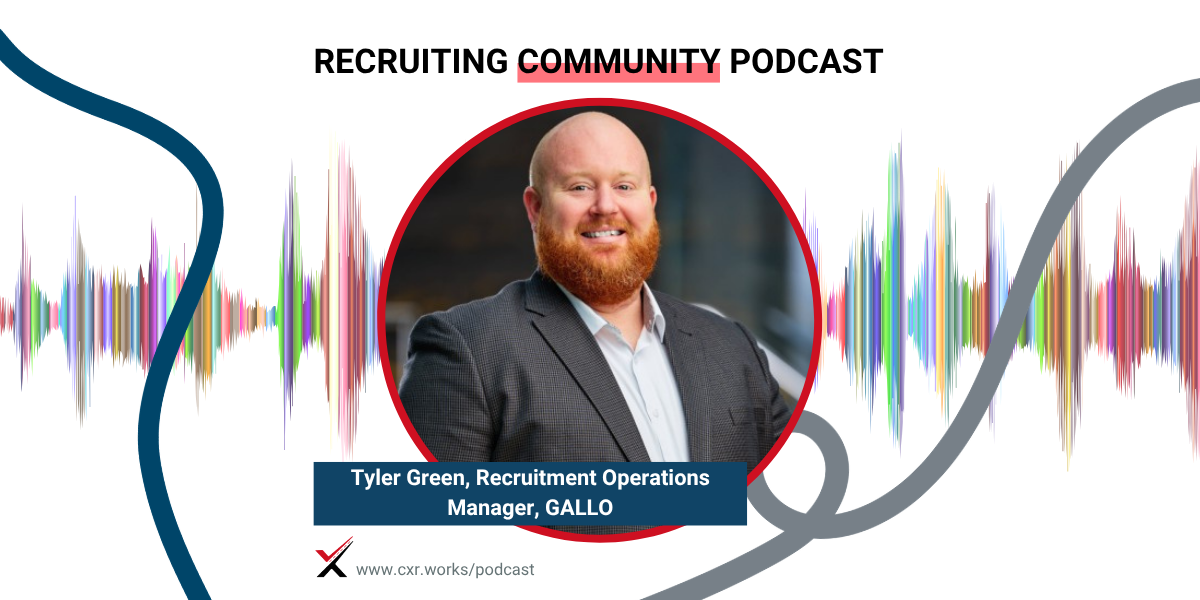
Tyler Green, Manager of Recruitment Operations, E. & J. Gallo Winery
Hosts:
Chris Hoyt, President, CareerXroads
Gerry Crispin, Co-Founder, CareerXroads
Episode Overview:
Tyler Green, Manager of Recruitment Operations at Gallo, walks through the design and build of an in-house AI-powered offer letter compliance checker. With over 1,400 offer scenarios spanning multiple entities, union agreements, California and non-California requirements, and varying employment classifications, Gallo’s offer process carried significant legal and candidate experience risk. Tyler and his colleague Ryan built a browser extension that cross-references every outgoing offer against a documented decision tree and component library, flagging non-compliant offers before they reach candidates. The episode covers the architecture of the solution, the documentation work that made it possible, and early recruiter response since go-live.
Key Topics:
The scale and complexity of Gallo’s offer process: 1,400-plus scenarios across multiple entities, union and non-union populations, California-specific requirements, and five accompanying legal documents
How manual auditing created a lag — errors caught days after sending — eroding candidate trust and creating compliance exposure
The decision to build rather than buy, and what made that feasible
How the offer letter checker works: a browser extension that runs against an offer letter alpha file and a decision tree, then produces a pass/fail compliance report
The six months of documentation work — consolidating 40-plus offer templates into a single decision tree — that became the foundation for the AI tool
Unexpected challenges during build: the tool flagging numeric formatting and department label conventions as errors
Recruiter response and the psychological shift from audit anxiety to pre-send confidence
Plans for measuring impact: comparing pre- and post-go-live audit scores over the first three to six months
Tyler’s participation in the first-ever CXR Recruiting Awards as a finalist, and follow-up interest from EY and EchoStar
Notable Quotes:
“If you send something incorrect and a candidate signs it, they’re bound by that document — and if it’s wrong, we could be in serious trouble.”
“Instead of a recruiter waiting on me or someone on the operations team to double-check things — and I might be in a meeting, unavailable for 30, 45 minutes — they can run it instantly.”
“When I can make the process easier for recruiters to do their jobs, that’s where I find my joy. That’s what keeps me coming back.”
“Make sure you’re buttoned up with your process, your rules, and your logic before you start. Once you have that foundation, it’s really just a matter of teaching the AI the rules, validating that it applies them correctly, and making it look clean.”
Takeaways:
Gallo’s offer letter checker demonstrates that a well-documented process is the real prerequisite for AI — the tool succeeded because years of compliance work had already been translated into clear, validated rules. The browser extension shifted offer compliance from a reactive, audit-based model to a real-time, pre-send check, reducing legal exposure while improving recruiter confidence and candidate experience. For TA leaders facing similar complexity, the lesson is clear: get your logic documented first, then the build becomes straightforward.
Want more conversations like this? Subscribe to the CXR podcast and explore how top talent leaders are shaping the future of recruiting. Learn more about the CareerXroads community at cxr.works.
Chris Hoyt: Welcome to the Recruiting Community podcast. I’m Chris Hoyt, president of CXR and your host. Joining me as always is Gerry Crispin, our co-founder of CareerXroads. If you’re tuning in visually, he’s waving with enthusiasm. Gerry, how are you?
Gerry Crispin: I’m doing just fine.
Chris Hoyt: It feels like it’s been a minute since I’ve seen you. I know we were in Louisville last week, but that already feels like two weeks ago.
Gerry Crispin: That was one of the most interesting events we’ve done, for sure. Some of it was new, but the location and the venue really made it special. I had to learn about bourbon, which was tough, but somebody had to do it — and Chris, you know a lot more about bourbon than I do.
Chris Hoyt: I just know I like to drink it.
Gerry Crispin: There you go.
Chris Hoyt: We did learn a lot. We also learned more about Louisville Sluggers than I ever needed to know, which was also a lot of fun. We got a VIP tour at Angel’s Envy distillery — just a blast, although I’d argue they could use some air conditioning in parts of that building. We had a great time with some of our finalists.
NPS scores are coming back in the high 70s, which I’m really excited about. We’ve got almost all the results in, we’re learning as we go, and I think we broke a few models over those three days. We’ll continue to iterate. I’m excited about it.
Gerry Crispin: I think it was a great experiment. The 67 or so people we had were all leaning in — it was fascinating from that point of view.
Chris Hoyt: Yeah, I’m excited. And Tyler was definitely among them.
Gerry Crispin: Tyler among them, for sure.
Chris Hoyt: Our guest today is no stranger to leaning in. He was one of the finalists for the CXR Recruiting Awards — our first year running the program — and his entry was about building an AI solution within TA. Not buying one, but building one. We’re going to jump in with Tyler in just a second.
First, a quick reminder: on this show, we do our best to bring industry insights in the form of what we think is a genuinely fun conversation. If you don’t like it, turn the dial. It’s brought to you by the CareerXroads community, so nobody pays to be on here.
Today, as Gerry alluded to, we’re going to talk about what I’d argue is one of the quietest, highest-stakes moments in the entire hiring process — the offer. It’s the handshake on paper. It’s what the candidate has been waiting for through your entire process. It’s also where a surprising amount of risk hides for a lot of organizations. Get it right, and nobody notices. Get it wrong, and you can shake a candidate’s trust and create a compliance headache before anyone’s even said yes.
Our guest today, Tyler, and the team at Gallo took that challenge head-on. A little background before he joins: Gallo is the world’s largest family-owned winery, and they were staring down something most of us can barely imagine — roughly 1,400 different offer scenarios spread across multiple entities, union agreements, and a whole web of requirements. They built a solution from scratch, entered it into the Recruiting Awards, and became one of three finalists out of nearly 25 entries. We’re going to dig into all of that today.
Before we do, a quick reminder: we’re streaming on the socials — YouTube, Facebook, LinkedIn. You can check everything out at cxr.works/podcast, where you’ll find past episodes, upcoming guests, and hundreds of interviews with TA leaders and practitioners doing interesting work across the space — from attracting and recruiting talent to managing and leading global recruiting teams. Be sure to like and subscribe, and let us know if you’d like to join the conversation or if you know someone who’d be a great guest. And as I mentioned, we are an ad-free labor of love. Nobody paid to be here. Gerry, did I miss anything?
Gerry Crispin: Not a thing. We’re good.
Chris Hoyt: It’s almost like I get paid to talk.
Announcer: Welcome to the Recruiting Community podcast, the go-to channel for talent acquisition leaders and practitioners. This show is brought to you by CXR, a trusted community of thousands connecting the best minds in the industry to explore topics like attracting, engaging, and retaining top talent. Hosted by Chris Hoyt and Gerry Crispin — we’re thrilled to have you join the conversation.
Chris Hoyt: All right, Tyler, welcome. We gave you quite an intro there. I hope we didn’t steal too much of your thunder. How are you today?
Tyler Green: Doing great. Excited to be here, and really thankful for the invitation. Looking forward to talking about the project.
Chris Hoyt: This is so fun. Before we get into it, I want to give everyone a little background on who we’re talking to. Give us the escalator pitch — who is Tyler, and what does Tyler do at Gallo?
Tyler Green: Absolutely. I’ve been with Gallo for 13 years. I’m the Manager of Recruitment Operations, which covers essentially everything tech stack-related — compliance, data, and analytics for the TA department. As Chris mentioned, the offer process is something our recruitment operations team owns entirely, from the setup and logic to the build of the offer process in our ATS. We oversee everything. We conduct weekly audits to ensure every offer letter going out is correct and legally compliant.
My path at Gallo started in recruiting. I was an entry-level recruiter, starting out with union mechanics and winemaking, then moved into corporate recruiting — finance, IT, legal, and compliance. That gave me a chance to work closely with compliance members across the organization and develop a real understanding of how all the pieces fit together.
At the time, we had a centralized IT team that handled all recruitment operations work. If we needed to update the system or enhance configurations, they would do it, and I would test. Through that process, I realized this was a lot more fun than recruiting, honestly. Ryan then created a recruitment operations org within TA, and I was lucky enough to be selected for the role. I’ve been having a blast for the last four years.
Gerry Crispin: It’s really about governance. That’s the whole issue — that transition to governance of what’s happening in the system.
Tyler Green: Absolutely. And I think having a recruiting background has made me successful in this role, because I understand not just what the system can do, but the implications — what an action in the system means for your OFCCP compliance, your candidate audits, and a whole range of factors. That skill set has definitely been an advantage.
Chris Hoyt: Let’s start right there, Tyler — with the world you’re operating in today. For folks who picture an offer letter as a quick fill-in-the-blank template, which honestly used to be the case, what does an offer actually look like at Gallo’s scale? What makes it so much more involved than most people would expect? We had some pretty seasoned TA leaders in the room in Louisville, and even they were surprised when you walked through it.
Tyler Green: Yeah, absolutely. As Chris alluded to, we have multiple entities and a few key drivers behind those 1,400-plus offer scenarios. It comes down to: which entity are you joining? Are you in California or outside of California? Are you union or non-union? Are you hourly or a salaried professional? Those are the key indicators that determine what components go into your offer letter.
From there, you get into the nuances — what’s the work location? Are you on-site, telecommuting, or fully remote? What incentive plans apply? What benefits plans? What CBA are you under? It goes pretty deep. And when you look at all the forms that accompany an offer, you’ve got five different documents: an arbitration agreement, confidentiality agreements, publicity agreements, digital signature agreements, and so on.
As we’ve updated our offer process over the years, things used to be manual — here’s an Excel spreadsheet with a decision tree, select the type of hire, here are the documents you need. But people are human. You can accidentally click the wrong option, and that throws off your entire process, your offer letter, your paperwork. These are legal contracts. If you send something incorrect and a candidate signs it, they’re bound by that document — and if it’s wrong, we could be in serious trouble.
We conduct manual audits every week. I look at every offer that goes out and every accompanying form. If something is wrong and it was sent on a Monday, I may not catch it until Friday. That’s five days where a candidate is excited, has signed, and is ready to go — and then they get a call saying we accidentally sent something incorrect and need to send a new packet. As Chris mentioned, that erodes trust. The candidate may wonder, “What are you changing? I already signed something. Are you trying to pull something over on me?” That’s the kind of trust damage we wanted to eliminate.
What we set out to do with this new tool is raise the confidence level for recruiters — so they know the offer is accurate — and improve the candidate experience, so people receive the correct offer the first time and sign it with confidence.
Chris Hoyt: What made you decide that auditing after the fact wasn’t going to be enough? A lot of organizations still handle it with templates, training, and after-the-fact audits. It sounds like you and Ryan drew a line in the sand and said enough is enough with the risk — both the trust risk and the legal exposure. Walk us through the offer letter checker itself. When a recruiter is ready to send an offer, what does the tool actually do for them?
Tyler Green: When a recruiter creates an offer, they’ve been working with the hiring manager and the compensation partner to nail down the salary and the details. Once all that’s in place, they input everything into the ATS, and the offer letter is largely automated based on the logic we’ve built. What the offer letter checker does is extend that.
It’s a browser extension — you open it in Chrome or Firefox, whatever you use — and once you’re on the screen with your composed offer letter, you hit Run. The tool goes in and cross-references everything against what we’ve taught it. It checks the offer letter alpha file, which contains every possible component the organization offers, and then checks it against the offer letter decision tree — that matrix with 1,400-plus combinations. It looks at the entity, the location, the salary group, whether the hire is union, non-exempt, or salaried, and from those three key indicators, it determines every other component that should be included for that type of hire.
For example, if you’re hiring into our Gallo Vineyards entity, there’s usually a driving requirement — you’re out in the vineyards daily, so the offer letter needs language about a valid driver’s license and a safe DMV record. If that’s missing, the tool will flag the offer as non-compliant and tell you exactly what needs to be added. It gives the recruiter an opportunity to confirm: Did I check everything? Am I looking at the hire type, the requisition details, the location? Am I compliant?
At the end of the check, it produces a report showing every area as a pass or fail, along with a final summary that either says “This is a compliant offer — feel free to send,” or “This is a non-compliant offer — here’s what needs to be fixed before you proceed.”
Instead of a recruiter waiting on me or someone on the operations team to double-check things — and I might be in a meeting, unavailable for 30, 45 minutes — they can run it instantly. You’ve already given the candidate a verbal offer. The hiring manager may have gotten their hopes up. They’re waiting, excited, wanting to see it in writing. The faster you get it to them accurately, the better their experience.
Ryan and I built it, trained it, and then brought in our IT partners to deploy it at an enterprise level, which we couldn’t do as individual users. They’re also cleaning up the UI and making it look more polished. But we got the core logic built — all the rules, all the scenarios — and we’re really excited to see the recruiter response.
A lot of recruiters feel anxious about the audits. When I reach out on a Friday, their first thought is, “What did I mess up?” That fear culture can drive mistakes, and it’s mentally taxing. If this tool gives them confidence — knowing the offer is correct before it goes out — they’ll work more peacefully and recruit more effectively. Beyond the legal and compliance benefits, there’s a real human benefit to the TA team overall.
Chris Hoyt: What I found really striking was how accessible you made it by delivering it as a browser extension — pushed out to everyone at once. That’s smart. But I think a lot of people hear “AI” and assume it’s just automation. Was there anything in building this that surprised you — something the tool did that a regular template or checklist just couldn’t?
Tyler Green: Yeah, one thing I didn’t anticipate was how much it wanted to correct grammar and sentence structure. When it would see numbers, it would flag them — for instance, “3%” would get flagged because under 10 it wanted the number spelled out as “three.” Training it to recognize that those formats are intentional and acceptable took some real fine-tuning.
The other thing it had trouble with was our department structure. We have a specific format for department labels in our system — typically an abbreviated department name, a dash, and then a department number. Teaching it that all department numbers in that format are acceptable was another learning curve. I thought I was mostly looking for whether components were present or absent, but the tool was digging into every granular detail. Ryan and I had a good time working through all of that in testing.
Chris Hoyt: I love it. For a TA or HR leader who’s listening and has a version of this same headache — maybe not at Gallo’s scale, but a version of it — what would you tell them about getting started with something like this? Because for the awards, the task was specifically to build it, not buy it.
Tyler Green: The biggest thing is having your process, your rules, and your offer letter components documented as thoroughly as we did. Ryan and I spent a good six months a few years back completely revamping our decision tree and the offer letter alpha file. We used to have over 40 individualized offer templates. We went through each one, pulled out every instance of every sentence, mapped it, and told the tool: “All 40-plus offers share this sentence, so it’s universal. This unique template only includes this specific component if conditions X, Y, and Z are met.”
By doing that work, we were setting ourselves up for success without even knowing it at the time. Going line by line and building that decision tree with 1,400-plus rows of components was probably the single biggest contributor to our success, because it gave the AI exactly what it needed: clear rules and clear logic. I’d say that upfront investment allowed us to roll this out on a much faster timeline than we ever imagined.
Make sure you’re buttoned up with your process, your rules, and your logic before you start. Once you have that foundation, it’s really just a matter of teaching the AI the rules, validating that it applies them correctly, and making it look clean. That groundwork is everything.
Gerry Crispin: It sounds like you genuinely enjoyed the process of building it — almost like a game, given that you knew the rules so well and could just construct the logic piece by piece.
Tyler Green: Yeah, absolutely. And one thing I mentioned to someone at the event last week — everyone asked about the “plus” in “1,400-plus.” Today we’re at 1,482. It used to be 1,320, then we added a new entity, then more unions. We’ll keep growing. It may reach 1,600 or 2,000 eventually. But because the framework is built and we have an established process for adding new components, updating the logic is straightforward. You add the new rule, validate a few examples, confirm it’s capturing correctly, and roll it out.
In the past, adding something new meant guessing where the paperwork went and hoping you got it right. Now we have confidence. I tested it thoroughly with every recruiter — I asked each of them to bring me the most complex scenario they’d handled in the last three to six months, and we ran it through the tool together. The reaction was unanimous: “This is going to be a game changer. I’m going to be so much faster and so much more confident.” That reaction is what drives me. When I can make the process easier for recruiters to do their jobs, that’s where I find my joy. That’s what keeps me coming back.
Chris Hoyt: Your passion for the project is clear.
Tyler Green: Thank you. It was a big challenge when Ryan said he wanted to make this happen. But I looked at what we had and thought — we’ve got the meat and potatoes to pull this off. I appreciate him pushing me to build a proof of concept and then refining it together over time. It was a great project and a great partnership, and I couldn’t be happier with how it turned out.
Gerry Crispin: This is still relatively new — what’s it going to take to see long-term metrics that demonstrate the impact?
Tyler Green: We’ve agreed that I’ll continue auditing for the first three to six months, which works well because we’re currently in busy season with harvest recruitment. After that, we’ll be able to compare audit scores from the six months prior to go-live against the scores since, and we’ll see the level of improvement. We have an accuracy improvement estimate we’re hoping to hit — I’m optimistic we’ll reach it, and I’m actually optimistic we’ll exceed it.
The other factor, as we talked about last week, is recruiter buy-in. The tool is only as good as the people using it. If someone is rushing and doesn’t take the time to run it, there’s still an opportunity for error. But the early signs on buy-in are really encouraging — recruiters are excited, and I’m already hearing things like, “Hey, it caught this — thank you.” Once we have consistent usage data, we’ll likely roll out updated individual KPIs for offer accuracy in partnership with the operations and delivery team leaders. The goal will be to raise the expected accuracy threshold and show that with the tool in place, we’re substantially reducing errors — whether we measure that weekly, monthly, or quarterly.
Chris Hoyt: I love it, and I’m looking forward to the updates. Tyler, I also just want to congratulate you again — and the team at Gallo — for making it to the finalist round. Nearly 25 submissions came in, and the judges had a genuinely hard time narrowing it down. Congratulations on the work and the recognition.
Tyler Green: Thank you. I was really excited to enter. I’ll be honest — for a first-year program, I was expecting fewer entries. But the level of interest and the quality of what everyone submitted was impressive. After we presented to the room, I had a few people come up and ask follow-up questions, and I’ve got calls this week and next with folks from EY and EchoStar who want to dig deeper into what we built and how we set it up. So thank you for putting the program together — I had a blast.
Chris Hoyt: We were happy to do it. We just wanted something that was practitioner-driven and practitioner-judged — a little different from what’s out there. Gerry and I fully recused ourselves from judging, which was genuinely hard, but we sat on our hands. It was just really fun to watch you all do the work. Well done.
Tyler Green: Thank you.
Chris Hoyt: If you want to check out the other finalists, head over to cxrrecruitingawards.com. We keep it straightforward. We’ll be interviewing the other finalists in upcoming episodes, and you can find all our past interviews at cxr.works/podcast. We’ll see everyone next time. Thank you so much.
Announcer: Thanks for listening to the Recruiting Community podcast, where talent acquisition leaders connect, learn, and grow together. Visit cxr.works/podcast to explore past episodes, see what’s coming up next, and find out how you can join the conversation. Whether you have insights to share or want to be a guest, we’d love to hear from you. If you’re interested in becoming a member of the CXR community, visit us at cxr.works. We’ll catch you in the next episode.
Deepfake candidates are infiltrating hiring pipelines. Matt Moynahan of Get Real Security joins CXR to explain the threat—and what TA must do now.