
Building the TA Machine
Tracey Friend returns to unpack how TA leaders orchestrate RPOs, contractors, and internal teams — and why planning beats adding vendors.
 play_arrow
Empathy, AI, and the Business of People Alessa Rivera Badillo
 play_arrow
Building the TA Machine Alessa Rivera Badillo
 play_arrow
The AI Talent Race Alessa Rivera Badillo
 play_arrow
Built for Change: Tracey Friend’s Career Crossroads Alessa Rivera Badillo
Featured Guests:
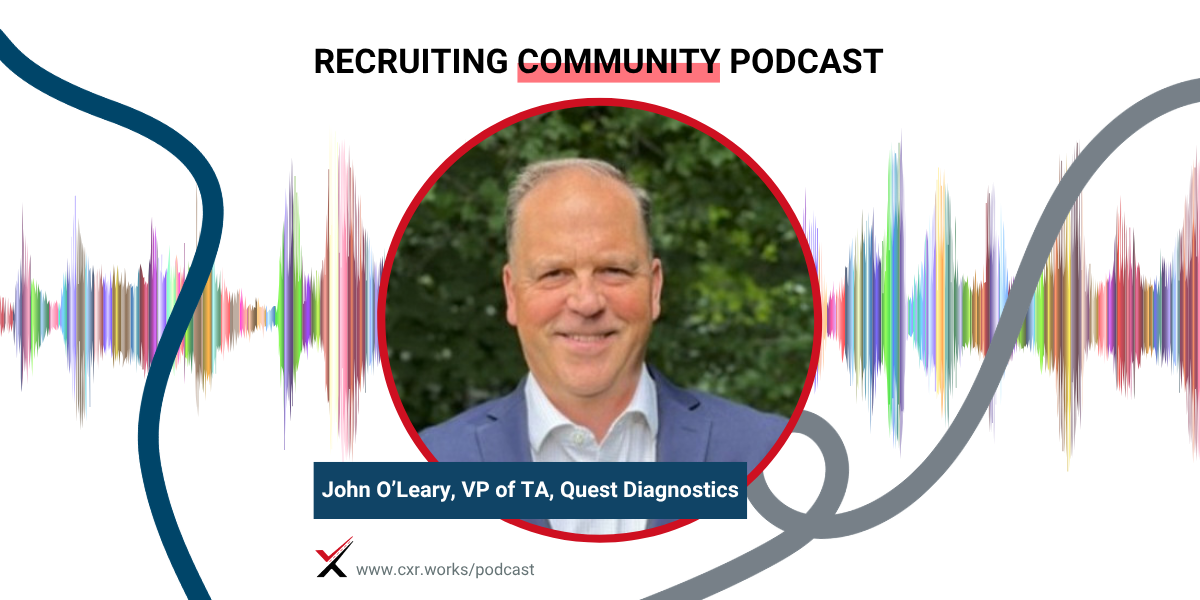
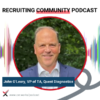
John O’Leary, VP of Talent Acquisition, Quest Diagnostics
Hosts:
Chris Hoyt, President, CXR
Gerry Crispin, Co-founder, CareerXroads
Episode Overview:
In his first podcast appearance, John O’Leary talks with Chris Hoyt and Gerry Crispin about leading talent acquisition at Quest Diagnostics. Quest hires frontline roles such as specimen processors, phlebotomists, and logistics drivers, as well as PhD scientists, sales, corporate functions, and executives. John describes his path from 13 years leading a staffing firm into corporate TA leadership at The Hanover Insurance Group, Biogen, Fresenius Kidney Care, and a health system, before joining Quest four years ago.
The conversation covers three main themes. The first is leading with empathy and how to make it consistent across a large organization. The second is why TA leaders need deep fluency in the business they support. The third is how Quest is applying AI in a regulated healthcare environment while keeping humans responsible for judgment calls on candidate fit.
Key Topics:
Talent acquisition at scale, covering frontline, enabling functions, R&D, and an internal executive search team
Recruiters who understand how the business operates and makes money
Leading with empathy, including the “owner’s manual” exercise a former boss used at Hanover Insurance
Making empathy systemic through top-down consistency and “freedom within the framework”
Links between engagement, productivity, retention, and patient outcomes
Business fluency as a source of credibility with hiring managers and candidates
Market intelligence on talent location, competitor practices, compensation, and flexibility
Learning a new industry while leading, described as “flying the airplane while working on the engine”
Staying close to the business through lab road shows, relationships with HR peers, and business leader briefings
Job shadowing and ride-alongs as a way to build trust and give candidates a realistic job preview
Current AI uses at Quest: job description tweaking, reference checking, interview question development, intake call summaries, candidate outreach messaging, and candidate notes for executives
Caution around AI in a regulated industry, including bias concerns and the risk of technology becoming obsolete quickly
Keeping the human in the loop on candidate fit, final candidate debriefs, and alignment with core principles
Resume fraud and exaggerated qualifications in an AI era
Future skills for recruiters: consulting, market understanding, business knowledge, and storytelling, supplemented by AI
Notable Quotes:
“If you lead with people, then I think results follow.” — John O’Leary
“My boss has a great expression: surprises are for birthdays, right? And also, inspect what you expect.” — John O’Leary
“We can save our hiring managers from themselves by giving them insights around talent.” — John O’Leary
“Getting comfortable with the uncomfortable is something that we all have to do, and you just have to embrace it, and you’ve gotta hit it head on.” — John O’Leary
“Ask the questions. Don’t be afraid to sound stupid.” — John O’Leary
“You don’t wanna pull the trigger on a technology if it’s gonna be obsolete in three to six months.” — John O’Leary
“So the fit piece is still being driven, without question, by that human interaction and collaboration amongst interview teams.” — John O’Leary
“Just the act of doing that job shadowing helps to build trust with the people that you’re going to be working with or have to serve.” — Gerry Crispin
“We used to make a joke about keeping the human in human resources, but I think we’re really at a point where that does become part of a strategy.” — Chris Hoyt
Takeaways:
John O’Leary ties empathetic leadership to higher engagement, productivity, and retention, and ultimately to better patient and business outcomes. He argues that business fluency gives TA teams credibility with hiring managers and candidates, and he builds it through lab visits, job shadowing, and business leader briefings. At Quest, AI is being applied carefully to efficiency tasks, while decisions on candidate fit stay with people. He expects recruiters who understand the business and can tell its story to be best positioned to use AI effectively.
Want more conversations like this?
Subscribe to the CXR podcast and explore how top talent leaders are shaping the future of recruiting. Learn more about the CareerXroads community at cxr.works.
Chris Hoyt: Gerry, I know I talk to you every day. I know the world is jealous. I talk to you every day. It’s true. I don’t know about the jealous part being true, but talking to you every day is true. I don’t know why it feels like it’s been weeks since we’ve done a podcast, but it really hasn’t.
Gerry Crispin: Yes, it has been a little bit of time. I mean, you traveled a bit, you know?
Chris Hoyt: Yeah, we’re on the road.
Gerry Crispin: We had a couple vacation days here and there, so yeah.
John O’Leary: We’re on the road. Gosh, we’ve got a dinner in New York City, so I’ll see you in a couple of nights. We’re flying in for a dinner. I look forward to it.
Chris Hoyt: Yeah, it’s a full table. We’ve got about 18, 19 companies at the table. It’s gonna be fun. Following week, we’re at LinkedIn Talent Connect. We’re gonna be there also.
Gerry Crispin: Yeah, you’re gonna try and make a dinner there too.
Chris Hoyt: We’ve got a dinner there. That dinner’s done. We’ve got about another dozen leaders that are gonna be at that dinner. It’ll be fun, so I’ll see you there. We’re swooping you in by helicopter. No, there’s no—
Gerry Crispin: Train.
Chris Hoyt: Train.
John O’Leary: Not the CXR helicopter. You’re on the CXR train.
Chris Hoyt: Yeah. Well, look, for those of you who are wondering what the heck you just turned on, welcome to the Recruiting Community Podcast. I am Chris Hoyt. I’m the president of CXR. I’m your host for this podcast, along with my brother from another mother, Mr. Gerry Crispin, who is, of course, the co-founder of CareerXroads. On this show, as we like to say, we’re just doing our best to bring you industry insights and updates in the form of what we like to call a fun conversation. It’s, of course, brought to you by the CXR community.
Our guest today runs talent acquisition for one of the biggest lab businesses in the country. John O’Leary is the VP of TA over at Quest Diagnostics. It is a Fortune 500 diagnostics company, roughly, I think, between 50 and 60,000 employees, about 11 billion, I believe, in revenue. And they are hiring. We were talking about this earlier in the green room. They’re hiring everyone from these overnight specimen processors to PhD scientists to an entire sales force.
And before Quest—I’m not gonna steal John’s thunder—he led TA at Biogen, at an insurance group company, at a medical care organization. He’s here to really talk about two or three things that I think don’t always sit comfortably together. We’re gonna talk about leading with empathy, which I think is just so timely. We’re gonna talk about putting AI to work in recruiting. And we’re also gonna talk about why the best TA leaders know the business they’re hiring for cold—like, knowing it as well as anybody else in the room. I think that’s just vital.
Before we jump in, really quickly, a few things. We do the streaming on the YouTube, the Facebook, the LinkedIn. We’re still trying to figure out why we’re on the Facebook, but I’m sure millions of other people are too. You can check us out at cxr.works/podcast. There you can see past and future episodes. You’re gonna find hundreds of interviews that Gerry and I have done with TA leaders and practitioners from all over the world. And these are people that are doing really interesting work that touches on how we’re attracting and how we’re recruiting talent, as well as managing and leading these global teams.
On that site, you’re also gonna find a really easy way, of course, to like and subscribe, and then to let us know if you’d like to be on the show, if you wanna be part of the conversation, or if you know somebody like our guest today that just really needs a microphone to talk about some really cool ideas and cool work they’re doing.
I will also tell you that the like and subscribe button is the only pandering you’re gonna get on here. We are an ad-free labor of love. Nobody pays to be on the show. We don’t get paid to be on here, and we don’t pay anybody to join us or any of that. Gerry, did I miss anything?
Gerry Crispin: You got it all.
Chris Hoyt: All right. We’re getting pretty good at that at about 700 interviews.
Announcer: Welcome to the Recruiting Community Podcast, the go-to channel for talent acquisition leaders and practitioners. This show is brought to you by CXR, a trusted community of thousands, connecting the best minds in the industry to explore topics like attracting, engaging, and retaining top talent. Hosted by Chris Hoyt and Gerry Crispin, we’re thrilled to have you join the conversation.
Chris Hoyt: John, welcome to the show, man. I hear it is your first podcast.
John O’Leary: It’s my first podcast, so thanks, Chris and Gerry, for taking a flyer on me on my first podcast. Really looking forward to the discussion, and yeah, excited to be here.
Chris Hoyt: Thanks for dialing in. We’re glad to have you. John, for those who have not had the pleasure of meeting you before or working with you directly or indirectly—I kind of laid it out earlier—can you give us just a little bit of an elevator pitch of who is John O’Leary and why should we be paying attention to what he says today?
John O’Leary: That’s great. Well, it’s interesting. I started my career in recruiting about 30 years ago on the agency side, the headhunting side of the business, and spent 13 years leading a staffing firm there. I’m one of the few people that made a transition directly into corporate talent acquisition leadership. I ended up getting recruited by one of my clients, The Hanover Insurance Group, a large property and casualty insurance company, to really bring that agency high-touch, high-sense-of-urgency approach to recruiting.
It was quite a gamble on me, and a gamble that I took, and I really fell in love with how to transform talent acquisition functions to be consultative, with a high sense of urgency. Show that you are a profit center—showing that return on investment.
And I moved on to a couple other organizations and found my way into healthcare. As you mentioned, Chris, I was at Biogen for a short time, and Fresenius Kidney Care, and found my way into a health system, which was really a neat experience because it combined doing the right things from a mission perspective with lots of work to do and things to fix.
And then I made my way to Quest and have been here for four years, which has been a great experience. So that’s a little bit about my background. What I tell my kids: it’s been 30 years I’ve been in this business. They like to make fun of me, and then they understand why my hairline is the way it is. But yes, it’s been a lot of fun.
Chris Hoyt: Well, I’m right behind you. If you’re lucky, you’ll get Gerry to take his hat off, so—
John O’Leary: There it is. Way to go. Almost there, Gerry.
Chris Hoyt: You’re in good company today, my friend. So John, when we talk about Quest and the work you do, you’ve got a TA operation that spans everything from—and I mentioned this in the intro—these overnight specimen processors we were talking about earlier, PhD scientists, you’ve got sales, you’ve got corporate. It’s somewhere between 50 and 60,000 people within the organization. So for folks who are listening who maybe don’t know Quest from the inside, what does talent acquisition actually have to solve for at that scale?
John O’Leary: Yeah. So look, we use expressions like blocking and tackling, and the core to our company and its success is our frontline hiring. You mentioned, Chris, specimen processors, our phlebotomists. Look, our logistics drivers, right? They obviously carefully handle—and we talk about it—it’s a life that you’re carrying, and you have to treat it that way and make sure those specimens get to our lab safely and can be tested accurately.
Then you’ve got to shift to our enabling functions. So whether it’s accounting, finance, marketing, HR, right? And then you’ve got R&D. You’ve got that different level. And then, of course, we have an internal executive search team that is responsible for our executive searches, and we take pride in that. We do go out to search from time to time when we need to.
But the key to all of it is making sure that our recruiters really can connect the dots to the business. How does Quest work? How do we make money? What does the whole flow look like from rec to cash? And truly understanding how that works, because then they can get that message out to the public, and they can identify talent the right way.
So it’s complex, but we certainly have swim lanes of folks that specialize in their areas of expertise. Because it is so complicated, you’ve got to narrow that focus down a little bit.
Chris Hoyt: Yeah. I think a lot of folks, certainly on the candidate side, but also sometimes from the TA perspective and from different lines of business, forget just how complex some of these bigger organizations can be, and just how many functions sit inside of them that aren’t so unique to a particular industry but are pretty universal across any organization of that size. I think that gets missed a lot.
John, when we originally said, “Hey, what do we wanna talk about?” you put leading with empathy at the top of your list. So if we strip that buzzword away, I’d love to hear from you: what does empathy actually look like in a normal week for you? Where might it come into play and maybe change a decision that you have to make?
John O’Leary: Yeah, that’s a great question, and I’ll do my best to be succinct here. I’m passionate about leading with empathy. I’ve always felt that, from a personal perspective, what gives me joy is developing your team, having trust with your team, recognizing all the time we spend at work together. I’m a believer that you’ve gotta really understand your people and who they are outside of work as well, what makes them tick.
I had a former boss at Hanover Insurance who was new to the organization. She brought in the leadership team and said, “Look, I want you to bring in your owner’s manual. What makes you tick? What makes you upset? What makes you angry? What’s not gonna work for you?” And that type of approach is really important. It helped me carry on as I became a leader in other organizations. If you don’t really understand the whole person, you’re not gonna be able to meet people where they are. You’re not gonna be able to push the buttons that, number one, maximize their talent, their engagement, and ultimately productivity—not only for them as far as their career, but for the organization, and for us here at Quest, right?
So empathy for me, I think, is the key. If you lead with people, then I think results follow. And I think our organization has done a fantastic job of that, led by Jim Davis, our CEO, who as a new CEO four years ago really embraced that approach. One example I could refer to is the former CEO of Best Buy, Hubert Joly, who basically turned around Best Buy, and did it by shifting his approach to leadership—leading with people and enabling that empathy, meeting people where they are, also promoting humility and vulnerability—and results come.
So I think that’s something we’ve gotta carry every day. When I think about my direct reports, I want them to lead their teams with empathy. And look, we wanna be perfect every day, but at the end of the day, we are gonna make mistakes, and people need to feel comfortable that they’re in a safe place, that they can make those mistakes, they can be accountable for those mistakes, and then we move on, right? So that’s a little bit of my elevator pitch on empathy and how I think it’s so critical to ensuring the success of an organization.
Gerry Crispin: That really is so indicative of a servant leader. And empathy has to go hand in hand with the kind of trust that comes from knowing me, if you will. You’re using your knowledge of me to help me, to empower me to do my best work, as opposed to how I could be manipulated, if you will. So that trust becomes a critical issue, and I just love it when we move in those directions, ’cause I think the 21st century really requires it.
Chris Hoyt: It does feel like that gets scaled back a little bit—the humanity. And I know that we’re gonna talk about AI, and I know this is the era of AI, but it does seem like a lot of these organizations who are saying AI-first, AI-forward seem to be doing that at the cost of some humanity, if you will, right? Cutting some of these teams to the bone, operationalizing in the name of profit without really thinking through how a lot of this stuff works. So I think leaders like the servant leaders Gerry mentioned—or folks like you, John, who can lean in and understand what’s going on with their teams—become even more valuable, even if some of the orgs haven’t realized it yet.
One of the things I push on, just to be difficult: I think empathy one-on-one is one thing. Not always easy to do, but it is certainly a skill. But John, I’d be really curious how you would share with others how you build that into a process, right? The standard of work, or make it systemic, so that it survives at, like, a 50,000-person scale, and doesn’t just depend on whether a given manager’s having a good day or not.
John O’Leary: You know, look, I think in our case, it’s leading from the top down—what does leading with empathy mean—and trying to be consistent in how you implement that across the organization.
And then for me, I think another example is being honest and upfront. I mentioned the owner’s manual, right? That exercise of, hey, what makes me tick? What’s important to me? My boss has a great expression: surprises are for birthdays, right? And also, inspect what you expect.
But you just set the guidelines, like, “Hey, here’s what I’m gonna need from you for this department, for talent acquisition, and for you to be successful. What do you need from me to be successful?” And the freedom within the framework might be a little different, right? And it should be for each person. Because look, I might have someone who reports to me who has, I don’t know, five school-aged children, right? They need to deal with what they need to deal with at work, but then they’ve got a personal life that might need some accommodations or some flexibility. I need to understand that and figure out a way to meet them where they are.
And if I meet them where they are, and they see that I have their back and there’s that support, more than likely—it always pans out—our engagement score is gonna be high, productivity is gonna be higher, and retention. And ultimately, better patient outcomes for Quest Diagnostics. And obviously we’ll be more profitable, where we can reinvest in the organization and reinvest in better patient outcomes, right? So it all ties together.
That’s how I think we as an organization have done a pretty good job taking that message of leading with empathy and trying to be pretty consistent with how we do it in each function. But that freedom within the framework, to me, is important, because you have to adapt to who needs what on your team. Not everyone’s gonna have the same needs, wants, and desires. You’ve gotta adapt a little bit.
Chris Hoyt: Yeah. And John, I love that you’ve tied this—it trickles all the way down to the different lines of business—because we know you’ve argued that TA leaders need real fluency in the business, right? Not just knowing recruiting, but also knowing that business cold. So my question to you, I guess, is: what does knowing Quest—the labs, the strategy, the customers, what happens in those lines of business—what do you think that lets you do that a process-only recruiter or recruiting leader couldn’t do?
John O’Leary: Yeah. Well, it certainly gives you credibility, right? With, for example, your hiring managers and the leaders that you’re recruiting for. It gives you credibility in the market when you’re talking to candidates. And where it gives you credibility, it allows the leaders that you work with to trust your expertise in the talent space, right?
So look, obviously our commercial sales leader is gonna understand what profiles we need to go out and hire, and we need to lean in and understand not just the skill sets and what type of DNA it requires, but we’ve gotta be able to connect the dots.
But then we can also—I use this expression sometimes—we can save our hiring managers from themselves by giving them insights around talent, or, for example, how we’ve interacted with candidates, to say, “Look, you might like this candidate because on paper they’re perfect, but let me showcase some of the behaviors that we’ve been able to identify. And let me give you a little bit of intelligence around our competitors, to say, ‘Hey, look, here’s what they’re doing. It’s something that we should maybe implement.'”
And that could be something where we can provide insight outside of our swim lane of understanding candidates. We might be able to understand compensation practices, right? That’ll help us change our compensation practices to attract the right talent.
So I try to empower our TA team to say, “Look, yeah, stay in your swim lane from an expertise standpoint, but if you only stay in your swim lane, you’re doing the organization a disservice, because there’s so much information you can uncover that can lead to improvements in other aspects of the hiring cycle.” Again, that would lead to retention and engagement and better patient and business outcomes.
Gerry Crispin: I really love that. Not only because it’s important at your level, John, but because it’s something you can use to empower people all the way down through your organization to be curious about what other people are doing and how they are impacting the success of the company. And the more they learn about that, the more they can put that together in how they advise their client base.
John O’Leary: Yeah, exactly. And it comes to certain things too. I bring up market intelligence, right? Someone says, “Geez, we want this position located here,” or, “It’s gonna be remote,” or, “We’ve got a lot of technology people in this location; it should be here.” But the talent doesn’t sit there, and here’s where the talent does sit, and here’s what we’re seeing our competitors do to get that top talent. They’re offering more freedom within their framework, or more flexibility.
So exactly, Gerry. I think we’ve got to continue. And tying into AI, that’s something AI’s certainly gonna help us with. But being able to tell that story based on data we might get from AI, or just market knowledge—those are things we’re not gonna be able to replace. That’s that trust and that human connection of knowledge that we need, to make sure that we’re always being consultative when working with our hiring managers.
Chris Hoyt: I do wanna get into AI, ’cause I’ve got a couple questions for you there. But really quickly, though: is this portable? You came up through healthcare and these regulated industries, right? Biogen and insurance—we mentioned them earlier. I have a take on this, but I wanna hear your stance. How much of business fluency do you think actually transfers? How much did you have to relearn walking into a diagnostic lab, a diagnostic type of shop?
John O’Leary: So, a lot. And the tough part about shifting industries—again, another expression that I use, and others use—is you’re flying the airplane while working on the engine. You come in as a new leader, you understand you’ve got some internal people challenges you’ve gotta fix right away. You’ve obviously got staffing challenges and big projects going on. How do you truly adapt and learn the industry that you’re moving into?
So for me, if I look back, I would have liked to take probably another two, three, four weeks of understanding Quest a little bit before I jumped into leading. But again, flying the airplane and working on the engine probably worked out pretty well—though I’m still continuously learning. It’s complex.
And then look, I think the nice thing about AI now is it’s helping me, as a leader who’s been in recruiting for 30 years, become more efficient and be more nimble. For example, I’m working on executive-level recs that I’ve never worked on before. I’m using AI to help me: “Hey, what are the best interview questions to ask for this particular role, for a person who’s applying for this role in a $10 billion-plus healthcare diagnostics company?” right? So I’ve used those types of things even to learn about Quest, so that’s been helpful.
So hopefully that answers your question. But yeah, changing industries and trying to learn something complex while you’re the leader, that can be a little uncomfortable, because you’re expected to know as a leader. But I think that’s another thing: getting comfortable with the uncomfortable is something that we all have to do, and you just have to embrace it, and you’ve gotta hit it head on.
Chris Hoyt: I love it. We’ve got this Monday question I’ve been asking a lot of our guests lately, and I’m sorry, we don’t prepare you for it. If I’m hearing this, I’m going, “Oh man, that is a habit I’ve gotta get into,” or, “That is an aspect of the business—no more shut up and dribble the ball. I really need to take a look at the broader things the organization does.” What would you tell the listeners—something they should kick off on Monday? What’s a habit or maybe a routine that you use, John, to stay close to the business? Are you sitting in on ops reviews? Are you having shadow days at a lab? Is it tracking the industry? What do you do to stay dialed into that?
John O’Leary: Yeah, look, I think a lot of those things, and you can lose sight of it because you’re so busy in your day-to-day survival and getting the job done—blocking and tackling and making sure the roles get filled from a TA lens.
But absolutely, we do road shows. We have major lab hubs throughout the country, so I travel a good amount during the first half of the year, usually, to have those visits with the labs and see how it works. Everything could be a little bit different. And then obviously you’re meeting with leaders: What are some of the challenges that you have from a recruiting perspective? And then you learn about other challenges that we need to address that might be outside of talent acquisition, and I can take that back. And if we can fix some of those challenges, it’ll help us attract and retain talent.
So leaning in, I think, is important. As a leader on the HR leadership team, truly getting to understand and build good relationships with my HR peers, who are basically the quarterbacks for the respective businesses that they run. Ask the questions. Don’t be afraid to sound stupid. Like, how does this work again? This doesn’t make sense to me. Okay, how can I tie that back to my recruiting team to make sure they understand?
We sometimes have business leaders speak to HR and to my TA function to give an overview of their business and what the plan might be for 2026 and 2027. So the more information they have—meaning my team—the more they can connect the dots, to say, “Hey, here are the priorities.” And when the whole team hears it, there might be other priorities in different parts of the business, and we might need to shift a little bit. Say, “Hey, we know your world’s important. Everyone’s swim lane is important, but the priority for our organization—this business unit—might take precedence,” right?
So really making sure that not only we as leaders, but also my team, lean in to learn how the whole operation works, because it does shift. Priorities shift.
Chris Hoyt: Yeah, I don’t know that you’ll find a bigger fan of job shadowing than Gerry. In the almost 30 years, I think, that I’ve known Gerry, he’s always talking about job shadowing, always talking about the importance of new recruiters coming in and doing a tour of the business. It was one of the first things they did for me when I joined PepsiCo. I went on this big round-the-world tour to really understand all the different lines of business, and I think it’s a game changer.
John O’Leary: Absolutely. We do it a lot. Just for example, a day in the life of a logistics driver. We had an HR leadership meeting, and we had folks come in to show what it’s like to draw blood and go through each process. Visiting patient service centers—even though they’re super busy, the phlebotomists will take time so you can understand what’s happening, what’s not happening, those types of things, in the room with the patient. So you’ve gotta learn, you’ve gotta lean in.
Gerry Crispin: I love that, John. I will tell you that in my early days, I had this big promotion to Ortho Diagnostics, which was part of Johnson & Johnson, and I was really responsible mostly for sales and marketing—that was the biggest issue. And so I went to the head of marketing, and I said, “I’m gonna be starting next week. I wanna spend two days with the best salesperson you have. I wanna ride with them. And the last part of the week, I wanna spend two days with the person whose performance is the least successful in your organization. And I’ll come back next week, and we can talk about what I’ve learned.”
John O’Leary: Yeah. I love it.
Gerry Crispin: And I’m telling you, it’s not only what I did learn—I mean, it was enormous—but fundamentally, just the act of doing that job shadowing helps to build trust with the people that you’re going to be working with or have to serve: that you know something about their damn business and their roles that need to be filled.
John O’Leary: Back to the credibility piece, Gerry, to your point: when you’re having those conversations out in the market, you can say, “I actually went on a ride-along, and I’ve seen what these commercial salespeople do,” or, “I’ve seen what this logistics driver does.” How awesome is that for a candidate to hear? Wow, that recruiter has really given me almost a realistic job preview. Don’t you think that candidate’s gonna be more excited if a recruiter delivers a message that way, versus a competitor that’s just reading a job description and doesn’t really understand the business and how it works? So yeah, it’s great.
Chris Hoyt: You’re so much better positioned for the interview. You’re so much better positioned to have a discussion with the candidate, without a doubt. Yeah, 100%.
Well, okay, so let’s get into the AI part of the conversation. What I wanna learn is where it’s already changing the work at Quest for you and your teams—sourcing, screening, scheduling, candidate comms, candidate forms—versus where I kinda think it’s probably still more—I’m gonna coin a new phrase—more hype than help, John. Do you have a little bit of that going on too?
John O’Leary: Yeah, look, I think this is one of the nice things: when we have conversations like this, it’s almost like an AI therapy group. Hey, what are we doing? What are we not doing? And me as a leader, I focus as much on what I’m not doing, or what I should be doing more. Are we behind? And I’m getting myself to a better place about where we are.
Because look, we are healthcare. It’s regulated. We are very concerned about doing things that we should not do, or what we don’t know that we don’t know as it relates to AI. So I think what we’re doing is we’re all curious—one of our five Cs. We’ve gotta be very curious, and we’ve gotta have all the right conversations, and you go after it where you feel very comfortable that you can.
So the things that we’ve done: a lot of job description tweaking, right? We’ll do reference checking, right? So how do you do a reference check and ask the right questions in a different way using AI? That’s been very helpful.
Also, as I mentioned, interview questions. I’d like to think I’m an expert across the spectrum. I am not. So if I’m all of a sudden handling an executive-level position here in the organization, and I’m interviewing candidates, I’d better darn sure know what I’m talking about, or be able to engage in that conversation, and that’s been helpful.
I think it’s also been helpful for our professional and executive teams when we do intake calls, right? You do intake calls, you summarize the notes, you give a recap, and it helps move that process along. And then: hey, did we miss anything, right?
We certainly, when we’re reaching out to candidates, construct important sizzle messages to get people interested, but we always make sure that human element’s there, right? So you might have a way to construct a message, but give it that John O’Leary feel. What makes it real.
So what we’re doing is really trying to optimize our time with things that we feel good about. We’re still kinda tiptoeing, because we don’t wanna be in a position where we feel at all that there’s any bias involved when talking to candidates, and we don’t wanna miss out on great talent because maybe we’ve used AI inappropriately. So we’re very cautious as it relates to that.
As we move forward, though—I mean, the volume of applicants that we get is huge, and we’ve gotta figure out a way, through technology, through AI, to satisfy all of our obligations of making sure there’s no bias, but move that process along. Those are the things we’re continuing to deal with and try to figure out, because it moves so fast. You don’t wanna pull the trigger on a technology if it’s gonna be obsolete in three to six months.
So those are some of the challenges we’re still having, but I feel good that our team’s getting to a better place in using it day-to-day to operationalize things that would take hours. Candidate notes—how do you write up candidate notes and send them to an executive? Now we can summarize that a little bit easier.
Chris Hoyt: Yeah, 100%. At the scale that you’re dealing with, I would just agree with you 100%. But you do mention something: you’re talking about using AI to add efficiency, but also to cut bias out of this, and I think plenty of leaders also worry that it may do the opposite for them, at their orgs or wherever they’re at on their AI journey. John, where do you keep the human in the loop? What’s a judgment call that you would never hand to an algorithm?
John O’Leary: Yeah, look, I think a lot of the roles that we have, there are table stakes. You’ve gotta have certain requirements, right? When you think about phlebotomy, you’ve gotta have the right level of experience—you’re dealing with humans as a phlebotomist. So there are certain things that you feel good about automatically, where you can even rule people out without discrimination because they’re just not qualified, right? That could be with all our roles.
So for us, there’s a lot of collaboration. When we think about high-level positions, we do just such a great job when it comes to candidate debriefs with final candidates—talking to our core principles. I mentioned the five Cs earlier. Do they represent that? Are they bought into the mission, right? Is it about patient outcomes? Is it that spirit? That’s where the human element comes in. With our executives, we take time to make sure we have robust discussions around candidates: what are some of the pluses, what are some of the areas of opportunity, and where they ultimately land.
So the fit piece is still being driven, without question, by that human interaction and collaboration amongst interview teams.
Chris Hoyt: I love it. So I’m gonna do my Monday question again, right? Okay, actually, we’ll do a future question. If you’re looking out two or three years, based on the work you’ve done so far, John, and the teams you’ve built, where do you think AI inside the talent acquisition function is headed? And for folks who are listening now, what books should they pick up? What course should they be taking? What skills should they be working on building on Monday that will still be valuable in your vision of the future?
John O’Leary: So I’m gonna say almost away from AI is what’s gonna be most important, and I’ll explain. Not moving away from AI—that’s not my intent here. But I think what’s gonna be most important, especially for folks that are seasoned, folks that have been in the recruiting game for a while, is what I talked about at the beginning. You’ve gotta continue to be a consultant. You’ve gotta understand market conditions. You’ve gotta understand the business that you’re supporting, and why a candidate may or may not be a fit—not just on skills, or whether they check the box on requirements. So I think those recruiters that continue to do that will absolutely thrive.
Then what you wanna do is supplement with what AI can give. How do I make it more efficient? How can I summarize my notes and my thoughts in a way that works for my leaders and the other business partners that I’m working with?
And I think we’ve gotta be nimble. We’ve gotta continue to listen and have the right conversations around AI, and be very careful about making sure we don’t make poor decisions, or use AI in a way that eliminates the right person getting hired because we’re just using it the wrong way, right?
But I do think the people piece is gonna be more important than we think. I do think there are gonna be opportunities for us to find efficiencies when we’re looking at sourcing candidates, and the number of bodies, maybe, that are sourcing candidates. But I think the folks that can tell a story, the folks that understand the business, that connect the dots—those are the folks that are gonna be able to utilize AI in a way that’s just gonna make them more efficient and better at that piece.
Chris Hoyt: I love it, John. We used to make a joke about keeping the human in human resources, but I think we’re really at a point where that does become part of a strategy.
John O’Leary: Yeah. And look, another topic: you think about resume fraud, or resume enhancement, as it relates to AI. We see it, right? And there are certain particular swim lanes where we see it more than others. But recruiters need to maybe even use AI to identify where there are issues or potential exaggerations in qualifications. And managers are gonna require us to make sure that we can peel back that onion before we invest time in having those conversations. Are they truly representing themselves in a way that would be a fit for us? So recruiters are gonna have to be on their toes, and they need to be, as it relates to that piece, because that’s a challenge for us too.
Chris Hoyt: Yeah. I agree with every word you just said. I love it. John, we ask every guest this question before we let ’em off the hook, so you are no exception today. If you were gonna write a book about this chapter in your own career, where you are as a leader, what do you think the title of that book might be?
John O’Leary: So, as a leader. You know what? I think something like this: I’d say people first, then the results follow. Something like that. People first, business-driven. Look, it’s truly—I think if you focus on people, and you focus on people in the right way, with a balance of empathy and accountability, and those expectations are there, results will follow. So that’s my title: People First, Results Will Follow.
Chris Hoyt: I love it. Absolutely—getting the talent right first. It’s fantastic. John, last question for you. Present company excluded, who gets the first signed copy of your book?
John O’Leary: I’ll say my wife, because she would probably never believe I would ever be able to write a book. So just to show her I could do it, I guess.
Chris Hoyt: You’re a good man, Charlie Brown. That’s a smart decision. It’s a smart decision.
John O’Leary: I’m learning. It’s taken me many years, but we’re all learning to say the right things as it relates to that kind of stuff.
Chris Hoyt: Good for you. Well, John, thanks so much. I know you’re super busy. Much gratitude, man. Thank you so much for giving us some time, walking through the day in the life and the work that you’re doing, and how you’re leading these teams. We just really appreciate it. Thank you so much.
John O’Leary: My pleasure. Thanks, Gerry. Thanks, Chris.
Chris Hoyt: Yeah, be well. Happy to have you on. Everybody, if you wanna listen to it again, go back and listen to it again. There’s a lot of good stuff in here. You can find this recording at cxr.works/podcast. Again, you’re gonna find hundreds of others out there. We’ll remind you to hit the like, the subscribe—make Gerry famous that way. And if you’ve got somebody you think ought to be on the show, or you want to be on the show yourself, or you think there’s a topic we should be leaning into, let us know, ’cause that’s why we’re here. Until then, we’ll see everybody next time. Thanks, folks.
Announcer: Thanks for listening to the Recruiting Community Podcast, where talent acquisition leaders connect, learn, and grow together. Be sure to visit cxr.works/podcast to explore past episodes, see what’s coming up next, and find out how you can join the conversation. Whether you’ve got insights to share or wanna be a guest on the show, we’d love to hear from you. If you’re interested in learning more about becoming a member of the CXR community, visit us at www.cxr.works. We’ll catch you in the next episode.
Tracey Friend returns to unpack how TA leaders orchestrate RPOs, contractors, and internal teams — and why planning beats adding vendors.