
Recruiting Frontline: Yesterday, Today, Tomorrow
Adam Godson (Workday) on why frontline hiring stays broken—and how process redesign, not just AI, cut time-to-hire from 21 days to 3.5.
 play_arrow
Empathy, AI, and the Business of People Alessa Rivera Badillo
 play_arrow
Building the TA Machine Alessa Rivera Badillo
 play_arrow
The AI Talent Race Alessa Rivera Badillo
 play_arrow
Built for Change: Tracey Friend’s Career Crossroads Alessa Rivera Badillo
Featured Guests:
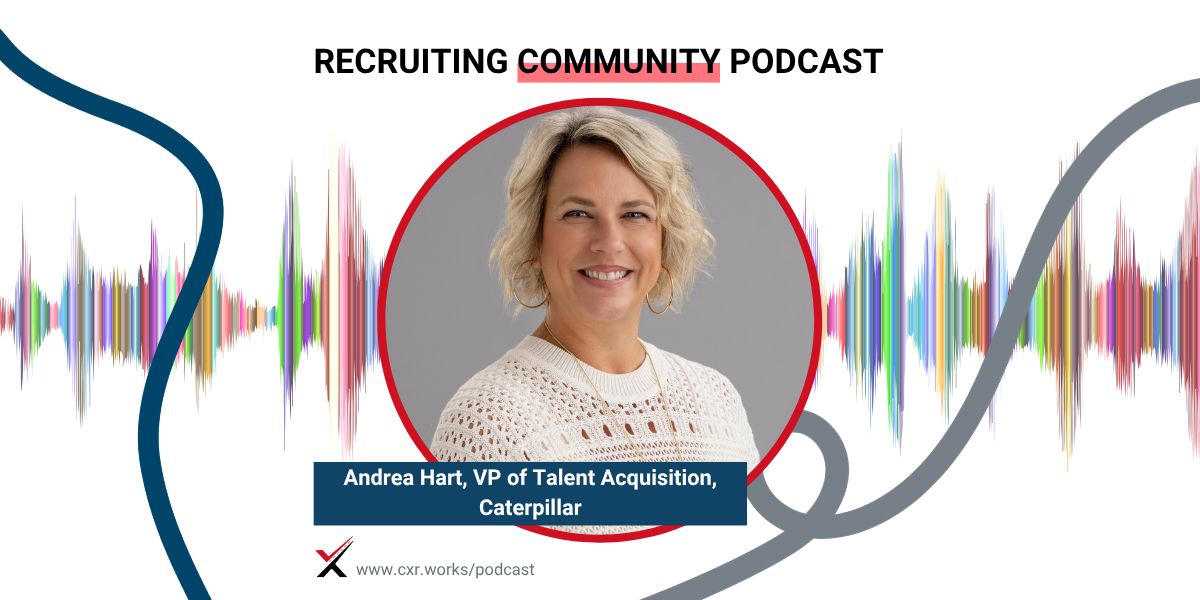
Andrea Hart, VP of Talent Acquisition, Caterpillar
Hosts:
Chris Hoyt, President, CXR
Gerry Crispin, Co-Founder, CareerXroads
Episode Overview:
Chris Hoyt and Gerry Crispin speak with Andrea Hart, VP of Talent Acquisition at Caterpillar, about her transition from 25 years in HR and business partner roles into leading Caterpillar’s newly unified TA Center of Excellence. Andrea discusses why she views the TA professional—not technology—as the true competitive advantage, how AI should be used to enable recruiters rather than replace candidate-facing conversations, what HR often gets wrong about partnering with TA, and what surprised her most about volume, complexity, and skilled trades sourcing since stepping into the role five months ago. The conversation also covers internal mobility philosophy at Caterpillar and where she draws the line on human-in-the-loop decision-making.
Key Topics:
Andrea Hart’s career path from technical recruiter to HR business partner to VP of Talent Acquisition at Caterpillar
Why the TA professional, not the tech stack, is positioned as the competitive advantage
AI as augmentation: using AI for behind-the-scenes tasks (resume screening, interview prep, scheduling) while keeping the candidate-facing screening and interview process human
What HR business partners often get wrong about TA, including bringing TA in too late on business cycle changes
The volume and complexity surprises of moving from an HRBP seat into TA leadership
Skilled trades sourcing as a focus area at Caterpillar
Internal mobility philosophy: career ownership by employees, leader-assisted and leader-enabled
TA as “art versus science” — balancing hiring manager needs with data and market intelligence
Human-in-the-loop governance and where TA leaders draw the line on AI involvement
Notable Quotes:
“I truly believe you have to have good talent to have a good business.” — Andrea Hart
“I think candidates don’t want to talk to a bot — they want to talk to a person. They want to really be heard.” — Andrea Hart
“It’s an art in understanding what a hiring manager really needs and wants, and how you get them to articulate that, to finding the candidate who can articulate the same thing. So I call it art versus science.” — Andrea Hart
Takeaways:
Andrea Hart makes the case that the TA professional—not technology—remains the true competitive advantage in recruiting, with AI best applied to behind-the-scenes tasks like screening, interview prep, and scheduling rather than candidate-facing conversations. Her experience moving from HR business partner to TA leadership highlighted the volume and complexity of the TA function, along with the value of bringing TA into business planning earlier. She frames Caterpillar’s approach to internal mobility as employee-owned and leader-enabled, and describes TA decision-making as a balance of art and science.
Want more conversations like this?
Subscribe to the CXR podcast and explore how top talent leaders are shaping the future of recruiting. Learn more about the CareerXroads community at cxr.works.
Chris Hoyt: We are the Recruiting Community Podcast. I am Chris Hoyt, president of CXR, and I’m your host for this podcast, along with my brother from another mother, Gerry Crispin, co-founder of CareerXroads. Gerry, how are you on this glorious day?
It is a glorious day. Feels like yesterday you were cold, and now today it’s hot.
Gerry Crispin: It’s hot and humid.
Chris Hoyt: So on this show, for those who don’t know, we do our very best to bring you industry insights and updates in the form of what we think is a fun conversation. It’s all brought to you by the CXR CareerXroads community. You can learn more about that out at cxr.works.
I am excited because today Gerry and I are joined by Andrea Hart. She’s the VP of Talent Acquisition over at Caterpillar, and I think what makes this a little different than what we normally talk about is Andrea has sat on both sides of the table. Gerry, we always make the joke that we’re in TA and we’re not in HR.
But we’ve got somebody here today who spent years in HR leadership — as a VP and business partner — before stepping into this TA COE, the Center of Excellence piece. So when she says talent acquisition is a potential competitive advantage and not just a function, she’s not defending her turf.
I feel like she’s telling us what the business actually sees. So we’re going to get into that — the TA-HRBP partnership, what surprised her about that, the inside view from TA, and maybe how you keep humans at the center, because we’ve got to talk about AI today, right?
We do. All right, a few things before we jump in. We do the streaming on YouTube, on LinkedIn, we’re on Facebook — we’re still trying to figure out why we’re on Facebook — but you can check us out at cxr.works/podcast. When you’re out there, you can see past and future episodes where Gerry and I have interviewed hundreds of TA leaders and practitioners doing super interesting work, managing global teams, recruiting talent all around the world.
So very exciting stuff, lots of great conversations, really impressive work being done out there. On the site you’ll also find easy ways to like and subscribe. Let us know if you want to join the conversation yourself, or if you think we should have somebody on the show — let us know. That’s how a lot of the guests get here: they reach out and say, “Hey, I’ve got something to talk about.” So let us know if you have something to talk about.
Last thing I’ll remind you of: this is an ad-free labor of love. Nobody pays to be on the show, and nobody paid to be here. So I’m excited to jump right in.
Announcer: Welcome to the Recruiting Community Podcast, the go-to channel for talent acquisition leaders and practitioners. This show is brought to you by CXR, a trusted community of thousands, connecting the best minds in the industry to explore topics like attracting, engaging, and retaining top talent. Hosted by Chris Hoyt and Gerry Crispin, we’re thrilled to have you join the conversation.
Chris Hoyt: Andrea, welcome to the show.
Andrea Hart: Thank you, Chris. Thank you, Gerry. And at least you’re not on MySpace, so be proud of that.
Chris Hoyt: I heard a rumor that MySpace — like, Tom is coming back is what I heard.
Andrea Hart: Hmm. Be interested to see.
Chris Hoyt: Yeah, I don’t know if I’m still connected to Tom. Wasn’t he the first friend you got when you joined?
Andrea Hart: I think so.
Chris Hoyt: Do you remember Friendster? Does anybody remember Friendster?
Andrea Hart: No, I don’t remember Friendster.
Chris Hoyt: Ugh. Was that before MySpace, Gerry?
Gerry Crispin: No, but it was competitive, you know? It was also one of those very unusual things that kept on pivoting.
Chris Hoyt: Yeah, it was weird. And then MySpace became music, or something, for a while, and then Tom took all his money and went away. Rumor is he’s coming back, but we’ll see.
Well, Andrea, for those who maybe weren’t connected to you on MySpace and haven’t had the pleasure of meeting you or working with you, can you give us a little bit of an elevator pitch on who Andrea is, what she does, and where she’s been?
Andrea Hart: All right, would absolutely love to. It’s a pleasure to be here. I’ve had the wonderful ability to work at the same company — I worked at Caterpillar for 25 years, which is kind of unheard of in this day and age. I always choke a little when I say “Oh, 25 years,” because I remember when people said that when I first started, and I was like, “Geez, they’re old.” Now I know people are saying that about me.
But I always tell folks I’ve kind of come full circle. I started as a recruiter — first for a tech recruiting company, then joined Caterpillar as a recruiter — and then spent most of my career in human resources as a business partner in some form or fashion. I’ve worked in operations as well, and then had the wonderful ability to lead our TA team for the last five months. So, definitely an expert now.
Chris Hoyt: Yes, of course. For sure.
Andrea Hart: I sit in Nashville, Tennessee. You can probably tell, we are hot and humid, Gerry, and typically are in August. It’s going to feel like 107 today, I think.
Chris Hoyt: Oh, man. Well, look, you’ve spent a chunk of years in HR, and as you mentioned, you started your career as a technical recruiter before this lengthy run at Caterpillar. Now that you’ve been in the seat leading TA, can you take us through, full circle: what made you say yes to this TA leadership role?
Andrea Hart: It was really easy. In human resources at Caterpillar, we’re a very decentralized — or federated, however you want to call it — organization, but I’ve always had talent acquisition in some form reporting into me, or dotted-line reporting into me. So I’ve always had a connectivity to it, and I truly believe you have to have good talent to have a good business.
I was very excited because this is the first time we’ve had one true head of TA, and we have a lot happening — a lot of investment, a lot of focus on what those future skills are that we’re needing, both on the manufacturing side and the technology side. So to me, this was an opportunity to really bring the community together and for me to be able to champion the culture and champion the work we do with our business.
Gerry Crispin: Great.
Chris Hoyt: I love it. And I think the very first thing you put on our list when we started talking about doing this interview was that you categorized the TA professional as the competitive advantage — not your tech stack, not your refined processes, but the professional. That’s a pretty strong claim, given everything going on in our space, especially in the last year, in a market where a lot of companies are trying to automate that role, or shift how they use that person and that role.
Can you make the case for why the professional is the competitive advantage?
Andrea Hart: I feel very passionate about this, and we’re investing in technology as well — we’re investing in AI, we’re doing all that. But to me, the technology should be invested in to enable that TA professional to do what they do best. I truly believe it is a competitive advantage, for a couple of different reasons.
One, I love to sit in the midst of a TA group and listen to their calls, listen to them talk, sell Caterpillar, listen to them talk about a role, listen to them ask the questions. You can’t replicate that.
And then I always go back to — this probably comes from working in human resources — whenever I’ve done onboarding, or had the chance to present to groups of new hires, whether senior level or entry level, I always ask them, “Why’d you choose Cat?” And the answer is always the people they talked to in the process. The recruiters, the interviewers, the hiring manager — that’s why they chose to come. They didn’t choose because of a technology or a flashy part of the process. It really was about the conversations. So I don’t want us to lose sight, in this technology evolution we’re in, that that really is what makes the difference.
Chris Hoyt: Yeah, I love it. Well, I love that you’re dialed in, too, and listening to conversations, because, Andrea, it sounds to me like you’re of the mindset — sticking with the AI vein — that AI truly is augmentation. It’s an accessory, a tool in the toolbox. It’s not a replacement for the recruiter.
Andrea Hart: I agree, and I don’t think candidates want that either. I think candidates don’t want to talk to a bot — they want to talk to a person. They want to really be heard. I don’t think, as technology continues to advance, you’re ever going to replace that human need of being heard and recognized.
Chris Hoyt: I agree. I think there’s a lot of really cool opportunities, and I don’t agree with a lot of the folks out there screaming that the recruiter’s going away. I think it’s a different skill set, a different managerial approach, a different learning agility. I think the recruiter as we know it today changes, but I don’t think the recruiter job just gets done away with.
Gerry Crispin: And maybe a difference in positioning as well. One of the things you’re totally aligned with, Andrea, is that Caterpillar is such an iconic brand — known for not just the manufacturing process, but the kinds of people who come out of Caterpillar.
Andrea Hart: Agreed. You want to be authentic to whatever your brand is, regardless of wherever you work. And to me, the way to find out what that is, is those conversations, those people. You want to be authentic to that.
Chris Hoyt: I love it. Well, so you’ve lived the business partner side before leading TA. Let’s get a little uncomfortable. I’d love to know — what do you think, by and large, HRBPs get wrong about TA? And if you want to get really honest, what do you think you got wrong about it before you were on the inside?
Andrea Hart: I’ll stir the pot with you gentlemen a little — I do see TA as a sub-function of human resources. I think a lot of core competencies are the same, and I think they’re transferable skills, by all means.
For me, what HR sometimes gets wrong with TA is not bringing them in early enough. Let them know when you see a business cycle coming. Let them know when you see a change coming in your demand schedule. Let them know when you’re going to invest in different technology that’s going to require a different talent skill set. Bring TA in early, because guess what — they provide market insights.
One of the things I’ve enjoyed since coming into this group is the insights I’ve been getting from employment brand — what does our offering look like, is it competitive, what’s the talent landscape in a specific location. TA’s not just going to deliver — they’re not just a supplier of talent, they’re going to provide you those insights to help you better position the business too.
Chris Hoyt: I think you’re spot on. I laugh every time I think about this — we had a TA leader tell us a funny off-the-cuff story where the CHRO came to them and said, “I need your three-year hiring strategy.” And the TA leader said, “Well, do you have a two-year people planning strategy? Is there a forecast I should be working from?” The HR leader said, “Well, we don’t have that.” And the TA leader just went, “Huh?”
Andrea Hart: Yep. It’s all connected.
Chris Hoyt: I think that gets missed a lot. I think you make a really good point — there is an opportunity there. And my wife is an HR leader — we argue all the time about whether TA’s in HR or not. So that’s a pot I don’t mind stirring.
Andrea Hart: I have a feeling she might be right. She might be right, is all I’m saying.
Chris Hoyt: She’s usually right about most things. Well, you also told us one of the things you wanted to talk about was what surprised you about moving into the TA COE from the HR VP chair. So what surprised you the most?
Andrea Hart: For me, I think the surprise, a lot of times, is the amount of volume on a TA partner’s desk, or in the TA community. From an HR business partner seat, you see it from your own lens — but seeing it across the board, we’re a very global team, a very diverse business, is how much volume there is.
But then also the complexity that comes with sourcing and finding talent. I’m focused and very passionate about skilled trades — it’s easy for the business to say “I need this,” but sometimes we have to get creative in thinking about how we build that capability too.
So I think that’s an opportunity. Also — probably not a surprise, but just a value in the profession — we have folks who we encourage to go into HR or other career paths, from TA and back and forth, and I always encourage that because I think it’s really good for people to have different perspectives of the business, going into a COE and out of a COE.
But I also really value those TA professionals for whom this is their passion, their love — they continuously build that skill set. I really have great respect for that. Some people call them the hunters — they find ways to build a talent pool and make great recommendations and suggestions.
And then there’s the connectivity that TA has with community — that’s definitely part of the community cycle, too, and how we give back to the community and build talent in that community as well.
Chris Hoyt: Yeah. Well, you mentioned a little bit — you’re a strong case for internal mobility, you’ve been there 20-plus years, you talk about moving throughout the organization. What’s the lens on internal mobility at Caterpillar when it comes to TA?
Andrea Hart: When we talk about TA from an internal perspective, the philosophy — my personal philosophy — is that employees own their career. It should be leader-assisted, leader-enabled, but definitely employee-owned. Our internal mobility is very healthy — you see a lot of movement, and I think you want to see that at a company. You want to see that mix of people who have the ability to move across the organization and upward in the organization.
But you also want to make sure you’re bringing in fresh talent, with different perspectives and different skill sets, to further the holistic landscape.
Another surprise I had moving into TA: I think everyone puts a priority on TA, but it’s definitely one of those — it’s an art, not a science. It’s an art in understanding what a hiring manager really needs and wants, and how you get them to articulate that, to finding the candidate who can articulate the same thing. So I call it art versus science.
Chris Hoyt: I don’t think you’re wrong. From a relationship standpoint, managing those relationships, I think that’s 100% an art, and I think it gets to that point we were making earlier — can all of this be automated, can all of this be replaced? I don’t think we can replace the relationship. I don’t think we can replace the trust between the TA function and the hiring functions.
So I agree with you completely. And the science of it is beautiful too, because you’ve got the data that comes in, the market research, the counterintelligence — knowing where to look and exactly what to look for. You’re only half a year into this TA piece, but I think you’ve got a lot of these key pieces down, and you know what you’re looking for.
Andrea Hart: Well, fortunate to have a lot of great people who work around me and help bring me up to speed and educate me on it.
Chris Hoyt: Well, and I think Gerry mentioned this too — the scale that Caterpillar hires at is no joke. AI is now involved in nearly every layer of that recruiting process. Is there a headspace you’ve got around how you decide — and this is a hot debate in our space all the time — human in the loop? How do you decide, or how are you discussing internally, where the human stays in the loop, and where you draw a hard line?
Andrea Hart: It goes back to the earlier discussion — it’s really what’s going to better enable that TA partner. So to me, it’s the more task-based-focused pieces. I don’t anticipate us — and other companies do this, and it’s the right thing for them — but I don’t anticipate us moving to where you’re interviewing with AI. I see the screening discussion being with us.
I do see some of the behind-the-scenes tools — that’s where I see AI being able to deliver, to help. Could be screening resumes, could be how you help prep for interviews, how you get interview guides, how you do scheduling. That’s where I see AI as our biggest benefactor. It’s not going to be the candidate-facing piece — that’s going to truly be the TA partner.
Chris Hoyt: I love that. Gerry and I talk all the time about this decision governance and accountability territory for TA leaders today, both seasoned and new in role. You’re talking about stakes and philosophy and tactics — you picked a wild time to step into recruiting. Or back into recruiting, I should say.
Andrea Hart: It is. It’s very different than the day and age when I first started in recruiting — Monster.com and Headhunter and paper resumes. We’re in a new age, but it’s a good age.
Chris Hoyt: I remember hovering over a fax machine waiting for that updated resume to come in so I could run it up to the hiring manager.
Andrea Hart: Oh, boy.
Gerry Crispin: But I think there’s an extraordinary opportunity for those who have experience in HR — especially where they’re knowledgeable about everything from rewards to risk mitigation, to a lot of the issues that fundamentally should be coming to bear in how we look at selection decisions in a company. So I love that you’re marrying the issues that keep you up at night from an HR professional’s perspective into the issues TA is facing. I think that’s great.
Andrea Hart: It is. And I do think TA gets a lot of those questions and has to have that skill set too, to marry into HR as well. But I’d agree — you come at it with a bit of a different lens from an HR perspective.
Chris Hoyt: Yeah, for sure. And I’ll probably get killed for saying this — I think there are a lot of HR people who could probably be pretty good at TA, and a lot of TA people who could be pretty good at HR. But I wouldn’t say it’s one-to-one across the board. It takes a very special set of skills and experience to be able to cross that divide.
Andrea Hart: It’s not one-to-one — it’s what do you want to do, what do you enjoy, what excites you too.
Chris Hoyt: Yeah, what gets your heart pumping about getting up in the morning and going to work.
Well, Andrea, you’re relatively new in seat in this pretty impressive role at a wildly impressive organization. We’re going to have to circle back in another six months to catch up with you and see where you’re at. But at this point, if you were to write a book about your experience so far — what you’ve learned in this last year — what do you think the title would be?
Andrea Hart: Normally I’d go very cheesy, something like Spirit Fingers or something — but I won’t. I used to have this thing where we’d talk about if you had a made-for-TV movie, what would it be called and who would star as you. My book title, I think, would be Don’t Forget the Person.
Chris Hoyt: I love that. And who would play you in the made-for-TV version?
Andrea Hart: Oh — I used to think about what celebrities were typically in those. I can’t think of her name, but she was the one in Beverly Hills — because that’s my era — who played Andrea in Beverly Hills, 90210. So that’s my answer. Just letting you know, I have it all thought out.
Chris Hoyt: Oh my God, I love that. I was more of a Melrose Place guy than a 90210 guy.
Andrea Hart: Ah, could explain a lot of things.
Chris Hoyt: Yeah. Well, look, Andrea — if you called it Jazz Hands and the Spirit Fingers, starring whomever, in the made-for-TV show — who would you give your first signed copy of that book to?
Andrea Hart: I would give it to the TA community I get to work with every day. I don’t think they’d want signed copies, but I’d be happy to, because they’re the ones who make it happen, who I’m learning from every day, and who make it work. So that’s who I’d give it to.
Chris Hoyt: I love it. You’re pretty good on your feet — we ask some weird questions at the end, so we appreciate that.
Gerry Crispin: I love weird questions. It’s all right.
Chris Hoyt: Well, Andrea, we know you’re super busy, and we really appreciate you and your entire team for how they lean in and show up within the community. Thank you so much for cutting out some time to give us today for a quick chat. We appreciate you.
Andrea Hart: Thank you. Appreciate you guys as well. I’ve definitely been on CXR quite a bit as I’m transitioning in.
Chris Hoyt: Cool. Well, you know where we’re at, so we’re always here if you’ve got any questions or need anything at all. And with that, I think we’re going to do a wrap. I want to thank everybody — cxr.works/podcast is where you can catch up on all the other episodes we’ve got out there, hundreds of interviews. And if you want to be on the show, let us know — we’re always talking to fun people, like today. Until then, we’ll see everybody next week. Bye, folks.
Announcer: Thanks for listening to the Recruiting Community Podcast, where talent acquisition leaders connect, learn, and grow together. Be sure to visit cxr.works/podcast to explore past episodes, see what’s coming up next, and find out how you can join the conversation. Whether you’ve got insights to share or want to be a guest on the show, we’d love to hear from you.
If you’re interested in learning more about becoming a member of the CXR community, visit us at www.cxr.works. We’ll catch you in the next episode.
Adam Godson (Workday) on why frontline hiring stays broken—and how process redesign, not just AI, cut time-to-hire from 21 days to 3.5.