
Beyond Recruitment: Talent Marketing as a Business Driver
Maurice Taylor of Lilly unpacks how mission-driven talent marketing, strong internal partnerships, and metrics change the game for TA teams.
 play_arrow
Empathy, AI, and the Business of People Alessa Rivera Badillo
 play_arrow
Building the TA Machine Alessa Rivera Badillo
 play_arrow
The AI Talent Race Alessa Rivera Badillo
 play_arrow
Built for Change: Tracey Friend’s Career Crossroads Alessa Rivera Badillo
Featured Guests:
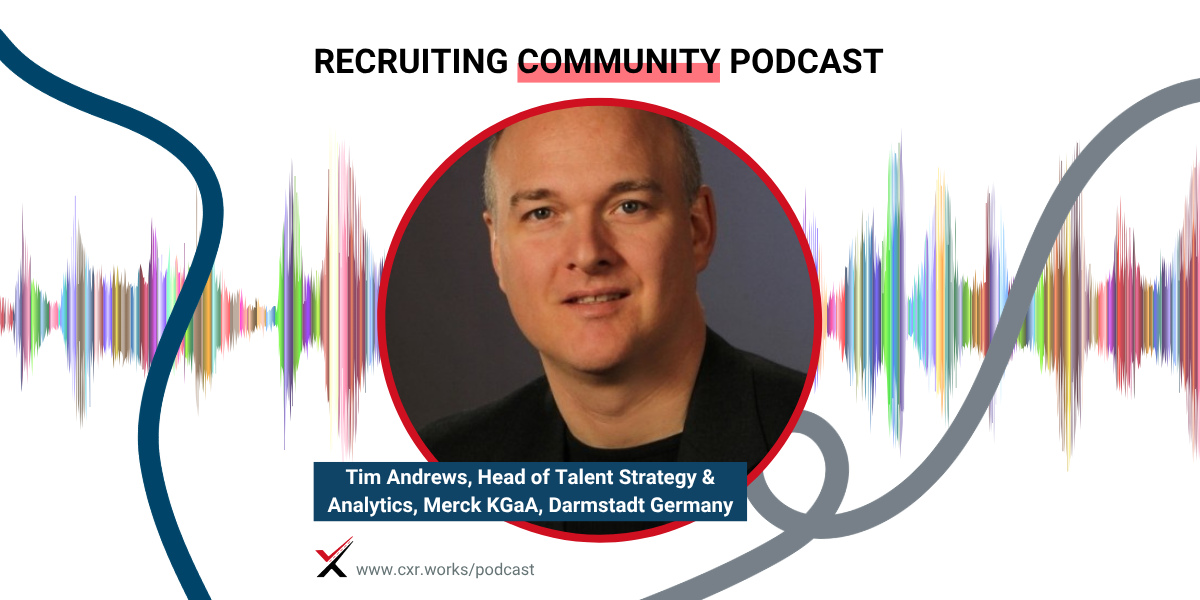
Tim Andrews – Head of EMEA Talent Acquisition, Merck (KGaA, Darmstadt, Germany)
Hosts:
Chris Hoyt – President, CXR
Gerry Crispin – Co-founder, CareerXroads
Episode Overview:
Chris Hoyt and Gerry Crispin discuss the 2026 CXR Recruiting Awards, the first-ever AI-focused edition of the awards, which drew 23 submissions from talent acquisition teams worldwide. Three finalists presented at Marketplace Live in Louisville, including Assurant (Microsoft Copilot agents) and Gallo (an AI offer-letter compliance checker). The winning team, from Merck, is featured for their tool “Recruiting with Ease” (EASE), which turns interview transcripts, CVs, and job descriptions into hiring manager reports, candidate summaries, and Works Council justifications. Tim Andrews, who leads Merck’s EMEA TA team, describes the tool’s origins, the internal approval process, how the team built it on Merck’s internal MyGPT platform, bias-reduction learnings, and results including 88% pilot adoption and NPS gains of over 20 points in EMEA and APAC.
Key Topics:
Overview of the 2026 CXR Recruiting Awards (practitioner-built AI solutions, judging rubric, finalists)
Merck’s rising applicant volumes (40–45% YoY increase) without headcount growth
Origins of the “Ease” tool, built on Merck’s internal MyGPT no-code platform
Approval process: data privacy, digital ethics, labor law, and Works Council Technology Commission (ITK) review
Tool functionality: generating pros/cons, follow-up interview questions, hiring manager reports, executive summaries, and personalized rejection emails
Human-in-the-loop design and talent advisor oversight
Bias-reduction testing: refining prompts to prevent fabricated “cons” for strong candidates
Training the model on Germany’s Works Council agreement and anti-discrimination law
Regional rollout differences (US restrictions on personalized rejection emails due to litigation concerns)
Impact on candidate experience, hiring manager satisfaction, and talent advisor presence during interviews
Results: 88% pilot adoption, 20+ point NPS increase in EMEA/APAC, reduced administrative burden
Notable Quotes:
Tim Andrews: “It’s really a testament to the team.”
Tim Andrews: “I’m a hiring manager — when can I have access to this?”
Tim Andrews: “Neither AI nor humans alone are best — it’s the combination that produces better outcomes.”
Gerry Crispin: “This whole issue of feedback is probably going to matter a lot for the next several generations of candidates entering the workforce.”
Takeaways:
Merck’s TA team built an in-house AI tool, EASE, that reduced administrative burden on talent advisors while improving candidate and hiring manager experience. Key to its success was a human-in-the-loop design, close collaboration with legal and data privacy teams, and deliberate testing to reduce AI-generated bias. The pilot achieved 88% adoption and lifted candidate NPS by more than 20 points in EMEA and APAC markets.
Want more conversations like this?
Subscribe to the CXR podcast and explore how top talent leaders are shaping the future of recruiting. Learn more about the CareerXroads community at cxr.works.
Chris Hoyt: All right, welcome to the Recruiting Community Podcast. I am Chris Hoyt, president of CXR, and I’m your host, along with Jerry Crispin, co-founder of CareerXroads. Jerry, how are you?
Gerry Crispin: I’m doing pretty good. It’s a nice day. Rain’s done. Beautiful.
Chris Hoyt: All right. Together on this show, we do our best to bring you industry insights and updates in the form of what we call a fun conversation. It’s all brought to you, of course, by the CXR CareerXroads community.
Today I’m pretty thrilled because we’ve got the winner of the 2026 Recruiting Awards, the CXR Recruiting Awards, with us. This year was something special — it was the first year we’ve done this, and this is the AI edition of these awards.
The whole idea, Jerry, keep me honest, was for TA practitioners to recognize TA practitioners. So no sponsorship or lead-gen type recognition here, but a way to recognize teams who have built AI to measurably improve recruiting. Not vendors, not off-the-shelf products, but real-world solutions built in-house by the people actually doing recruiting.
I want to call out that the competition was very deliberately practitioner-first, and it was open to anyone — no CXR membership was required to submit an entry or to win. Judging ran on a four-part rubric weighted toward impact, usefulness, usability, and responsible AI.
To put it plainly, I think the industry showed up. We had 23 submissions from talent acquisition teams across the industry and around the world, and every one of them was original work. From that field, three finalists earned a chance to present in person at Marketplace Live in Louisville last month. For those interested, the details are at cxrrecruitingawards.com.
Standing alongside them were some seriously impressive solutions. Assurant brought a suite of Microsoft Copilot agents on track to save an estimated 3,200 hours a year. Gallo built an AI offer-letter checker validated against roughly 1,400 compliance scenarios.
Gerry Crispin: Yeah, it was a great checker, and it was fascinating.
Chris Hoyt: Tough company to be in. But the traveling trophy, the team dinner, and the rest of the goodies went to the team from Merck for a solution they call Recruiting with Ease — E-A-S-E. It’s a tool that turns interview notes, CVs, and job descriptions into manager reports and candidate summaries, and even auto-drafts Works Council justifications in seconds.
For those who don’t know anything about Works Council, that’s no small feat, so stay tuned — we’ll get into why that’s such a big deal, and I think it really wowed the room during that finalist presentation. In their pilot, they hit 88% adoption and lifted candidate NPS. It’s built by TA professionals, for TA professionals, and we’re going to talk about it.
Before we jump in, a couple of things first. We stream on the socials — YouTube, LinkedIn, and Facebook — but you can also check out cxr.works/podcast, where you’ll find past episodes and hundreds of interviews with TA leaders and practitioners doing really interesting work that touches how we attract and recruit talent, as well as manage global TA teams. On the site you’ll also find an easy way to like and subscribe — do that so we know we’re not just talking into the wind. Let us know if you want to join the conversation, too, or if there’s someone you think would make a great guest.
And the big reminder we like to close with every time: this is an ad-free labor of love. Nobody pays to be on the show, and we don’t pay anybody to be here. So let’s get started.
Announcer: Welcome to the Recruiting Community Podcast, the go-to channel for talent acquisition leaders and practitioners. This show is brought to you by CXR, a trusted community of thousands connecting the best minds in the industry to explore topics like attracting, engaging, and retaining top talent. Hosted by Chris Hoyt and Jerry Crispin, we’re thrilled to have you join the conversation.
Chris Hoyt: Tim, welcome to the show. How are you, man?
Tim Andrews: Doing well. Appreciate it. Thanks for inviting me.
Chris Hoyt: Man, I’m pumped, because this is such a cool project and such great work by the team. Before we jump in, can you give us the elevator pitch — who is Tim Andrews, what does he do at Merck, where does he sit? A little background about yourself, please.
Tim Andrews: Sure. I’ve been with Merck since 2021. I actually joined to head up our HR data governance space and build out that capability for HR at Merck, which didn’t exist before. I have a background in data, governance, and analytics, and I transitioned from that role into heading up our EMEA talent acquisition team, because I got the chance to see the need to transform how we worked — to become more data-driven, digital, and AI-driven.
It was an interesting challenge to help the team through that journey, and part of that has been this experiment around how we use AI to help transform how we work. So that’s a bit of my background, and how I got into talent acquisition, and why I’m passionate about data and AI.
Chris Hoyt: So first off, congratulations on taking first place. Before we get into the solution itself, can you take us back to what was happening inside the TA organization that made you say, “We have to build something here”? I understand applications were up 40 to 45 percent year over year for you guys — what was that actually doing to your talent advisors, your teams, in the day-to-day?
Tim Andrews: It became quite challenging, because volumes were increasing significantly, but from a headcount perspective, we weren’t augmenting or building out the teams. In fact, we were seeing a reduction in requisition volumes, so within the organization we were keeping headcount in line with that reduction on the requisition side.
But with that increase in applicant volume, we found we had more work than ever, even though our executives assumed we’d be fine. Between the extra volume and complexity, the increasing demands from candidates came up — candidates often feel like they can’t be seen or heard in the process. Oftentimes it’s an auto-generated rejection email that comes across as really dry, giving them no insight into why they didn’t get the role. In this modern era, people want to be connected with the what, how, and why, and that lack of context is really an opportunity for differentiation.
So the combination of wanting candidates to feel heard, the applicant volumes hitting us, and the struggles our talent advisors had keeping up — it’s really difficult to personalize at scale, and we knew we couldn’t do that. Those were two big drivers. The third is that we’d raised our expectations for talent advisors to become more strategic advisors to hiring managers and the business — not just operational recruiters, but people who deliver insight and guide the hiring managers through the process in a more strategic way.
But to ask that of them, we had to give them the tools and the ability to do it — not just tell them, “Now you need to be more strategic.” How do we help them close that gap of delivering better, faster details and insights to hiring managers? Those were all the drivers that led us to think maybe AI could help us become more efficient and effective in these ways.
Chris Hoyt: Yeah, I love it. One of the things that stood out about the project is that it wasn’t handed to you by a vendor — it was literally built by TA people for TA people, on your own MyGPT platform. Before we get into exactly what was built — because we talk to a lot of leaders who have this hunger, this drive to do it, but aren’t sure how to pull everybody together — can you tell us how the project team came together, and what it was like for the talent advisors to build and test their own agents in a no-code environment?
Tim Andrews: Definitely. It’s really a testament to the team. It started with Lindsay Schindler, who heads up our Germany enabling functions team. She had this idea: “We have this internal MyGPT platform — what if I loaded a transcript, a job description, and a CV in, and asked it for feedback on a candidate? What would happen?”
Obviously, from a data privacy perspective, that’s a bit of a risk, so we did some exploratory work in a very controlled environment just to see if there was something there. Once we realized there was, we said, “Okay, this is really cool, but before we proceed, we have to get the necessary approvals.” So we went through the full data privacy, digital ethics, labor law, and ITK review — that’s our internal Works Council Technology Commission. Basically, anytime you use personal or employee data in any system, you need their review and approval first. So we went through all those approval gates.
After that, I pulled in a couple of talent advisors who were more excited and forward-thinking about AI. I briefed them quickly, since I was about to go on vacation for three weeks, and said, “While I’m gone, can you keep this moving? We want to bring this to life.” I was blown away — I came back, and in two and a half weeks they had literally built an agent using this internal MyGPT platform, which we’re lucky to have at Merck.
Not only did they build it based on our original scope and vision, but they also added the idea of auto-generating the justification for the Works Council, which is a huge time savings we’ll talk about later. And they didn’t have to worry about coding — in this platform you can draft all the language and guidance. It’s not just a prompt; it’s guidance for what and how the agent should operate. You can load in documents to inform and train it. So they loaded in the Works Council agreement and the anti-discrimination law in Germany, which really improved the quality of the output.
The funny thing is, before we built the agent — while we were going through approvals — we just had exploratory examples of what a basic chat experience and output would look like. Our labor lawyers in EMEA were a little concerned about the personalized candidate email. But after we built it as an agent, trained on the anti-discrimination law with more guidance and set parameters, the output for the personalized candidate email was so good that I told the team, “We really should revisit this with the labor lawyers.” We did, and the labor lawyer in Germany said, “I’m a hiring manager — when can I have access to this?” I said, “Does that mean it’s approved?” He said, “Yes, you can use it.” It was really an exciting journey.
From there, we also had team members who helped with enablement — how do we integrate it into the process, what should that look like, and how do we roll it out across our global teams? The one challenge we ran into from a legal and regulatory standpoint was in the US, where the labor lawyers were quite concerned and reluctant about the candidate email, even after we took all those measures. So that’s the only functionality we couldn’t roll out globally — given the litigious nature of the US market, they didn’t want us to take that risk there.
Chris Hoyt: Litigious in the US? That’s crazy talk.
Tim Andrews: Right.
Chris Hoyt: So, Tim, before we talk results — for those who didn’t get to see the presentation or the demo, can you walk us through what this solution is like? What’s the experience you’re improving, and what’s actually delivered?
Tim Andrews: What are the outputs of the tool — yeah.
Gerry Crispin: Yeah.
Chris Hoyt: Yes.
Tim Andrews: So what happens is, the talent advisor loads in the job description, the candidate’s CV, and the transcript of the interview, and the tool generates pros and cons for the candidate. Those pros and cons compare the candidate’s CV and interview responses against the requirements for the role — it’s not a general assessment of the individual, it’s specifically how they fit the criteria we’re looking for.
The cons might flag, say, a component the candidate hasn’t expressed in the interview or that isn’t present in the CV. For those cons, we also generate suggested follow-up interview questions, because just because something didn’t come up doesn’t mean the candidate lacks that skill. That’s where the human in the loop comes in — the talent advisor is the ultimate judge of whether the candidate has enough qualifications and fit to move forward.
Once they decide to move the candidate forward, the pros, cons, and suggested follow-up questions are all generated in about 20 seconds. Again, human in the loop — the talent advisor reviews it: do I agree with this, is there something missing I want to add, is there something that doesn’t make sense that I should remove? Then it’s automatically packaged into a Word document — the hiring manager report — which they can load into the candidate profile in our CRM and send to the hiring manager: “I met with this candidate, I think they’re great, you should meet them — here’s a detailed report.” We also generate an executive summary, a shortened version for an email, since some managers just want the highlights.
That’s one part of the output. The other is that if a talent advisor decides a candidate is skilled but not the best fit for the role, they can generate a personalized rejection email. This was a big deal to me. The first part always thanks the candidate for their time, effort, and energy. Then it speaks positively about the areas of strength where their candidacy was compelling — pulling from the pros, highlighting what we liked about them. Then it explains the decision — what we were looking for that we found more strongly present in other candidates.
This is where the labor lawyers originally got worried, but at the end of the day it’s always honest and fair, and the human in the loop reviews it for accuracy. I think candidates appreciate understanding the decision — that’s what they’re missing, and it’s what leaves them feeling like, “Why did I even apply? I don’t understand why you didn’t like me — I thought I was a good candidate.” Helping them understand is really powerful. And at the end, we encourage them to explore other roles: “We think you’re a great candidate, there’s an opportunity for you here, please keep looking and applying to positions you’re interested in.”
What’s fascinating is that while people were worried, we didn’t get a single complaint during the pilot or afterward. In fact, the volume of response emails with positive feedback thanking us was overwhelming — our talent advisors were like, “I’m getting all these responses!” It’s been really powerful, and as you mentioned, it’s boosted our net promoter scores by over 20 points in the markets where we can use it.
Chris Hoyt: I think that’s fantastic. At a time when I feel like we were getting better as an industry, and then suddenly backsliding on responsiveness to candidates — this whole “black hole” resurgence — I think it was a bold move for Merck to take this on. And especially given how worried everyone is about the litigious side of giving feedback, I love that you guys stepped up and said we owe it to the people who expressed interest in our organization.
Gerry Crispin: I love the process you’ve gone through, Tim. What blows me away is that recruiters are taking on the responsibility of upskilling themselves — with facilitation and support from leaders, and the opportunity to go back to the lawyers and say, “I know you were concerned, but look at what we’re able to do, and let’s continue to defend what we know to be a best practice that puts our brand in high regard.”
Fundamentally, what you’re finding is that candidates see a regard for their journey with you that’s different from what they get elsewhere. This whole issue of feedback is probably going to matter a lot for the next several generations of candidates entering the workforce. You’re leading the way, and doing it in Europe, where a very disciplined approach has to be demonstrated to defend that — whereas in the United States, we’ve got this litigious society, and people aren’t always listening to the logic and positive value of doing the right thing for our employer. So I think this is great.
Tim Andrews: Yeah, it’s interesting — you hear this feedback from candidates all the time: “AI is in the mix, so I never get a real chance, I’m automatically ruled out.” It’s ironic, because I often find that human bias is actually less advantageous for the candidate than AI can be.
An example: say someone has a job title, but all their background and skill set is in a different area. I see people ruled out more often by a human saying, “Why did this person apply for this job? Look at their title.” But everything they did before that role qualifies them. Put them through AI like this, and it immediately says, “This person is incredibly qualified — it’s irrelevant what their current title is, they have the skills and experience for the role.” So there’s a perception that AI is the problem, but I’d say neither AI nor humans alone are best — it’s the combination that produces better outcomes. And the idea that AI responses feel impersonal — actually, AI is helping us personalize at scale. I think people need to flip that script.
Gerry Crispin: Tim, one more thing I’d like to ask about — you mentioned your background is in governance. Increasingly, the conversations we’re hearing are about operationalizing governance as AI becomes more embraced, so the humans in the loop become more of a quality control function. And as that’s built out, we’re able to gain productivity and efficiency.
Tim Andrews: Definitely, yeah.
Chris Hoyt: I think I heard someone say at one of our previous meetings that when a recruiter looks at a resume, they get maybe five seconds. If I give that same five seconds to an AI solution that still has a human in the loop, I think we uncover way more talent than typically gets overlooked — not on purpose, but just because there’s so much to go through and so many recs to fill.
Tim Andrews: Absolutely. Imagine 100, 200, 300 candidates — in India we have thousands for one role, and honestly, of a thousand, maybe 100 are qualified. You’re not going to get through it all, and you’re going to miss some diamonds in that pool. This really just allows us to uncover them.
Chris Hoyt: You’ve said a couple of times that you were pretty deliberate about keeping a human in the loop — transparency, human oversight, and actively working to reduce bias. For listeners doing something similar, how did your team bake those principles in while keeping the advisors and hiring managers clearly in the driver’s seat as decision-makers?
Tim Andrews: Great question. I want to start with assessing and reducing bias, because that was the aha moment for us — the big learning. Being transparent about data privacy is one thing — you disclose what and how you use the information, jump through the hoops, and cover yourself there, which we did. But where we learned the most was in assessing and reducing bias.
Before we even went through the approval gates, we did a ton of testing — before it was an agent, when we were just prompting the LLM directly. We compared the outputs as we added more data: CV and job description alone, then adding the transcript, across multiple candidate types. What we saw, which was fascinating, was that as we gave more context, the cons got worse and worse for our top candidates in the field.
We wondered why — was it hallucinating, making things up? The more information we fed it, the worse it should have gotten, but it got worse in a different way. Then it hit me: these were the candidates we wanted to hire — our finalists. As humans, we struggle to find cons for someone we think is amazing and want to hire tomorrow. So the model was essentially just following orders — “You’ve asked me for cons, so I have to produce some, regardless of whether it makes sense.”
Once we realized that, we changed the guidance in the agent. We added language saying there could be no cons for a candidate — if there are none, don’t make any up. We said, don’t give us a set number of cons; only provide ones that are legitimate and realistic. It’s one of those learnings where you think, “That’s kind of obvious,” but we’d forgotten it’s literally an order-taker — unless you tell it how to think, or free it up to think, it’ll just give you what you asked for.
That was one of the fascinating learnings from that extensive testing and refinement. The other piece — I mentioned it already — is that we trained the model on the anti-discrimination law. We loaded the law in directly, and part of the guidance was: “You must abide by this law. Every output should ensure you don’t infringe on these rights.” That’s an example of how we worked through it.
Chris Hoyt: Everybody talks about how it’s all in how you ask — how you prompt the LLM. But out in the wild, doing the actual work, that stuff really floats to the top. Let’s talk results before we wrap up — your hiring manager experience scores were climbing, your candidate NPS jumped 20-plus points in APAC and EMEA, and real time got handed back to your talent advisors. Of all those wins, which meant the most to the team? Do you have a candidate or hiring manager story that captures what really changed?
Tim Andrews: I can give you one of each. For the team, the candidate experience bump was huge. My team will roll their eyes, but I can’t tell you how often we focused on candidate experience for an entire year — workshops, brainstorming sessions on how to work differently — and a quarter later, we hadn’t seen much movement. My team felt frustrated: “Why do you keep harping on us? We think we’re doing the best job we can.” I think we all felt that.
So when we empowered them with a tool that helped them be more responsive to candidates in the way candidates want, and we saw those numbers jump, that was significant. The other thing talent advisors appreciated is that, because they had a transcript and were freed from scribbling notes nonstop, they could actually listen, read body language, and be more present in the interview — conducting a more thoughtful, meaningful conversation. Some told me, “I feel like I have a better engagement with the candidate as well.” So I think that contributed, even if it’s hard to measure — candidates feel more seen and heard, not just in the rejection response, but in the interaction itself.
Chris Hoyt: Those are excellent examples, and one really resonates. We talk to TA leaders all the time, and the minute I see them scribbling notes while we’re talking, I tell them, “Don’t worry about that — I’ll forward you the AI summary and notes.” That wave of being present — I think the conversations get better, we go deeper, people pay more attention. I wouldn’t have framed it that way, Tim, but I’m glad you did — I think it makes a real difference.
Tim Andrews: Yeah, definitely. I can also give an anecdote about the hiring manager experience. My peer who heads TA at APAC and I were talking about how things were going in her region, and she said a hiring manager booked 30 minutes with her to talk about one of her talent advisors. I asked how it went — good or bad? We hadn’t originally rolled the solution out to our RPO provider, since we divide our recruiting scope a bit differently than many companies, and a pretty large scope goes to RPO providers who hadn’t gotten the tool yet.
It turned out the hiring manager wanted to compliment the talent advisor, saying she’d given him amazing insight into the candidate and really supported his ability to understand their strengths and weaknesses in a new way — “It’s exceptional, way better than what I get from the equivalent RPO providers supporting us.” My peer went back to the talent advisor and asked what she was doing differently, and she said, “Nothing — I’m just using Ease.” I thought that was a fun anecdote. It clearly makes an impact for those who use it, and that’s really the number one thing you can ask for.
Chris Hoyt: You’re going to laugh at me, Tim, but my face hurts from smiling — this hits all the buttons. It takes care of everyone involved in the equation. I’m really excited about it, glad it’s showing returns for you and the team, and impressed you built this yourselves. I’m really happy you submitted, that it’s working, and that you took first place.
Tim Andrews: I appreciate it. It’s a testament to the team, honestly — we have such an amazing group of people who are eager, open, and willing to try new things. It goes to the entire project team, and to all the talent advisors who used the tool and helped deliver those results.
Gerry Crispin: There are a number of conferences that would love to hear your story, if you’re open to that.
Tim Andrews: Yeah, happy to talk about it and share.
Chris Hoyt: So, Tim, the traveling trophy — it’s obnoxious, it’s huge.
Tim Andrews: It’s pretty big, yeah. I showed a picture to our chief HR officer and my leader, Nora, and they said, “That’s a big trophy.”
Chris Hoyt: So where’s it headed — is it sitting in Germany?
Tim Andrews: Yeah, I think so — that’s where we’re headquartered. We’re Merck KGaA in Darmstadt, Germany, so we always have a bit of an awkward reality with our branding, since there’s the American company in the US and we’re not the same company. But yeah, I think we’ll have it sitting at headquarters here.
Chris Hoyt: As you should. I think what you guys should do, as the first winners of the trophy, is flip it over, sign the bottom with a Sharpie, and we’ll seal it up. It’s exciting — one of the other prizes was a team dinner, so I can’t wait to get the logistics figured out and come visit. Really excited. Congrats.
Tim Andrews: That’s gonna be great. I think we’ll want to include our labor lawyer and data privacy officer, because so many TA professionals we talk to who’ve heard about what we’re doing say they want to do something similar — and they always struggle with data privacy, labor law, and ethical considerations. We do a lot of advising and consulting with folks on that, so I think we need to recognize them and their willingness to work with us, which allowed us to explore these capabilities. We’re going to invite them too, if you don’t mind.
Chris Hoyt: You’re a good man, Charlie Brown. In the hundreds of interviews we’ve done — 600-something — never once has a TA leader said, “Let’s invite the lawyers to dinner.” You’re breaking new ground.
Tim Andrews: It’s got to be a partnership — it’s the only way you can move the needle.
Chris Hoyt: I love it. Well, Tim, thanks so much for your time — I know you’re busy. Much gratitude for showing up, and congrats again to you and the entire team, not just for the award, but for the returns you’re getting and the recognition and acknowledgment you’re giving back to candidates, which is just so important.
Tim Andrews: We appreciate the recognition, guys — it’s a huge honor. Thank you for hosting the award, and for really embracing what we’ve done.
Chris Hoyt: Happy to do it. Again, for those who don’t know — Jerry and I recused ourselves. We had nothing to do with the judging. It was all practitioners and peers, so the recognition came from your colleagues, my man.
Tim Andrews: That’s awesome.
Chris Hoyt: Good stuff. All right — cxr.works/podcast for anyone who wants to see past episodes. Listen to this one twice, there are a lot of nuggets in here. Tim’s a great guest. And cxrrecruitingawards.com — check it out, you can see every submission, with a brief summary, and the three finalists, and learn more about what’s going on at Merck. With that, everybody, we’ll see you next time. Thanks.
Announcer: Thanks for listening to the Recruiting Community Podcast, where talent acquisition leaders connect, learn, and grow together. Be sure to visit cxr.works/podcast to explore past episodes, see what’s coming up next, and find out how you can join the conversation. Whether you’ve got insights to share or want to be a guest on the show, we’d love to hear from you. If you’re interested in learning more about becoming a member of the CXR community, visit us at www.cxr.works. We’ll catch you in the next episode.
Maurice Taylor of Lilly unpacks how mission-driven talent marketing, strong internal partnerships, and metrics change the game for TA teams.