
Both Sides of the Table: Why TA Is the Advantage
Caterpillar’s Andrea Hart on why the TA professional—not the tech stack—is the real competitive advantage, and where AI fits in.
 play_arrow
The AI Talent Race Cami Grace
 play_arrow
Built for Change: Tracey Friend’s Career Crossroads Cami Grace
 play_arrow
 play_arrow
Featured Guests:
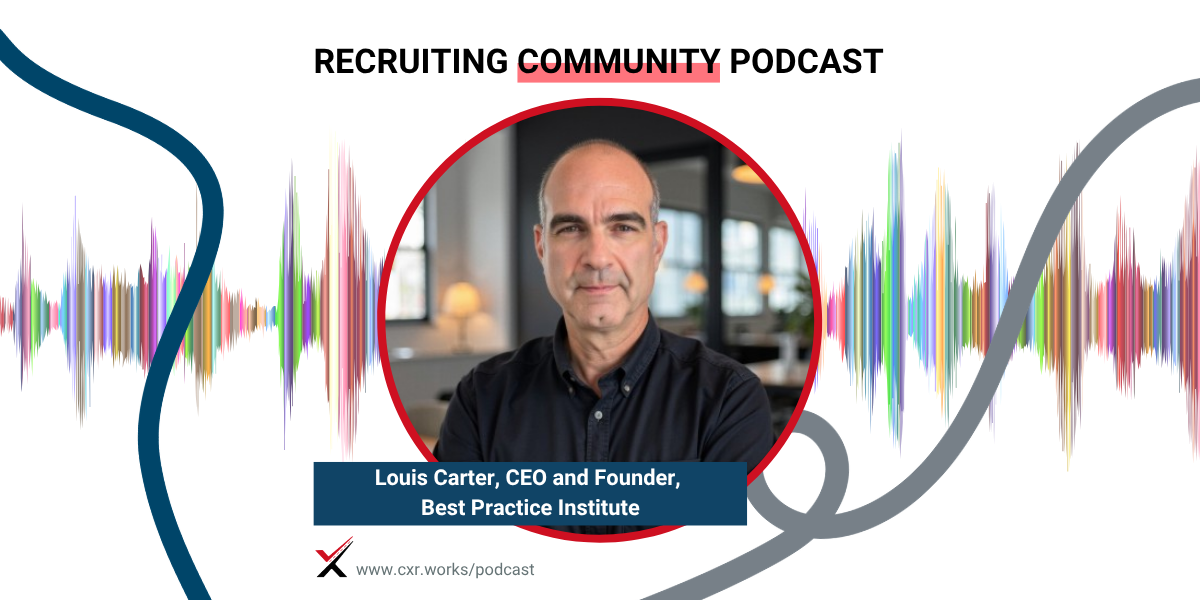
Louis “Lou” Carter — Founder and CEO, Best Practice Institute; Creator, Most Loved Workplace Certification
Hosts:
Chris Hoyt — President, CareerXroads (episode host)
Gerry Crispin — Co-founder, CareerXroads (credited as co-host in show intro; did not speak in this episode)
Episode Overview:
Chris Hoyt speaks with Lou Carter, founder of the Best Practice Institute and creator of the Most Loved Workplace Certification, about employer branding as a measurable business strategy rather than a marketing checkbox. The conversation covers Carter’s career background, the “Love of Workplace Index” (SPARK model), how to tie employer brand to metrics like time to fill and time to impact, how AI is changing the way candidates evaluate employers, how companies should respond to negative reviews on platforms like Glassdoor, the role of domain authority and citations in AI answer engines, and Carter’s recommendations for TA leaders looking to invest in employer brand.
Key Topics:
Lou Carter’s background and the founding of the Best Practice Institute
The “Love of Workplace Index” / SPARK model and the Most Loved Workplace Certification
Culture fit vs. skills/experience in hiring decisions
Tying employer branding to measurable outcomes: time to fill and time to impact
Compensation structures and proving ROI in executive search
AI and “vibe coding” as an emerging skill set across business functions (not just engineering)
How candidates use AI to research and evaluate employers
Responding to negative reviews on Glassdoor/Indeed — the concept of “evidentiary reviews”
The role of lawsuits and reviews in shaping employer reputation
Domain authority, citations, and AEO (answer engine optimization) in AI search results
Building a “moat” of published content (articles, case studies, data) to support employer brand
A five-year prediction on what will separate winning employer brands from others
Carter’s book recommendations: In Great Company and No Brainer Hire
Notable Quotes:
“I think it’s the number one thing to filter for, I really do. Skills and experience are extremely important… But I’d take someone who’s been there, done that, and fits the culture, over someone who’s been there, done that, and doesn’t, any day.” — Louis Carter
“Validation and data. Let’s stop right there — validation and data.” — Louis Carter
“Evidence is everything, which is why we call them evidentiary reviews — give evidence that your culture is not that.” — Louis Carter
“Don’t just document the negative employee experiences. Document the positive ones.” — Louis Carter
“It’s domain authority that seems to get ranked really well with these AI engines bringing back what the world thinks about your brand.” — Chris Hoyt
Takeaways:
Lou Carter argues that employer branding should be treated as a measurable business strategy, tied to concrete outcomes like time to fill and time to impact rather than treated as a soft marketing function. He emphasizes that AI answer engines are increasingly shaping how candidates evaluate employers, making domain authority, citation quality, and a consistent body of published evidence critical. Carter recommends that companies respond to negative reviews with evidence rather than canned replies, and that TA leaders build a steady practice of documenting and publicizing positive culture stories daily.
Want more conversations like this?
Subscribe to the CXR podcast and explore how top talent leaders are shaping the future of recruiting. Learn more about the CareerXroads community at cxr.works.
Announcer: Welcome to the Recruiting Community podcast, the go-to channel for talent acquisition leaders and practitioners. This show is brought to you by CXR, a trusted community of thousands connecting the best minds in the industry to explore topics like attracting, engaging, and retaining top talent. Hosted by Chris Hoyt and Gerry Crispin, we’re thrilled to have you join the conversation.
Chris Hoyt: All right, everybody, welcome back. This is the Recruiting Community podcast. I’m Chris Hoyt, president of CareerXroads, and I’m your host on this episode. On this show, if this is your first time joining us, we do our best to bring industry insights and updates to you in the form of a fun conversation, and of course it’s all brought to you by the CXR CareerXroads community.
Now, really quickly, our guest today is Lou Carter. Lou is the founder and CEO of Best Practice Institute and the creator of the Most Loved Workplace Certification — organizational psychologist, author of, I think, eleven books, Lou can keep me honest on that, all related to leadership and culture, including In Great Company.
And he’s the mind behind the research that now, we think, spans millions of employees across more than a thousand organizations worldwide. His Most Loved Workplace Certification has been featured in Newsweek, in the Wall Street Journal, in Forbes, in Fast Company. So we’ve got a lot to talk about today.
Before we jump in, just a couple of quick reminders. We do all the streaming on the socials — YouTube, Facebook, LinkedIn. We’re still not really sure why we’re on Facebook, but we’ll figure that out. You can check out past episodes and see what’s coming up out at cxr.works/podcast. You’re going to find hundreds of interviews with TA leaders and practitioners and folks in our space doing really interesting work that touches on how we attract and recruit talent, as well as manage and lead these global recruiting teams. On the site, you’re also going to find an easy way to like and subscribe.
Let us know if you’d like to join the conversation, or if you’ve got somebody you think we should have on the show as a guest. And as a last reminder, this is an ad-free labor of love. Nobody pays to be on the show, and—
Announcer: we don’t pay anybody to join in.
Chris Hoyt: So with all of that — Lou, welcome to the show. We’re glad you made it, we’re glad you cut out time for our listeners today. Really appreciate that.
Louis Carter: You got it, Chris. Looking forward to talking with you today about all things employer branding and visibility, and being the culture you deserve to be.
Chris Hoyt: I love it. Well, Lou, for those who haven’t had the pleasure of meeting you, why don’t you give us the elevator pitch? Who is Lou? Why should we be listening to what you have to say today?
Louis Carter: I’ve been around for twenty-five years — you might see I’ve lost some hair. In some of my older photos you can see I had much more hair. So, twenty-five years I’ve been working at this, really since 1996, when I started my work — really working with people who are kind of the “poet society.” I won’t put “dead” in front of them — they’re not dead, they’re alive, like me — and they’re wonderful people. I wouldn’t be here, able to create and innovate in this field, without them, and I want to give honor to them.
I worked with people like Marshall Goldsmith, Peter Senge, Noel Tichy — those were sort of the founding fathers, if you will. And there were founding mothers too: Sally Helgesen, Frances Hesselbein, Bev Kaye. They brought best practices to the world. And what does that mean? It’s really bringing the best thinking, right?
We started really — I was the head of research at a place called Linkage Incorporated, which was later taken over by SHRM. [Editorial note: claim not independently verified — flagged for client fact-check.] I was the head of their best-practices research division, and what we meant by “best practices” back then was: who is doing the best thinking in the field, implementing it with evidence-based research, to show that what I’m doing and what they’re doing works — conceptually and in real life.
And it did, and it does, and it continues to. Even with new technological innovations, the founding basics of organization development, of organizational psychology, remain true today. So that’s where I started. And after that I decided, well, I’d better get some of the degrees that all these luminaries have, because they have all these fancy degrees. So I did.
My first day at — I was getting my graduate degree from Columbia University — 9/11 hit. So, not a good day. It was literally 9/11 on my first day. The tower hit, the whole city was in shambles, the whole place was a mess. And I said to myself, “What do I do now? What do I do with this, in this current state, in New York City?”
So I did what any red-blooded American would do at that time: I started a drum circle. What else could I do? I’m a drummer, I drum in bands, and that’s how I’d been making some money in the city — not a lot. I don’t like getting paid in beer, so I was trying to increase the amount.
So I started a drum circle, and it grew — because of community. And I don’t say that lightly. What I mean by community is a space, a place for people to go and let go of all the stuff that weighs them down and makes them feel like nothing is possible in the world. When you drum with other people, everything’s possible, because you’re just focusing on the beat, focusing on being with each other and having a good amount of fun. You achieve a greater awareness together, and the more you do it, the more you get this real feeling of oneness.
That feeling of oneness has been the through-line in everything I do, and I’ll describe more of what I mean by that. So — “Well, now what do I do with this community?” I didn’t know. I did know I needed money, and I didn’t have any, and I was living in New York City. Not a good combination. And I was a drummer — a really bad combination — with a graduate degree from Columbia. So what was I going to do with all that? It’s a lot of money.
I did have friends, though, and that was a good thing — fancy friends. I went to one of them, who had a big fancy title — VP of leadership development at Pfizer — and he said, “Come on over, Lou, we’ll have some lunch.” So I went to his office. I’ll never forget it. I sat down in his fancy Pfizer office and said, “Joe, I need a job. Can I be your head of leadership development or something like that?”
After he finished laughing, he said, “Lou, there’s no way you’d want to work in a place like Pfizer anyway. You have an entrepreneurial mindset. You like to think, innovate, create. You drum. You don’t want to be in this.” And, lo and behold, he was right. I said, “Well, look, let’s put that entrepreneurial mindset to use — let’s do that now, Joe. How about I keep doing all these books that I don’t make any money on, and I bring you guys in to pay to create the future — to create innovation, to create really the best practices in the world” — for leadership development, performance management, talent acquisition, talent management, all of the HR soup that we do.
He said, “That sounds cool, man, I want to try that.” So he said, “I bet I can get Lou Manzi from GSK to do that — he’s my buddy down in Philly.” [Name unconfirmed — flagged for verification.] Then Lou said, “Well, I can go get Brian Fishel from Bank of America.” [Name unconfirmed — flagged for verification.] And then Brian said, “I can get John Nelson from QBE.” [Name unconfirmed — flagged for verification.] And he said, “Well, I can get Nilu Sardari from Volvo.” [Name unconfirmed — ASR captured as “Nulu/Nilu Sardari,” flagged for verification.] It just kept going — boom, boom, boom — building and building, and people loved it. They said, “Yeah, I want to be part of this future.” So we built it up.
We did benchmarking events — events where we could actually make a difference, not just events with sponsors. We went to places where you could make a difference. What do I mean by that? The United Nations — we’d help with their sustainability goals, their Global Compact. We did that with Ursula and the heads there. [Full name/title unclear — flagged for verification.] And someone said, “We want to help veterans in transition” — from the military to the civilian sector. So we went to the Pentagon and did that as a group. We just kept doing things like that, building this whole anthology of best practices — and it gave people purpose, meaning, and structure. Again, that thread-line of community.
That was important to us, and especially to everyone at the time. But I realized I had to do something more with this. I kept doing it for many years — it became like a family to me. I was sort of like a minister or a father figure there, spiritually, whatever it might be. I was good to these people, I was kind, I was understanding, and they liked that. But I couldn’t do it forever. I moved to Florida, met my wife, started my own family, and said, “This has to change. I need to give this deep love, this deep community thread, to family — and I need to figure out how to make this scale.”
So I said, “Okay, I’d better do the research and find out what this magic sauce is that we were creating.” I wrote a book about it — In Great Company. What does it look like? What are the aspects of the special sauce that gave us meaning, purpose, and high achievement? It became the SPARK model — the Love of Workplace Index — with five sections. It’s simple: How do we collaborate and create? How do we align what we are with the values of what we’re creating? How do we respect the contribution we give to the company, and the opportunity to contribute — which is different from what you might think “respect” means. And then, how do we achieve together?
We changed the paradigm of what emotional connectedness — what love really means — is in a company relationship versus a friendship, to being something we do to achieve together. It turns out achievement is very different in a personal relationship than it is inside a workplace. So that’s what we created together: the Most Loved Workplace Certification, which captures the special sauce of emotional connectedness — what that really means at work, and how it’s different from typical companionate love. Turns out it’s not the same at all.
Chris Hoyt: I wouldn’t think so.
Louis Carter: Not at all. So that’s how we differentiated. We spent five years working with Newsweek on their covers. Now we’ve gone independent — it’s about independent research, about earning the right to get certified, and then achieving from there.
Chris Hoyt: You know what we do — we’re all about community for practitioners and people, and what we’ve found, and what I think is part of our secret sauce, is that it’s not just about the work they do, but about how they care for each other, how they take care of each other. When one is having a hard time, others raise their hands and say, “Hey, can I help?” And it’s that connective tissue that I think is really the magic of them being productive and excelling in their roles — and then also these relationships. When I hear about some of our leaders meeting every week to play mahjong, or some of them in a golf league together, or a book club together — it makes my heart sing, because that’s exactly what you’re talking about: what do we care about, and how do we work with the people we care about when we care about the mission and the work we’re doing together.
Louis Carter: Matthew Sweet has a song I like called “Where Do You Get Love?” [Song title as heard — flagged for verification against the actual track/artist.] And I ask, where do you get love? Down the road, or somewhere up above? People get love in different ways. The group I created, Best Practice Institute, and the group you have, Chris, have people with different reasons for being there. Some want community, some want belonging. Some are filling a void for themselves; some haven’t found their path yet. Meeting people where they’re at is really important for business in general — something that took me a while to fully understand, because it makes business sense to meet people where they are.
Not everybody can be in a certain place. You could hire people who are all spiritual — that would be wonderful — but I think it’s important in a culture to find the sweet spot of the people you’re around. Chick-fil-A is a great example: it’s a spiritual culture. People who are spiritual apply there. You go into their cafeteria and they’re praying before lunch, sitting together, holding hands — I’ve seen it, I’ve been there. So it’s about: where do you get love? What does love look like to you? For the Best Practice Institute’s senior executive board, love was being passionate about making change in the world, and that mattered to them. They said, “I will pay to go help the world.” That’s really cool — I was impressed by them for doing that, for using funds for that purpose, for legacy. I think that’s a noble pursuit.
You can use funds for so many reasons, and it’s important to earmark that. At the end of the year, most people ask, “How much did I give to charity?” What these people were asking instead was, “What did I do to fundamentally change or shift the world in the way it should be, and how did that help or change us?” Because there’s ROI all over the place, and people value ROI in different ways.
Chris Hoyt: Well, I think what’s really interesting to me, Lou, and certainly on our topic today, is the transparency of that mission or culture. You mentioned Chick-fil-A as a great example — a very spiritual culture. That may not be my jam. And that transparency, shining a light on it externally, may help me appropriately opt out. So it’s not just about how fat we can make the top of the funnel, but how we make sure we get the people in who align with the mission and the values — and it won’t be a fit for everybody, and I think that’s perfectly fine.
Louis Carter: I think it’s the number one thing to filter for, I really do. Skills and experience are extremely important — have they been there, done that, can they do it in your culture? But I’d take someone who’s been there, done that, and fits the culture, over someone who’s been there, done that, and doesn’t, any day. There’s probably only one or two, out of the whole population, who check that full box — been there, done that, fits the culture — versus maybe twenty who fit the “been there, done that” part alone. The skilled population is much smaller, but the ratio who also fit the culture is even smaller, and TA leaders really have to be looking for that.
Chris Hoyt: Let me bring us back to the EB standpoint.
Louis Carter: Yeah, let’s do it.
Chris Hoyt: Some of the work you’ve been doing, and some of the discussions you’ve had, really frame — in this modern era of talent acquisition — employer branding shifting from a marketing checkbox to a measurable business strategy. Not just about being transparent about the culture and what leadership means, but — for a skeptical CHRO or CFO who might be listening, or even a TA leader building their case — what does that measurement actually look like for EB to be part of a measurable business strategy? What should get tracked? How can they tie it to a business outcome the C-suite is going to care about?
Louis Carter: Time to fill. I’ll tell you why — I’m going to take it from my own perspective. I’m hiring right now, and I see other TA departments doing this too. You’re going to fill a spot much faster if you’re able to crack my culture equation — which means understanding how I think, how I make money, how I think about my cost of goods, how I get MQLs, how I get SQLs, how I put together my financials. How do I think about that, and what do I expect of an executive coming into that role to be able to do?
Now you’re also thinking about the amount of time required for that individual to achieve those objectives. If somebody came into my company right now — small company, obviously, not mid-size or large — I’d argue that if you’re mid-size or large, you should do the same thing you’d do at a small company. It’s not even an argument, it’s the truth. The best of the best do this.
It’s never accepting that something that could take a year takes five years — or that something that should take two days takes a year. I believe in Parkinson’s Law: the task expands to fit the time you give it. So if people say, “It takes me six months to get up to speed,” and I see HR people going nuts over this — “You’ve got to give them ninety days, four months, five months, they need to get into the culture, have their interviews” — anybody else thinks you’re crazy. We have this laissez-faire, lazy attitude in businesses.
The best TA leaders, the best recruiters, understand there’s a chairperson, a CEO, a CFO — people who need to get to alpha much quicker than the timeline you’re giving them. Now, I know HR disagrees with me vehemently on this — “You’re supposed to be the culture guy, why would you say people don’t need time to get ready, to know what the culture is?” No. If you, as a TA leader, understand that culture equation — and I’ll plug my own thing here, the Love of Workplace Index — there’s a component around “killer outcomes,” career achievement, how you achieve outcomes. [The acronym/model letters as spoken were unclear — flagged for verification.] Achieving outcomes at a SpaceX or a Tesla is far different from achieving outcomes at a Johnson & Johnson. One has 360-degree feedback, many raters, many reviews and surveys, and a big Johnson & Johnson credo posted by the door. The other expects you to work extremely hard and fast and perform at your best — if not, you’re gone, and you’d better be a high achiever. One’s a slower burn, one’s a fast burn — we’re talking rocket ship versus, say, the drug development cycle, which takes longer. We spend money differently in different places, with different burn rates tied to different outcomes. It’s just true.
Chris Hoyt: Right. You’re talking about time to fill, which is such an interesting metric, because not a month goes by that we don’t have a TA leader ask us, in some way, “What’s the average time to fill for X, Y, or Z?” And while you can point to published benchmarks, what we typically tell them is the best-in-class place to measure your time to fill against is yourself — for tracking purposes. External benchmarks are great to have, wildly helpful within a function or an industry, but it’s interesting to hear you talk about rocket ships over here and drug cycles over there.
Louis Carter: Very different. If you’re at a small company, or you have a founder or CEO with a certain runway, know their runway, and make sure the talent fits that runway for the position. It’s that simple. And here’s another secret I’ve picked up working with TA people: if you’re going to ask for a really high number for a role — say, “I want you to pay me $125,000 to fill a $250,000 role” — that’s typical, with OTE and equity and so on — you’d better be ready to say, “I know I can get that person who will materially bring you into this market, and they’re ready to bring you 10x value.” That’s very different from, “It’s going to take me two or three months to find the people to sort through.” If you’re right about it, you’d better have great business acumen — you better know how to identify the person who can, say, bring you FDA approval for a new drug, or whatever it is. That’s a Fortune 500 problem. Most of the market is SMEs — there are far more SMEs than large Fortune 500s, and you could be making two million dollars off ten to fifteen SMEs if you can properly cherry-pick.
Chris Hoyt: Well, what you’re talking about now — correct me if I’m wrong — isn’t just time to fill, it’s time to impact.
Louis Carter: Right — when you’re making alpha, when you can prove the ROI. If you can prove that to me, I’ll pay you $300,000, forget the $125,000. I’ll pay $300,000 and make three million any day of the week — but you have to prove it, the math has to be there. So I think TA needs to get better at the math, and better at getting candidates to give guarantees — “I know they can do this” — and not be afraid of it. A lot of people are afraid: “I can’t say she can do that.” Well, see if you can. See if you can get that deal before the deal. Maybe you have a guarantee that this person can get your product into a hundred Best Buy stores. “Just that person will do that? Yeah, she said we can.” That’s worth more — “I’m not paying you $125,000, I want to pay you $200,000.” Those are materially different TA conversations, and they separate the TA people who are rich from the ones who are just right.
Chris Hoyt: Well, that’s a coffee mug or a T-shirt right there. I want to shift a little and talk about one of the tools in this space, because I think we’re all experiencing how AI is transforming how recruiters and sourcers find candidates. And I think one of your arguments is that the same thing is now happening on the other side of the equation — AI is changing how candidates discover employers.
We just held a meeting with about thirty employer brand leaders up in Indianapolis, at Lilly’s headquarters, and did some work around this — that pivot, the other side of the coin. What do you think that shift looks like in practice? What’s the moment a company realizes it hasn’t paid attention to how candidates are using AI — when they realize they’re already behind?
Louis Carter: I don’t think the AI shift is any materially different from the shift to laptops. There’s Moore’s Law — it was supposed to increase processing power in the CPU starting in 1990, and it did. We’ve had technological expansions roughly every five to six years since — skills changed, stacks changed, knowledge changed. We’re now at the cusp of a new one. It’s about a year and a half old — vibe coding started maybe a year and a half ago, and the big vibe-coding platforms emerged about nine to twelve months ago. So this is a relatively new skill.
The Bolts, the Lovables — how to use n8n better, how to use old tools like middleware differently now that we have one headless server to actually code with, which is insane. So the question is: do you need that person in the role to know how to vibe code? If you can vibe code with Claude Code, you can vibe code with Bolt or Lovable, and you know how to do integrations with those resources — then you’re set. You either develop that skill in-house or hire it in — same build-versus-buy scenario we’ve had for twenty years.
So the question is: who do you need, what do they need to know, and what are they using it for? A VP of customer growth or success should know how to vibe code, because they need to know where all the numbers are across all our platforms. How is our employer brand showing up on GPTs? Is our employer brand reputation better or worse than when we started? They have to know how to use that technology — to weaponize it in a positive way, to prove we’re materially helping people, and to check in with staff: “Did you run the security checks yesterday? Did you run the SEO? Did you run the AI checks?”
You have to give people grace, first of all, because nobody is truly an expert in this yet — nobody. If expertise is experience and hours, I’m now officially an expert — I’ve spent well over ten thousand hours on vibe coding since it began, and I don’t want to think about how many tokens I’ve spent to create what I create. So I think the first question anyone should ask a candidate for an AI-adjacent role is: what’s your token efficiency method? How do you prompt? Do you prompt one thing at a time, or ask for three things at once? How many databases do you pull from in a single prompt? That’ll tell you right away how much they’re going to spend in tokens in their first month — twenty thousand, thirty thousand?
The CEO of Nvidia said something like: if his $250,000 engineers don’t spend $750,000 in tokens in their first year, they’re not worth it to him. [Attribution and figures as stated by the guest — unverified, flagged for client fact-check.]
Chris Hoyt: I’d contest that and say—
Louis Carter: Those $250,000 engineers should probably be more efficient than $750,000 — if you’re really good at prompting and prompt engineering, you should be reducing the cost. It used to be spent on SaaS; now it’s spent on tokens and processing power. Look, I think the age of AI is so important because it’s just a new skill to develop, and the job is to find the people who know it and can do it well. For TA, that’s what it’s about — giving grace, understanding where people are, and being able to sell to your client that this candidate, just like any other engineer, is still learning Cursor, still learning CodeRabbit, still learning how to integrate Lovable or Bolt with GitHub. We’re all still learning, and these tools are still improving every single day. Something new comes out every day.
Chris Hoyt: Yeah, it feels like there’s a push every few hours.
Louis Carter: Every few hours there’s a push, exactly. So I think it’s grace, understanding, and caring for people. I’ve had to give myself that grace too.
Chris Hoyt: I love that, and I love that you’re calling out that vibe coding doesn’t just sit on the engineering side — it touches any function in the organization. I completely agree. But I want to circle back to: if we’re going to be more transparent about our culture and our organization, how do we make sure candidates looking for information on us can find it in a healthy way? Because AI is searching for company reputation — pulling from Reddit, from Glassdoor, from headlines. OpenAI announced this week that they’ve hit about a billion dollars in ad revenue and expect to hit $2.5 billion by placing ads within AI responses by end of year. [Figures as cited by the host — unverified, flagged for client fact-check.] So, getting concrete on “AI-trusted content” — when a candidate asks an AI platform where they should work, what determines whether your company gets surfaced and recommended versus sidelined and ignored? What separates content the AI trusts from content it discounts? Or is it all rigged?
Louis Carter: Validation and data. Let’s stop right there — validation and data. Now, of course, if you know AEO, you’ll say citations are really important. Yeah, they are. And the quality of citations is really important. But what’s important to understand is it’s not just quality or quantity of citations — you need data from your employees, and I want to talk about what kind of data, because it’s different than you might think.
There’s Glassdoor and Indeed reviews. You’ll notice on Glassdoor or Indeed — a string of negative reviews is different from a sporadic, staccato pattern of negative reviews interspersed with positive ones. What we call that, in what we do at Most Loved Workplace, is “evidentiary reviews.” If we see a string or staccato pattern of negative reviews, we put them in context: when they were written, who they were about, why they happened, whether they support a larger theme or trend inside the company — because we want to take seriously things that make sense. But we also want to understand: is this a competitor hurting you? That happens. Or is it someone who was a bad fit for your culture and got angry when they left? That happens a lot — not a little, a lot. Or was there a communication breakdown in onboarding, stay interviews, or exit interviews? Stuff happens, we make mistakes.
Then you have to look at things like lawsuits. A lawsuit, in and of itself, isn’t evidence of wrongdoing — that’s an important thing for companies to understand. If you dig into the lawsuits — and we do this, we have to, whenever we put something into media or publications, we run legal checks — we’ve found, in our research and legal reviews, that it’s reasonable to assume that, most of the time, it’s not the fault of the employer. In fact, we’ve found employees getting back at employers, or taking advantage of them for financial gain, on more than one occasion — a recurring pattern, not isolated.
So the most important thing is responding to these reviews, and how you respond. With the Love of Workplace Index, we get real reviews and data from your employees and your existing culture data, and cross-walk it with the index — which, forgive the word, “kills” evidentiary negative reviews. Not in a negative way — it repositions the narrative to reveal the truth of your culture and the hard work you’ve done to build something successful, rather than letting a few bad actors reduce your talent pipeline.
Chris Hoyt: Lou, employers sit in a couple of different camps here — I’ll use Glassdoor as an example, because this argument comes up all the time, and it came up at our EB meeting. There’s an argument that Glassdoor holds the brand hostage — you have to pay for elevated features or privileges to respond and dispute reviews. We heard at least three instances where the former employee’s complaint was, by the employer’s account, literally impossible to have happened, but the employer couldn’t get Glassdoor to take it down. So some employers say, “I’m not even dealing with Glassdoor, I’m not paying them $20,000 or $30,000 or $40,000 a year and assigning a resource to answer every piece of feedback.” Others say, “Are you kidding? It’s the spine of our strategy, we respond to everything.” Are you saying the recommendation is to respond to all of these, to balance the true against the false?
Louis Carter: I’m saying that when you do respond, have the right story — because the story matters, and it gets picked up by AI, by AEO, by search engines, in different ways. Don’t just respond with a canned reply. Respond with evidence that your culture is not that.
Chris Hoyt: Gotcha.
Louis Carter: You have to give real evidence, a validation layer, and the only way to do that is to get certified — because you get real data cross-walked with a real research construct, and you can prove the core of your culture inside those answers. Answer with evidence. Evidence is everything, which is why we call them evidentiary reviews — give evidence that your culture is not that.
Now, some might say, “That would just anger people more — no one ever told us that.” It’s like a customer having a bad cup of coffee at Starbucks, having a bad experience, and Starbucks saying, “We’re not like that.” Evidentiary reviews do work, though — you can prove that the entirety of your culture is a different experience, that these were one-off mistakes, and that you’ve been forgiven and given grace because you’ve done something about it. That one thing — showing what you’ve done about it — wins in media. I’ve worked in media my whole life, and that’s the one thing I’ve been told: if you want to prove you’re not that, tell me what you’ve done about it. Then they judge you on the “what you did about it” story.
So it’s the company that’s done something truly egregious — think about all the things companies have done that are genuinely bad — do we want to punish them for the rest of their existence, strip them of their ability to do business and grow? How much do we want to punish a company for what they’ve done? We have to think about the equal-and-opposite response that weighs what’s actually been done against the reality behind it. The people answering these reviews have to be mindful of that.
Chris Hoyt: There are a lot of organizations popping up now that say, if the employer gives them some money, they can improve how the company shows up within ChatGPT, or Claude, or any number of these LLMs. Is your take that EB leaders should invest in those organizations, or that they should instead double down on what we already know about SEO and how we show up in regular search — and let that carry over? Are those other organizations worth a look, or should that money go toward a resource that can answer evidentiary reviews on Glassdoor and Indeed?
Louis Carter: Both are really important. That’s what we’ve developed at Most Loved Workplace — we have certcheck.mostlovedworkplace.com and visapage.ai. [URLs as stated by guest — flagged for verification before publishing.] We don’t usually productize those separately; we built them to help our customers. What we do is create ten articles for them based on the ten most frequently asked questions candidates have — researched questions, formatted with the right JSON schema so they speak to AI systems correctly. Then we create articles by job — for engineers, say, what those engineers do inside our culture, how you can succeed in your career there. And we create pillar articles connecting all of that to their Spark scores, their Love of Workplace Index scores — the real data from real people happening inside the company.
All of that gets used when you respond to reviews, and to get cited by AI. It lives on Best Practice Institute, on Visapage, on CertCheck, and on their Most Loved Workplace profiles — an ecosystem of places and articles and research, all based on real statistics, real data. It makes a difference because they now have a body of knowledge — a library that defends them, almost like a moat around them.
I do think some of those pay-to-improve-your-AI-visibility organizations are — I have to say it — I think they’re a little concerning. I feel for a company when mistakes happen; people are flawed. This ecosystem is their moat, their protective layer, their insurance — the way they weather the storm of poor reviews. It doesn’t have to define you as a company. If you’re a TA leader or recruiter for these companies, don’t get scared off by a 3.2 rating. You can still fill the role, but you have to fill it with truth.
My truth is probably different from your truth, Chris — we might share some truths together. What matters is finding a company’s truth and representing it. To do that, you have to build the articles, publish in independent journals, show that you’re one of the best, show the signals — what we call “love signals”: press releases, articles, places you post. It’s about how you post, what you post, and how it speaks to AI answer engines in a very specific, consistent way. So: absolutely, both respond and publish — and publish the right way, with the right messages, with a validated layer.
Chris Hoyt: There’s an interesting thing that happened, I think within the last week or so — some massive reduction in Reddit content showing up in ChatGPT specifically; I’m not sure about the other LLMs. [Claim as stated by host — unverified, flagged for fact-check before publishing.] And some of the exercises we did at our last meeting really proved an interesting point: it’s domain authority that seems to get ranked really well with these AI engines bringing back what the world thinks about your brand. So I think the big takeaway was — and a lot of what you’re saying too, Lou — partner internally with your communications team, your corporate affairs team, anything like that. Because, to your point earlier, everything from lawsuits to the fairy-tale stories you wish you could print on a billboard tends to come back tied to resources with strong domain authority, which AI, at least presently, seems to give extra validation or priority to.
Louis Carter: And it has for years — domain authority has always impacted SEO, always impacted page ranking. The difference we see with AI answer engines is that, in addition to DA, it’s the thread-line and the story, and the volume of citations. There are citations at low DA that will still surface, and how low matters — some are so low they probably won’t surface but will still be in the algorithm. That’s the important point: your whole ecosystem has to be clean, not just the top pieces, because LLMs can handle millions and millions of data points — search never could. With search, you’d have to go three hundred pages deep to unearth the lowest-DA content. So while they might weight a high-DA article more, they’ll also weight the low ones. Its capacity for search is exponentially higher than any search engine has ever achieved.
Chris Hoyt: Yeah, I’m absolutely aligned with that. Let me ask our Monday-morning question. If you’re going to make a five-year prediction, Lou — when we look back, what do you think will separate the employer brands that won this race for talent from the ones that got left behind? Or, maybe better phrased: for the TA leader just now starting to invest in this, what’s the single first step you’d tell them to take? When they hit the office Monday morning, what’s the first trigger they should pull?
Louis Carter: The most important thing — and I’ve seen this time and again — is don’t get caught up in the minutiae of your work first. You’ve got a lot of pebbles in your work. I want to present one enormous rock that you have to do every single day. If you ignore this rock, in five years you’ll realize you’ve just made a bunch of pebbles. You need your big boulder, and here it is: start building your evidence every single day.
I’ve told HR leaders this for twenty years. I ask them, “What have you shown people this month that you’ve done really well? How are you being your own best marketer?” And they say, “No, I don’t want to brag, I want to be humble, it’s all about the people, I’m a people person, I don’t need to say what I did.” I say, slow down — they’re the ones doing these great programs in your culture, so put them forward for it. It was your initiative. Your job will be far more valuable in a year to your CEO when everybody knows what you did, rather than just your boss knowing.
So — don’t just document the negative employee experiences. Document the positive ones. Connect them to your culture code, to the Love of Workplace Index, to what you actually do in your culture. Double-click on sentiment and emotion — find the love sentiment, the happy sentiment — and put your microscope on that. Blow it up in front of everybody. We’ve always said positive psychology is about focusing on the positive; if you keep putting positive things in front of people, your culture becomes that. Your talent acquisition culture becomes that, and you keep your job, and your employer brand stays rock solid over five years.
The ones who win invest in it every single day — we call them “love stories.” You may laugh at the name, but it’s the truth, and it’s not as fluffy as you’d think. Get them written, get them into articles, write them yourself, get onto podcasts like Chris’s. A percentage of your work should be employer brand relations — communication, articles, creation — showing the amazing parts of your culture, because that’s what AI engines are going to look at. That’s what everyone’s going to be looking at. Enough of the positive, done consistently and mindfully, with a validated layer behind it, will always outweigh the negative.
Chris Hoyt: I love it — consistency will be key there. Well, Lou, we ask this of every guest before we let them go, but I’m going to change it up a bit for you. Normally we ask, if you were going to write a book about this topic, what would the title be — but since you’ve already written a few, I’ll ask instead: if there are one or two books you think everybody should be reading right now, what would they be?
Louis Carter: Two of them, and they relate to everything we’ve talked about today. The first is In Great Company — it has the research methodology behind everything I’ve described, with the questions employers should ask their employees about culture. Every one of those questions works against a negative culture; if you can answer them honestly with evidence, you have a loved-workplace culture. Go to the end, look at the methodology and questions, answer them honestly. Also look at the case studies — Starbucks, Best Buy — for good examples of how other cultures have done it.
The second is my newest book, No Brainer Hire. I love that we’re talking to your audience about this one, because people hired now, in the AI age, are materially different from how people were hired before. You have to be able to prove you’ll make other people’s lives easier, not harder. AI has made us privileged — tough word to use these days, but it’s true. Life is easy: you push a button and it does the work, even while you’re sleeping. So if an AI agent can do that, you have to show that hiring you is a “no-brainer” because you’ll be materially better for the person you’re working for. People forget that. They think, “That’s not my job, to make someone else happy — they should make me happy.” No — wrong. If you want to work for someone, you’re going to make their life materially better, and in turn your life gets materially better too. People who understand that in their bones grow, and help themselves grow by helping others grow. Others walk in asking about salary, PTO, extra days off, thinking they’re great before they’ve proven anything — no, you’re as great as we determine you to be. That’s the stark truth we don’t like to talk about: if someone doesn’t fit what a loved workplace looks like, they shouldn’t get anything but let go. Please read No Brainer Hire — it’s about people who actually work for other people. Imagine that.
Chris Hoyt: What I hear you saying is it comes back full circle to understanding whether you’re a fit at an organization before you’re even in the dialogue about the job specifics.
Louis Carter: A hundred percent, and understanding how that organization works and functions. Here’s the thing we’re missing, though, Chris, and I don’t think enough people see it: the culture has become so anti-organization, so anti-owner, so anti-business, so anti-profit, so anti-capitalism, that we’ve gone too far and forgotten what this is all about. It’s about growth — personal growth, yes, culture growth, yes — but also growth of the company, and making each other’s lives materially better. We’ve forgotten that.
When I talk to a TA person or recruiter who forgets that — and there are a lot of them, not just one or two — I press the red button on my phone. I do. And I guarantee you’ll get other people who want to press that red button too, because you have to know you’re not just representing candidates — you’re representing the people who are paying you, who give you their trust. Respect that. I’ve respected every opportunity I’ve gotten for twenty-five years, every invoice, every yes — I gave it my full appreciation, my full gratitude, and worked as hard as I could to make sure they got the outcomes they wanted and deserved. Start working for the people you’re working for, or it’s all going to fall apart, and you’ll retire never having helped anyone get better than they were before.
Chris Hoyt: I definitely think there’s a tie-in here about really understanding the organization. The flip side — as the candidate — is to ask the right questions. Ask whether this is an organization that aligns with what you believe in. Maybe it’s too capitalistic for you, maybe it’s not enough. Find the organization that matches your own values.
Louis Carter: That’s in the book too — and that’s a big part of it. But I do think the other part of the book introduces a sea change — a shift away from what’s become a too-far, too-far pro-candidate posture. Hiring works when there’s balance between employer and employee, equally respectful on both sides. Otherwise, you’re going to fill positions with people who don’t fit, who don’t understand how to use AI or fit the culture, and I give those hires about a year before it falls apart.
Chris Hoyt: There’s an interesting piece here — I know we’re wrapping up, but in my early EB days I learned a lesson about the EVP, the employee value proposition — the idea that it’s essentially a two-way promise: what the employer promises to provide and do for the employee, and what the employee promises the employer in exchange. If that’s aligned, you’ve got a match that makes sense for the business. But if one side gives more or less than the other, there’s an eventual mismatch, an eventual breakup.
Louis Carter: Well said — that’s exactly what No Brainer Hire is about, making that so apparent. Look at the economics: you’re given a financial outcome immediately, without knowing whether it’ll deliver ROI. You’re taking an enormous leap, and both sides are climbing aboard the possibility of failure simultaneously. That makes employers extremely vulnerable. I think we need to get to a place, especially in the age of AI, where that balance can be assessed in a microsecond — “Oh, it’s a little off, let’s get that back on track.” That’s what No Brainer Hire is about, because I don’t think any generation — mine, or the ones coming after — will have the appetite for the alternative. Think about future generations when you’re filling roles, because I guarantee you’re not connecting with them emotionally if you’re not fully understanding their pain.
Chris Hoyt: I find this topic wildly fascinating, and I’d agree we tend to overcorrect — and I think it also depends on supply and demand from a talent perspective; we overcorrect one way, then the other. That’s a whole other conversation, a whole other show. But Lou, I want to thank you for giving us so much of your afternoon — I know you’re busy, and I’m really grateful you sat down to talk with me today.
Louis Carter: I appreciate the opportunity to be on your show and contribute. Thank you.
Chris Hoyt: That’s good stuff, a great conversation, you’re always fun. For anybody who missed it — rewind it, watch it again, listen to it again. Lou, really quickly — where do we send everybody who wants to learn more about what you’ve got going on, and connect with you directly?
Louis Carter: Definitely go to mostlovedworkplace.com. I want everybody to check it out — search “mostlovedworkplace.com,” where you can get your free AI employer branding audit and strategy. You can start there and actually begin doing the exact work we talked about today.
Chris Hoyt: Perfect, I love it. All right, and for everybody else — thanks, we’ll see you next time. Don’t forget cxr.works/podcast. And again, if you’ve got a guest you think would be great on the show, or you want to come on yourself, let us know and we’ll see what makes sense. Lou, thanks again, man.
Louis Carter: Thank you, Chris.
Announcer: Thanks for listening to the Recruiting Community podcast, where talent acquisition leaders connect, learn, and grow together. Be sure to visit cxr.works/podcast to explore past episodes, see what’s coming up next, and find out how you can join the conversation. Whether you’ve got insights to share or want to be a guest on the show, we’d love to hear from you. If you’re interested in learning more about becoming a member of the CXR community, visit us at www.cxr.works. We’ll catch you in the next episode.
Caterpillar’s Andrea Hart on why the TA professional—not the tech stack—is the real competitive advantage, and where AI fits in.