
Quality of Hire in the Age of AI Fraud
Candidate fraud is hitting new highs. Mike Fitzsimmons of Crosschq joins CXR to unpack hiring intelligence, quality of hire, and what TA leaders must do now.
 play_arrow
The AI Talent Race Cami Grace
 play_arrow
Built for Change: Tracey Friend’s Career Crossroads Cami Grace
 play_arrow
 play_arrow
Featured Guests:
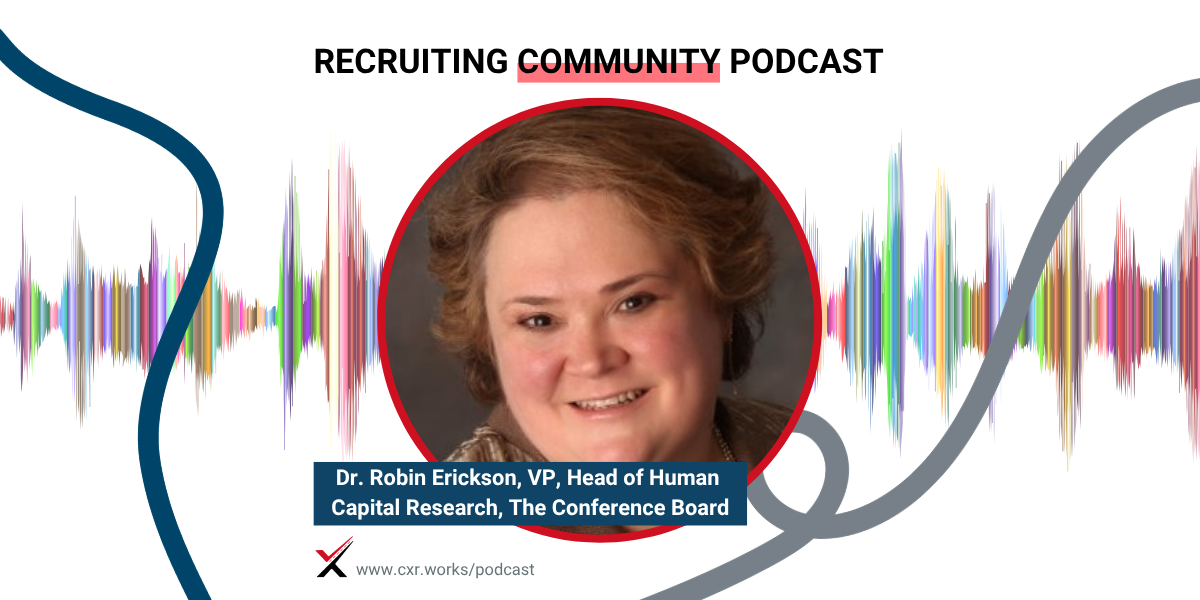
Dr. Robin Erickson, Vice President, Human Capital Research, The Conference Board
Hosts:
Chris Hoyt, President, CareerXroads
Gerry Crispin, Co-Founder, CareerXroads
Episode Overview:
Chris Hoyt and Gerry Crispin speak with Dr. Robin Erickson of The Conference Board about findings from the seventh annual Reimagined Workplace report. The conversation covers the gap between AI adoption narratives and organizational reality, misaligned expectations between leaders and workers on flexibility and benefits, retention challenges across professional and manual services sectors, the structural disconnect around AI fluency and promotions, and practical approaches to measuring employee wellbeing beyond engagement surveys.
Key Topics:
The Reimagined Workplace report’s methodology and seven-year longitudinal history, including how the survey evolved post-COVID
AI maturity levels across organizations: approximately 60% remain at stage one or two
Layoff drivers: restructuring (50%+) and financial pressures (37%) cited far more than AI or automation (6%)
A 17-percentage-point gap between individual contributors and senior leaders on whether AI fluency affects promotions
The absence of role-specific AI training and what that means for promotion fairness and the internal talent pipeline
Flexibility as a workforce expectation: 83% of workers ranked it in their top five benefits; leaders ranked bonus/incentive compensation first
Hybrid work findings: 51% of surveyed organizations are hybrid, 43% fully on-site, 6% fully remote
“Hybrid with purpose” as a more effective alternative to blanket return-to-office mandates
Retention disparities: a 36-point gap between professional/office workers and manual/industry services workers
Declining younger-generation interest in trades and the case for apprenticeship and employer-built training pipelines
The alignment gap between talent acquisition and learning and development
Limitations of engagement surveys: declining response trust, infrequent pulse checks, and the risk of asking questions organizations won’t act on
Stay interviews and operational signals (absenteeism, quit rates, leave usage) as more reliable retention indicators
Generative AI’s utility in surfacing themes from open-ended survey responses
The productivity perception gap: 74% of workers rated themselves highly productive; leaders estimated 56%
Notable Quotes:
“Flexibility is no longer a perk. It’s an expectation and should be part of an organization’s value proposition.” — Dr. Robin Erickson
“If employees feel they’re not being promoted because of a lack of AI fluency, but that expectation was never communicated, something is broken.” — Dr. Robin Erickson
“A failure in L&D to keep people means TA has to work twice as hard — filling the jobs of people who left in addition to growth hires.” — Gerry Crispin
“Don’t ever ask a question in your engagement survey if you’re not willing to act on the answer.” — Dr. Robin Erickson
“Most organizations don’t think about retention until they already have a problem.” — Dr. Robin Erickson
Takeaways:
Organizations face a compounding set of structural challenges — misaligned expectations around flexibility, undefined AI fluency standards, and siloed talent functions — that survey data alone cannot resolve. Leaders who fail to communicate what AI competency actually means at their organization risk both promotion inequity and pipeline gaps. Retention demands proactive listening through stay interviews and behavioral signals, not just periodic engagement scores. The organizations best positioned for tomorrow are those that define expectations clearly, align TA with L&D, and build workforce strategies specific to the segments they’re struggling to attract and keep.
Want more conversations like this? Subscribe to the CXR podcast and explore how top talent leaders are shaping the future of recruiting. Learn more about the CareerXroads community at cxr.works.
Chris Hoyt: Welcome to the Recruiting Community Podcast. I’m Chris Hoyt, president of CXR, and I’m here with Gerry Crispin, co-founder of CareerXroads. Gerry, how are you?
Gerry Crispin: I’m wonderful — right side of the dirt today. We made it to the seventies where we are, so I’m very happy.
Chris Hoyt: You mean the temperature.
Gerry Crispin: The temperature, yes. I’m almost in my eighties, so that might be a bit much.
Chris Hoyt: We’re in rare form today. For those still with us, we are the hosts of the podcast that we like to think brings you industry insights in the form of fun, watercooler-style conversation — all brought to you by the CXR CareerXroads community, which you can find at cxr.works.
Gerry and I today get to connect with longtime friend Dr. Robin Erickson of the Conference Board. We’re going to unpack her latest research and what it reveals about the state of today’s workforce. We may get distracted, but ideally we’re dialing in on what’s shaping the employee experience — job satisfaction, shifting organizational expectations, and the data-driven insights Robin brings to challenge some of our assumptions and spark fresh thinking for the talent leaders tuned in.
A few quick notes: we stream on YouTube, Facebook, and LinkedIn. You can check out cxr.works/podcast for past episodes and what’s ahead — and we have an entirely new design. We’re at nearly 600 interviews in the space, and we’re proud of the work we’re doing and the guests we get to feature. You’ll also find easy ways to like, subscribe, and let us know if you’d like to be part of the conversation — or if you think someone should be on the show, including yourself.
And a quick reminder: this is ad-free, a labor of love. Nobody paid to be here.
I also want to mention an upcoming event that is open to non-members — it’s called Marketplace Live. We’re hosting it in June. It’s technically three days if you’re there for the full experience, and it is unlike anything we’ve ever done. Nothing like any conference, roundtable, or networking event you’ve been to before. Check it out at cxr.org/marketplacelive.
Gerry, tell me if I miss anything — we’ve got a Shark Tank-style environment for vendors covering hot topic areas, a keynote speaker, signature CXR workshop challenges, an amazing dinner, an awards program, private tours of some impressive facilities, and a lot more. What did I miss?
Gerry Crispin: One of the subjects is cybersecurity and the issues around fraud, which have become a real priority for a lot of employers lately. This is an opportunity to get some expertise and find out where the solutions are right now. I’d come just for that.
Chris Hoyt: We’re organizing everything into three categories, and candidate fraud — this cybersecurity piece you’re mentioning — is a major focus. I’m really excited about the people coming in to talk about it. Some of them come from outside our space traditionally and have found their way into recruiting, and they’re making waves. So check it out and see if you qualify at cxr.org/marketplacelive. We make it easy.
Announcer: Welcome to the Recruiting Community Podcast — the go-to channel for talent acquisition leaders and practitioners. This show is brought to you by CXR, a trusted community of thousands connecting the best minds in the industry to explore topics like attracting, engaging, and retaining top talent. Hosted by Chris Hoyt and Gerry Crispin. We are thrilled to have you join the conversation.
Chris Hoyt: Robin, welcome. It’s great to have you back on the show — it’s been a minute. Or two.
Robin, we have been friends with you for decades. We have gone around the world with you, met in fun and magical places and interesting restaurants that shall not be spoken about on this podcast. But for those who haven’t had the pleasure of getting to know you, give us that elevator pitch — who is Robin Erickson, how long have you been doing this, and what is your area of focus?
Dr. Robin Erickson: I work for the Conference Board, where I lead their human capital research. I’ve been there since 2018. Before that, I was at Bersin by Deloitte — which is actually where I met the two of you. Before that, I was a management consultant in the human capital space. In terms of where I fit in this world, I’m very passionate about retention and, on the flip side, getting people in the door — which is one of the reasons we’ve gotten along so well over the years. I’ve also done a lot of research around how organizations respond to crises, which is actually where the report we’re discussing today started.
Chris Hoyt: I remember you were almost a secret weapon — though we always credit you whenever we mention your work. I remember a few distinct conversations during the pandemic where Gerry and I were saying organizations should be doubling down on internal mobility and L&D, and you came back with, “I have data that says so.” Your research really gave validity to what we were seeing in the space — it wasn’t just instinct. It was actually what was happening.
Dr. Robin Erickson: The Conference Board was one of the first organizations to have a survey in the field to find out how organizations were treating their workers. If COVID started in early March for most of the US, we had a survey in the field by April and published our first report in May of 2020.
Gerry Crispin: Robin and I were actually working together at the very start of that, in March, in Canada. We were speaking at one of her conferences, and then suddenly everyone in the room was getting a phone call saying, “Get on a plane and get back to the US before the borders close.”
Chris Hoyt: And here we are all these years later, still worried about borders closing.
Gerry Crispin: For a slightly different reason.
Dr. Robin Erickson: Slightly different reason, yes.
Chris Hoyt: You could call it a sickness — but it’s not a pandemic. Different conversation. I’ll digress. I want to get into the report. Before we dive into the topics, can you share a little about what sparked this research and the methodology behind it? Then I think we can dig into three or four things Gerry and I found really interesting.
Dr. Robin Erickson: As I mentioned, we started this report — the Reimagined Workplace — back in 2020. This is actually our seventh annual edition. At the beginning, we were asking things like, what was your retention like before COVID, and what is it now? After a couple of years, we realized — especially with employee turnover — that if the average employee stays about three years, many of the people in organizations weren’t there before COVID. So we remodeled the survey. We ask certain questions every year for longitudinal tracking, but we also ask about new and emerging issues.
Chris Hoyt: If you want to download the report, you can Google it — it’s easy to find. We’ll also put a redirect on screen: cxr.org/reimaginedworkplace.
Gerry Crispin: It’s a free report, available to anyone.
Dr. Robin Erickson: And the entire series is on our Reimagined Workplace hub, so if you’re curious what we were saying a few years ago, you can find that too.
Chris Hoyt: Let’s get into some of the data. There’s this theme of AI adoption — organizations being poised for tomorrow — but the data tells a complicated story. One thing I noted: AI maturity is still at a one or two for about 60% of organizations. But when you asked leaders who had conducted recent layoffs what drove them, only about 6% cited AI or automation. A lot of people are talking about AI-driven job displacement — it’s dominating the public narrative. So what do you think is the gap between that narrative and what’s actually happening inside organizations right now?
Dr. Robin Erickson: Two things are at play. Layoffs due to AI was the last choice on the list. Respondents could choose up to two reasons, and the number one was restructuring, cited by over 50%. Financial pressures came in at 37%. So yes, layoffs were not directly attributed to AI — but you could argue that for some of those organizations, the restructuring or cost-cutting was done to fund AI investment.
Chris Hoyt: That’s a fair point. We had a discussion not long ago where the consensus was that a lot of this is still correction from the over-hiring that happened in the early twenties. We had those surges in 2020 and beyond, and now organizations are right-sizing. But it’s a lot easier to say “AI and automation” than “we overhired.”
Dr. Robin Erickson: It is a very different spin.
Chris Hoyt: There was another really interesting finding — what you call a critical disconnect. There was a 17-percentage-point gap between individual contributors and senior leaders when it came to the perceived impact of AI fluency on promotions. We’ve been hearing a lot about this from early career hiring — companies are really focused on bringing in AI-fluent graduates, and Gerry’s been meeting with colleges about how AI is being built into curricula. Students coming out are increasingly AI-fluent. But what happens inside an organization when the people making promotion decisions are using criteria the workforce doesn’t know they’re being measured against?
Dr. Robin Erickson: First of all, that’s a real problem. If employees feel they’re not being promoted because of a lack of AI fluency, but that expectation was never communicated, something is broken. We also know that employees leave organizations when they feel safe to do so. That was part of what drove the Great Resignation in 2022 and 2023. I keep saying we’ll have another one — just not right now. Right now there’s too much uncertainty in the world, and people don’t feel safe to leave. But that disconnect is harmful because your employees won’t know what they need to be doing, even though your leaders think they do.
I also read something recently — I don’t remember the source — that most AI training workers receive isn’t tailored to their specific roles. It’s more high-level: what is AI, how do you use it — not job-specific. That’s going to be a problem down the road if role-specific skills are expected but never taught.
Gerry Crispin: There are a lot of layers here, but the reality your data is showing is that even top-level leaders aren’t being held accountable for fully understanding the compounding impact of AI. That’s a problem. There have to be consequences — especially if you’re bringing in early-career employees who are putting serious time and energy into building their AI capabilities for the future.
Chris Hoyt: Do you see this more as a governance and fairness problem than a skills gap? Because I feel like this is exactly the kind of tension TA leaders should be raising upward to their leadership teams.
Gerry Crispin: Without a doubt. The skills are clearly important, but what’s evolving right now is who’s actually taking responsibility for upskilling — who’s being held accountable. And by and large, it tends to be younger workers who are building those capabilities. The question is: who are they going to go work for? If companies aren’t requiring this of their leadership, there’s going to be a huge gap.
Dr. Robin Erickson: You also end up with a leadership pipeline problem. Organizations that define how AI affects each role early will have a stronger internal talent pipeline. And there are going to be companies with big technology ambitions that simply don’t have the staff to implement them.
Gerry Crispin: I’m not worried about startups — but the larger the company, the more likely this becomes a serious problem.
Chris Hoyt: Gerry has long emphasized the importance of communicating expectations clearly. But Robin, I think what we haven’t addressed yet is the need to actually define AI fluency — not just talk about it in the abstract. Not asking you to define it universally, just your take on the stance organizations should be taking.
Dr. Robin Erickson: AI fluency is going to mean something different in a manufacturing company than it will in a knowledge-based or services company. Someone needs to sit down and ask: given that AI is changing every day, what do we think our employees need to know, and how do we make sure they’re getting that learning?
Chris Hoyt: Exactly — what does it mean to be fluent here? What we’re seeing now is a lot of companies saying, “Here’s how we use AI.” But I haven’t heard many say, “This is what AI fluency actually means at our organization.” It’s a lot of “we’re AI-first, AI-forward” — without defining what fluency looks like internally. Have either of you seen that done well?
Dr. Robin Erickson: I haven’t yet, but we’re actually launching a research study on worker upskilling and reskilling due to AI. That’ll come out in the next few months from the Conference Board.
Chris Hoyt: That’s great. We hear a lot of people being told to figure out how to use AI in HR or TA, but we’re not hearing the other side of the coin — what does an AI-fluent HR or TA professional actually look like?
Gerry Crispin: It’s going to be context-based — tied to the categories of roles being impacted. Every function, whether marketing, HR, manufacturing, or anything else, has to be engaged in that conversation.
Dr. Robin Erickson: And there’s a dual responsibility for HR specifically. Not only do we need to make sure HR workers themselves are AI-fluent, but HR is typically responsible for training the rest of the organization. So we need to know what our own people need and then figure out what the rest of the organization needs and develop training accordingly.
Chris Hoyt: That’s a really good point. We have one member company where every employee — at every level — went through about 40 hours of AI training and awareness. I’d love to dig into what the segments looked like within that. Gerry, maybe we should reach out and open that up a little.
Let’s shift gears, because there was something else in the report I found really interesting — benefits, and how this plays into the return-to-office conversation. There’s a significant mismatch in how leaders and workers rank what matters most. Workers put workplace flexibility at the very top — something like 83% placed it in their top five. But leaders ranked bonus and incentive compensation as what they believed workers wanted most. Flexibility came in second for leaders but at a much lower percentage. What does that mismatch tell you about how well leaders are actually listening to their workforce?
Dr. Robin Erickson: One interesting finding in our report was that 51% of the organizations we surveyed said their workforces are hybrid — which surprised us. Forty-three percent said full-time on-site, and 6% are still fully remote.
Back in 2023, we asked workers for the first time: beyond a competitive salary, what matters most to you? We found that workers valued flexibility above everything else. We’ve been citing that ever since, but I finally said to my team, we need to ask this question again. Because you hear all about return-to-office pressure — leaders wanting workers back, managers caught in the middle. So in this year’s survey, we asked workers the same question, and flexibility was still number one at 83%. When we asked leaders, flexibility came in second, but in the low sixties percentagewise.
A lot of people, myself included, believe flexibility is no longer a perk. It’s an expectation and should be part of an organization’s value proposition — especially for anyone focused on attracting and retaining talent. Companies that offer more flexibility will simply have a better shot at both.
Chris Hoyt: Gerry, this is where I thought you’d go on a tangent about whether leaders are actually reading their employee data or just projecting.
Gerry Crispin: Without a doubt. Look — if you’re spending millions of dollars on a building in downtown Manhattan, you’ve likely made commitments to the city tied to a certain number of employees on-site. If you have full flexibility and only 20% of your people are in the office on any given day, the city may come looking for its investment back. So I do think some leaders would genuinely respond to what employees want — if they didn’t see dollars going down the drain in the process. There are also a few leaders who just prefer to be surrounded by people in the office. I get that. But ultimately, you have to listen to the people coming into your organization, understand what they want, and find ways to manage and empower them accordingly. We need to retrain leaders to actually lead.
Chris Hoyt: I remember when the whole return-to-office push started, a few folks called us and said the city had reached out — essentially saying, “Put people back in the office or return the tax incentives we gave you, because you were supposed to be supporting local businesses.” I always wondered how much more effective it would have been if those organizations had just been honest. Said: we have commitments to the city and we need you back to fulfill them — rather than “we’re more productive together” and “collaboration is better in person.” Some of that is true, but we still hear all the time about people going into the office to sit in a cubicle on Zoom calls all day.
Dr. Robin Erickson: And part of that is because technology enables global work. Your team isn’t necessarily in your conference room — they’re in your virtual conference room, like the three of us right now from three different states. It just doesn’t make sense to require workers to commute in to sit on Zoom calls all day, especially in cramped spaces where you can’t focus and you’re hearing everyone else’s conversations.
Chris Hoyt: The transparency would have been fascinating to watch. Would employees have gotten behind it if leaders had been upfront? I think it’s complicated, but it would have been an interesting experiment.
Dr. Robin Erickson: One thing we emphasize in the report is the idea of hybrid with purpose. Rather than simply mandating three days in the office and getting people on different days who still end up on Zoom calls, what if managers determined which days their teams were in together? Then you could actually hold a meeting in a conference room and see each other face to face.
Gerry Crispin: That’s a great callout. I was thinking about this as I looked at the data — there are really two approaches to flexibility. Is it top-down or bottom-up? Most employees want some degree of flexibility they personally control, because life is unpredictable. Your childcare provider might announce they’re going on vacation with a week’s notice. You need that flexibility in your own hands. But you also need leaders who are honest with you about when and why they need you in the office. If they do that, you’ve got a much better way of managing the operation.
Chris Hoyt: I really thought we were going to see a spike in internal scheduling tools — plugins or add-ins that would make it easy to say, “When I’m in, I’m in with intent.” I know I’m going to see this person and that person, and then I’m out. Rather than booking a room and hoping someone shows up.
Dr. Robin Erickson: There are also certain types of work that are genuinely better done alone. It’s really hard to write in a busy office unless you’re wearing noise-canceling headphones. But there are real benefits to being in the office too — getting to know colleagues, those water-cooler conversations. There’s value on both sides.
Gerry Crispin: If I were just coming out of college, that’s one thing. But looking at the three of us — we’ve all been working from home for a good part of our careers at this point. We have our own biases built in. The flexibility has to be there.
Chris Hoyt: We were actually talking about this earlier today, Gerry — a leadership role had opened up and the first questions were about whether it was hybrid or remote, and whether there was travel but not relocation required. That is now the number one question we get when leaders call us about their next move. It used to be about compensation and location. Now it’s flexibility first. They’ll travel, but they won’t move.
And looking at the report — about 83% of organizations said finding talent is the hardest part, while around 60% said retaining it is the biggest challenge. There was also a 36% retention gap when comparing professional and office workers to manual and industry workers. We talked a few weeks ago about demographics — immigration constraints, declining interest from younger workers, and the nature of the work itself as drivers. As most TA conversations are focused on knowledge workers right now because of the AI shift, what does the report say — or what should talent leaders in other sectors be doing that isn’t getting enough airtime when it comes to attracting and retaining their workforce?
Dr. Robin Erickson: Back in 2023, during the Great Resignation, organizations had a tougher time attracting and retaining professional and office workers. But at the beginning of COVID and again now, attracting and retaining industry and manual services workers is the bigger challenge. There are many reasons for that across both groups. Some people say AI is filling the gaps left by retiring workers — if 10,000 baby boomers are retiring a day, yes, you’re going to have openings. But there’s no silver bullet. Organizations need to ask themselves: what type of workforce are we struggling to attract and retain, and what do those workers actually want? Even industry and manual services workers want flexibility — the ability to manage their own schedules.
When we did our Gen Z study a few years ago, a common theme was: our managers don’t give us our schedules until the Sunday before the week starts, and then they tell us to stay late with no notice. You can’t manage your life that way. And I think younger generations simply don’t accept that the way earlier generations did. They believe they can ask for things — and they do.
Chris Hoyt: As I went through the report, I noticed these issues aren’t really tactical. They’re more structural. It’s beyond “pay more” or “improve culture” — it’s about building a real strategy. And that connects to something we were discussing a few months ago: what are the sourcing implications when the challenges are structural? How do we look for talent differently?
Gerry Crispin: People are in different places, first of all. I’m seeing more effort from the sourcing side to figure out where specific groups are — veterans, younger workers, women, whatever the target population is. The point is people are in so many different places, and we have to be where they are to get their attention. We also have to know what they’re interested in to actually engage them. And younger workers may be willing to do the job, but they’re not willing to do it for long. They don’t value tenure the way earlier generations did. They’ll do the job until they’re ready for something else — a different role, a different place, a different challenge. They move faster than any generation before them.
We used to be told by our parents, “You have to spend at least two to five years before you get a chance to do something else.” That’s gone. Six months in, some workers are already thinking about the next thing.
Dr. Robin Erickson: And that connects back to internal mobility. If organizations don’t have career paths for their workers, that younger employee who gets bored and has learned everything they can in their role will go somewhere else. But if you’re smart about it — if someone spends a year learning a job and then wants more — you can show them a path. Here’s how you get to the next level. Here’s what you need to learn, what experiences you need, where this can go. That’s where a talent marketplace becomes so valuable. It’s very appealing to people entering an organization — the idea that they can explore multiple roles, learn more about the business, and that opportunity is democratized across the organization.
Gerry Crispin: That’s exactly why talent acquisition and learning and development need to be much more closely aligned. A failure in L&D to keep people means TA has to work twice as hard — filling the jobs of people who left in addition to growth hires. That friction between those two silos has to be reduced, and it requires leadership and structure to make it happen. A lot of companies are trying, but I haven’t seen many successful examples of truly melding the two.
Dr. Robin Erickson: One of the things we also wrote about is the declining interest among younger generations in many industry and manual services fields. High school students are largely being steered toward college, so fewer people are going into the trades — even though you can often earn more as a union welder than as a liberal arts graduate working at Starbucks. But interest is declining. So organizations need to think creatively: how do you make these roles compelling? How do you build apprenticeship programs? How do you engage people at the high school level?
I knew of an airline that didn’t have enough mechanics, so they created their own training program — where participants got paid to go to school and were guaranteed their first job. They couldn’t guarantee long-term employment, but they could offer a clear entry point. These kinds of solutions exist. We just have to be smarter about pursuing them.
Chris Hoyt: I think AI is actually going to make some of these trades cool again. There’s a level of respect that’s been missing for a long time around carpentry, plumbing, skilled trades. That’s going to come back.
Gerry Crispin: The house of the future — construction of the future — is going to have sensors on all the infrastructure, giving homeowners and building managers visibility they’ve never had before.
Dr. Robin Erickson: Like our cars today, where the computer tells the mechanic exactly what’s wrong.
Gerry Crispin: Today’s auto mechanic is a completely different role than it was 20 years ago.
Chris Hoyt: And here’s an interesting sidebar on that — there’s a term called “servicification,” where things that used to be products become subscription services. A fun recent example: a lot of new cars have a built-in garage door button, but now some of those only work with an active subscription. Which makes me think about your smart home sensors, Gerry — I’m picturing wanting more ice cubes and getting a notification that my refrigerator subscription has lapsed.
Dr. Robin Erickson: It’s bad enough managing the subscriptions we already have. I can’t imagine adding one for my garage door or ice cubes.
Chris Hoyt: Buckle up.
I want to pivot briefly to something else in the report, because we’re talking about attracting talent and there’s been a big push for a while now around work-life balance, mental wellness, and psychological safety. The widest perception gaps between leaders and workers seemed to be in mental health and wellbeing — and a lot of leaders said those were the hardest things to actually assess. That has me thinking about TA and HR leaders who may have blind spots in this area. What’s the most practical thing they could start doing differently this quarter to close that visibility gap?
Dr. Robin Erickson: First, identify what you’re not currently assessing. I once wrote a report on inclusion and engagement, and many organizations were measuring engagement but not inclusion at all. Some companies still do their engagement survey once every two years. Life moves a lot faster than that. Even pulse surveys can be too infrequent. Organizations need to rely on more than just surveys to understand how employees feel about mental health and wellbeing.
One other thing worth mentioning: employees ranked themselves higher than leaders did in every single category we measured. We saw this last year too. So this year we asked: why? Part of the answer was that leaders genuinely can’t assess it — which is what we found. The productivity gap is a great example: 74% of workers said they were highly productive, while leaders estimated only 56% of workers were productive. But how do you measure productivity if no one is making widgets? There are a lot of ways to assess some of these things.
One of the best is the stay interview. Want to know if your employees’ mental health and wellbeing are okay? Talk to them. Ask them if they’re burned out. Ask them what they need. There are different ways to gather this information — organizations just have to start thinking about it.
Gerry Crispin: We also need to think about why we’re measuring what we measure. With engagement, for instance, a lot of organizations don’t actually know why they’re measuring it. Engagement is directly connected to company performance. You need to know whether your employees are engaged or not — but the survey doesn’t tell you why. And what we know from years of data is that engagement has been declining on average. So unless you’re pushing hard, you’re losing that performance connection. You have to ask why engagement is dropping, and that’s when you start listening more closely — whether it’s about mental health, flexibility, or something else entirely.
Chris Hoyt: I think engagement scores have become weaponized. I’m not a big fan of organizations broadly tracking engagement and treating those scores as gospel. And self-reporting is broken too — if you ask me to rate myself on my annual review, I’m always a five out of five. Prove me wrong.
What I think is more interesting is looking beyond survey data points to operational signals — leave usage, quit rates, absenteeism. And maybe AI helps here. Someone who’s fluent in AI could look for mismatched signals: the person says they’re doing great, but their show-up rate says otherwise. Looking at those data points at the team level, not just the individual level, could tell you a lot more.
Dr. Robin Erickson: Agreed. And I’d add two things. First: if a manager consistently can’t keep people on their team, that’s probably a management problem. We need to build people management skills — and the ability to retain talent — into the criteria we use to evaluate and promote into management. How are you doing on that one, Chris?
That said, generative AI has created something genuinely powerful here. Once upon a time, if you had an open-ended survey question, someone literally had to read every response and manually count themes. Now you can feed those responses into a generative AI tool, ask for the top ten themes, and suddenly you have specific, organized reasons behind lower engagement scores.
But here’s the key: don’t ever ask a question in your engagement survey — or any survey — if you’re not willing to act on the answer. Don’t ask employees how they feel about organizational flexibility if the organization has none and leadership won’t change it. Because what happens next is your employees will say, “They asked me this last time, nothing changed, I’m not answering it this time.” And then you’ve lost even more trust.
Gerry Crispin: That’s been true for as long as engagement surveys have existed.
Chris Hoyt: It’s like going to a restaurant and asking if I want steak, and when I say yes, they tell me they only have fish.
Dr. Robin Erickson: It’s even worse if it’s a steakhouse that only serves fish.
Chris Hoyt: “We’ve never had steak, but we do like to call ourselves a steakhouse.”
Robin, I love talking with you. So — if you were writing a book about the state of things today, what would the title be?
Dr. Robin Erickson: Beyond engagement and experience — which we’ve been talking about today — what I’m most passionate about is retention, and why it matters. Most organizations don’t think about retention until they already have a problem. So the title of my book would be: Keep Them: Why Your Best Workers Stick.
Chris Hoyt: I love that. Keep them.
Dr. Robin Erickson: Keep them.
Chris Hoyt: Fantastic. Curveball: present company excluded — who gets the first signed copy?
Dr. Robin Erickson: Gerry, of course.
Chris Hoyt: You can’t do that — I said present company excluded!
Dr. Robin Erickson: Oh right — present company excluded. Then I guess my boss, so they can be impressed with my work.
Chris Hoyt: Honest answer. Fair enough.
Dr. Robin Erickson: The real reason I haven’t written this book is that I don’t want it to end up as just another entry in the leadership book-of-the-month club. Think about how many leadership books you have in your library.
Chris Hoyt: Probably a thousand. I have an entire wall of nothing but recruiting and leadership books.
Dr. Robin Erickson: So if you want to know about retention, reach out to me on LinkedIn. There won’t be a book anytime soon.
Chris Hoyt: I love it. I would read it if you wrote it — even if it were a coffee table book with just pictures. Those are my favorite kind. Robin, thank you so much for joining us. A reminder to everyone: download the report at cxr.org/reimaginedworkplace — we’ve got it on screen for those still with us on the treadmill. Robin, where are you headed next? Any conferences coming up?
Dr. Robin Erickson: I’m speaking at a conference in the second week of May in New York — it’s focused entirely on talent and organizational transformation. Come join us if you can make it.
Gerry Crispin: That sounds great.
Chris Hoyt: I can’t wait to see you again — it’s been too long. Thank you so much for joining us. We know you’re busy and we really appreciate it.
Dr. Robin Erickson: Thanks so much for having me. I’ll come back anytime.
Chris Hoyt: We’d love to have you. Everyone, don’t forget: cxr.works/podcast to listen to past episodes and see what’s ahead. And check out cxr.works/marketplacelive — open to members and non-members alike. Brand new format, unlike anything else out there. We’re excited to see you there. Hit the like and subscribe buttons, and we’ll see you next time.
Announcer: Thanks for listening to the Recruiting Community Podcast, where talent acquisition leaders connect, learn, and grow together. Be sure to visit cxr.works/podcast to explore past episodes, see what’s coming up next, and find out how you can join the conversation. Whether you have insights to share or want to be a guest on the show, we’d love to hear from you. If you’re interested in becoming a member of the CXR community, visit cxr.works. We’ll catch you in the next episode.
Candidate fraud is hitting new highs. Mike Fitzsimmons of Crosschq joins CXR to unpack hiring intelligence, quality of hire, and what TA leaders must do now.