
When Your ‘Perfect Hire’ Isn’t Real
Candidate fraud has entered the big leagues. Teddy Chestnut of Bright Hire breaks down deepfakes, state-sponsored schemes, and what TA can do now.
 play_arrow
The AI Talent Race Cami Grace
 play_arrow
Built for Change: Tracey Friend’s Career Crossroads Cami Grace
 play_arrow
 play_arrow
Featured Guests:
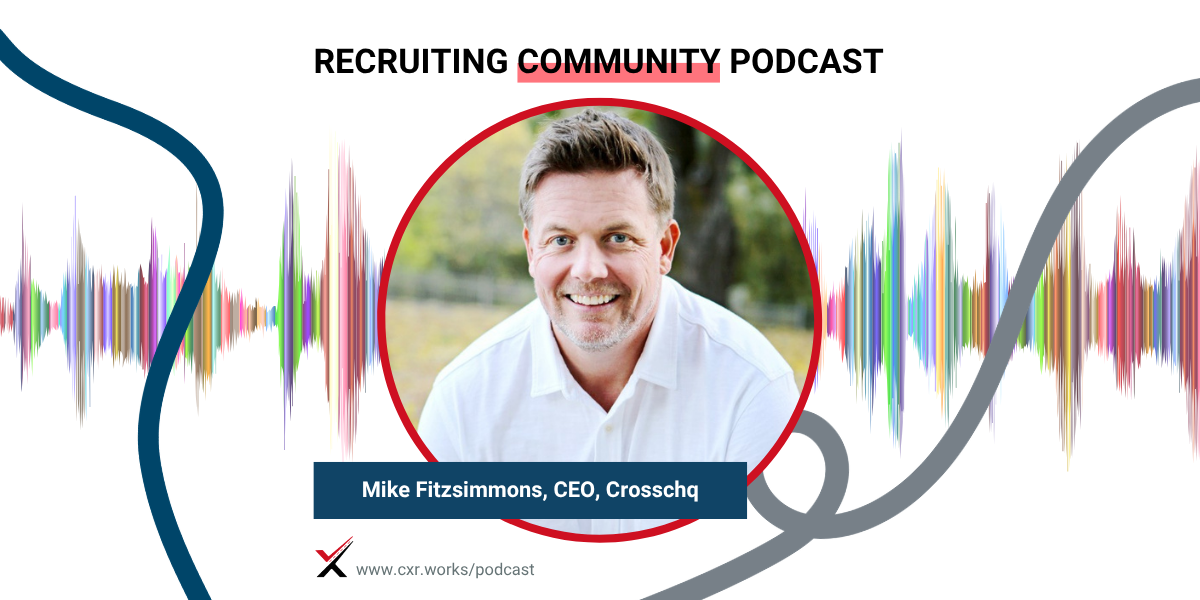
Mike Fitzsimmons, CEO, Crosschq
Hosts:
Chris Hoyt, President, CareerXroads
Gerry Crispin, Co-Founder, CareerXroads
Episode Overview:
Chris Hoyt and Gerry Crispin sit down with Mike Fitzsimmons, CEO of Crosschq, to discuss the growing threat of candidate fraud, the evolving definition of quality of hire, and how hiring intelligence — powered by AI, assessments, and outcome data — is reshaping talent acquisition. The conversation covers the spectrum of candidate fraud from resume inflation to sophisticated bad-actor infiltration, the emerging relationship between TA leaders and CISOs, and practical steps organizations can take to improve hiring outcomes.
Key Topics:
The cyclical nature of quality of hire as a TA priority and why it has resurfaced as the top concern for talent leaders
How AI is shifting hiring from deterministic to probabilistic decision-making
The spectrum of candidate fraud: from resume padding and LLM-assisted applications to deepfakes, white-fonting, and North Korean threat actors
The “red team vs. blue team” dynamic between candidates using AI tools and employers trying to detect misrepresentation
Low-friction identity verification signals as an early-stage fraud detection approach
Why TA leaders and CISOs are increasingly meeting together — and what that signals about organizational maturity
The case for outcome data as the foundation for validating and improving hiring intelligence systems
Crosschq’s acquisition of behavioral and cognitive assessment platform Tradify and the vision for a unified hiring intelligence experience
The potential for AI to accelerate the return of in-person interviewing and dedicated interview centers
The CXR Recruiting Awards: submissions open through April 24, with finalists presented at Marketplace Live on June 10
Notable Quotes:
“The most important decision a company ever makes about an employee is whether or not to hire them. Every decision after that is a consequence of that one.” — Mike Fitzsimmons
“It’s like a red team and a blue team. The red team — candidates with all these tools — is running fast. The blue team is just trying to keep up.” — Mike Fitzsimmons
“The recruiter working alone — just managing their assigned reqs in isolation — is becoming obsolete.” — Gerry Crispin
“I don’t care what it is. Just one more signal than you have today that helps you verify a candidate before you make an offer.” — Mike Fitzsimmons
“Will the death of remote work be caused by AI?” — Chris Hoyt
Takeaways:
Candidate fraud has evolved well beyond resume inflation and now requires organizations to think systematically across the entire hiring lifecycle — with dedicated attention from both TA and security leadership. Quality of hire is no longer a buzzword; it is increasingly tied to measurable business outcomes enabled by outcome data, integrated assessments, and hiring intelligence platforms. For practitioners starting from scratch, the immediate recommendation is simple: add one additional verification signal to the current process and build from there.
Want more conversations like this?
Subscribe to the CXR podcast and explore how top talent leaders are shaping the future of recruiting. Learn more about the CareerXroads community at cxr.works.
Chris Hoyt: Welcome back, everybody. We are the Recruiting Community Podcast. My name is Chris Hoyt — I am the president of CXR. I’m here with Gerry Crispin, co-founder of CareerXroads. Gerry, how are you today?
Gerry Crispin: Really wonderful.
Chris Hoyt: That’s a good day on the right side of the dirt, right?
Gerry Crispin: You got it.
Chris Hoyt: All right. Well, on the right side of the dirt, we’re going to host today’s podcast. We like to say it brings you industry insights and updates in the form of what we think is a pretty enjoyable conversation — water cooler chatter, if you will. Like we bumped into you in the hallway and just started chatting.
Anyway, it’s all brought to you by the CXR CareerXroads community. What we’re going to talk about today is pretty interesting: candidate fraud and bad actor concerns are rising to what seems like an all-time high in what’s starting to feel like an AI-driven world. Quality of hire can no longer be treated as just a talent metric. In today’s conversation with Mike Fitzsimmons — CEO of Crosschq — we’re going to explore why quality of hire matters more than ever, and how AI interviews, assessments, and outcome data are helping teams both predict success and verify candidate authenticity across the hiring lifecycle.
Before we do that, I want to remind everybody we’re streaming on all the platforms — YouTube, Facebook, LinkedIn. You can check us out at cxr.works/podcast, where you’ll find hundreds of interviews with talent leaders and practitioners just like Fitz, talking about what’s going on in their space. You’ll also find an easy way to like, subscribe, and let us know if you want to join the conversation. And I want to remind everybody: nobody pays to be on this show. This is an ad-free labor of love. Gerry, did you pay to be here today?
Gerry Crispin: Not at all.
Chris Hoyt: Rest my case. Really quickly before we jump in, Gerry, why don’t you set the stage for what we’re launching?
Gerry Crispin: We’re super excited about launching the CXR Recruiting Awards. I’m really excited because it’s focused on the folks in the trenches — what they’re doing with AI, with automation, with whatever. Their ideas at that level are fascinating and truly innovative. I’m really looking forward to it.
Chris Hoyt: Yeah, and I’ll remind everybody — people keep asking what qualifies as an entry. It’s everything from a really slick prompt you’re using somewhere in the recruiting workflow, all the way to a complete reimagining, like a custom GPT or an internal implementation. I shared on the last show that one organization was bringing in a vendor for a massive transformation, and they used AI to do a complete inventory of all the assets and artifacts they needed, organized everything, and built out the entire project and scope plan to prep for that implementation — saving what they’re calling countless hours of prep work. Pretty cool. So absolutely anything you’re using AI for within TA qualifies.
April 24th is the submission deadline. All we’re asking for is an up-to-15-minute demo. All data has to be fake or anonymized — we don’t want to see anyone’s private information. We’ll pick three finalists, and they’ll be hosted at Marketplace Live on June 10th, with a VIP dinner and an awards presentation.
Gerry Crispin: But everybody gets acknowledged.
Chris Hoyt: Absolutely — and that’s a great callout, Gerry. We have a wall of fame at the event. If you submit, you’re going to be featured in front of about 70 TA leaders, even if you’re not a finalist. Good callout. Ready to get started?
Announcer: Welcome to the Recruiting Community Podcast, the go-to channel for talent acquisition leaders and practitioners. This show is brought to you by CXR, a trusted community of thousands connecting the best minds in the industry to explore topics like attracting, engaging, and retaining top talent. Hosted by Chris Hoyt and Gerry Crispin. We are thrilled to have you join the conversation.
Chris Hoyt: Welcome, Fitz! How are you, man?
Mike Fitzsimmons: I’m amazing. And I’m sitting here looking at Gerry’s hat and my hat, feeling incredible guilt that our designers — when we launched our new logo a few years ago — may have knocked you guys off. It never really struck me until now, but apologies in advance.
Chris Hoyt: I’m just mad I didn’t get the memo. I would’ve worn my hat today too.
Mike Fitzsimmons: Oh my God.
Chris Hoyt: It looks great. Fitz, for those who haven’t had the pleasure of connecting with you before, give us a quick elevator pitch. Who is Mike Fitzsimmons, what kind of work do you do, and how long have you been at it?
Mike Fitzsimmons: Yeah, for sure. My name is Mike Fitzsimmons, I’m the CEO of Crosschq. You guys have been great friends since we started this journey, and that journey has really been focused on helping organizations improve hiring outcomes. Where that came from, personally — I’m a serial entrepreneur. I’ve started a few companies prior to this and have hired thousands of people along the way. One of those journeys took us to a pre-IPO stage, a couple hundred million in revenue, and in the final stretch we made two regrettable hiring decisions that changed the fate of the entire organization — and decades of my life’s work. So I started Crosschq to fix that problem: how do you fundamentally improve the likelihood of better hiring outcomes? That’s what we’re all about.
We call this category “hiring intelligence.” What we’re really trying to do is supercharge hiring workflows with data to help inform better decision-making. That straightforward.
Chris Hoyt: I love it. We started talking — I can’t even remember how long ago — about this quality of hire initiative. And I remember saying, you know, this is the stuff our TA leaders argue about all the time. Gerry, you may remember this: our first leadership retreat after the pandemic, we watched about 30 heads of TA argue for nearly two hours over what quality of hire meant and whether they should even bother tracking it. I think one of them threw their hands up and said, “I don’t even record it anymore because nobody can agree.”
Gerry Crispin: It’s also a cyclical issue. It quiets down for a while and then comes back. Of all the metrics out there, quality of hire is the most difficult to discuss, in part because of how we look at it and the lack of a standard definition.
Mike Fitzsimmons: I think the words just suck, if I can be blunt. There’s definitely a perception crisis around the problem we’re solving. But when you remove the jargon and simplify it down to “improving outcomes,” anyone who argues that their hiring outcomes can’t be improved starts to have a harder time bickering for two hours about how to measure it. We’ve been told “no” a lot over the years — but finally, to Gerry’s point, we’re in one of those cycles where we’re hearing a lot more “yes.”
Chris Hoyt: And to your point, quality of hire has kind of been a TA buzzword forever, but you’re making the case that it means something fundamentally different now. Can you summarize what’s actually changed from where you’re standing?
Mike Fitzsimmons: A few things drive these cycles, like Gerry mentioned. But one thing that has absolutely changed is the mindset of leaders — and why that’s changed, you guys probably have better perspective on than I do. But leaders just care more now. LinkedIn came out with their annual report and finally listed quality of hire as the number one priority. That same report said D&I was number one three years ago, and recruiting efficiency was number one two years ago. So someone’s finally acknowledging it.
As for why now — I’m a little Bay Area-centric, so bear with me — but Elon certainly caught a lot of people’s attention with the Twitter situation, and it had a downstream impact on the large FAANG companies. People were finding you can actually achieve better business results with fewer people, especially in knowledge-worker roles. That’s real, and it’s happening.
The precision of why now, I don’t have a perfect answer. But the AI conversation has also changed scrutiny around where and when we hire humans and what AI tools can do. And what gets me most excited about the market shift is that the data is now there. The access to data, the ability to train on it — this word “outcomes.” Anyone who doesn’t have their head in the sand understands we’re moving from technology that drives deterministic results to probabilistic results, which means we’re trying to drive better business outcomes.
And as our Dr. Hunt says beautifully: the most important decision a company ever makes about an employee is whether or not to hire them. Every decision after that is a consequence of that one. We’re on the right side of history here. The idea that we can better connect outcomes and understand the ROI of our human capital investments — I just don’t see how the world doesn’t confront that in this next phase.
Chris Hoyt: That makes complete sense. I had dinner with a friend a few weeks ago and he said it’s always just about getting the people part right. If you can get the people part right, that solves 90% of the issues you’ll face running a company or even a function. But that’s getting harder — because the topic of candidate fraud keeps coming up. And where candidate fraud used to just mean an overly padded resume, how sophisticated has it actually gotten today for those who are still grappling with this?
Mike Fitzsimmons: So we have this great slide in one of our decks because this is an incredibly hot topic — there’s no talent leader I talk to who doesn’t want to engage in this conversation. And what we’ve done to simplify it — because this topic gets deep fast — is map it on a spectrum from little-f fraud to big-F fraud.
Little-f fraud is the usual stuff: inflating your resume, using an LLM to match your application to the job requisition, updating your LinkedIn profile accordingly. This is stuff we all understand — it’s just happening more easily now and at greater scale. The ability to mass-apply to jobs is clogging up the top of our funnels. Whether we call that fraud or something else, it’s a real bucket.
As you move along the hiring continuum, any point where there’s engagement with a candidate is an opportunity for them to falsify something — and also an opportunity for us to detect something. You’re hearing about deep fakes and liveness detection in interviews. That’s not happening in 98% of interviews — it’s just one or two here and there — but it’s incredibly painful when it does, and everybody has a story about it. White-fonting on resumes to trick ATS systems into moving you up the funnel — that’s happening. Using an LLM as a co-pilot during the interview to cheat on answers — that’s happening too.
A partner over at SAP described it really well: it’s like a red team and a blue team. The red team — candidates with all these tools — is running fast. The blue team is just trying to keep up. I don’t know what the next tactic will be, but I do know we need a system that can detect suspicious applicants. And hopefully we’re running at the same pace.
The little-f versus big-F distinction is also important for talent leaders to internalize. Am I solving a recruiter efficiency problem — my funnel’s getting clogged with applicants wasting my time? Or am I solving a bad actor problem — like a North Korean threat actor trying to infiltrate my systems and steal financial records? They’re different problems. You can almost map the maturity of the organization and its approach based on where those threat vectors fall on the spectrum.
It’s a real thing. The number of customers and prospects we now have holding weekly meetings between their head of TA and their CISO — it’s absolutely happening. It’s never happened in our industry before. Those two typically don’t even know who each other are unless one hired the other. But now it’s happening, and it’s actually one of the first discovery questions I ask: is your head of TA meeting regularly with the CISO? If yes, I say, “Let’s go — you care.” If no, maybe you don’t yet.
Gerry Crispin: There’s a lot in there.
Chris Hoyt: There’s real tension here I think we have to call out. The more we use AI to screen and verify candidates, the more candidates use AI to game those systems. And I keep wondering: are we stuck in an arms race? Is there a way out of this loop?
In a recent colloquium meeting, we had the room map out the entire TA process — soup to nuts — and mark each step as fully automated, fully human, or hybrid. Nothing came back as fully automated. There always had to be a human in the loop somewhere. But does it feel like there’s a breaking point coming?
Mike Fitzsimmons: Honestly, I don’t know. What I do think is going to happen involves a delicate balance. We have a slide that maps signal fidelity on the Y axis against cost — both hard-dollar cost to the employer and the cost to the candidate experience — on the X axis. You have to plot your decisions against both dimensions.
For example: a full biometric identity scan at the point of application? Absolutely not — incredibly expensive, terrible candidate experience. But God, the signal fidelity would be high. And it would stop a North Korean bad actor cold. So the goal is finding more elegant ways to get high-fidelity signal earlier in the process without impeding the candidate experience.
Here’s a cool example of innovation on that front. We now have a partnership with a leading identity provider where, based on phone number, email address, and name, we can simply ping their system and get a binary answer: does this person have a verified account or not? The candidate doesn’t have to do a thing. We get a reinforcement signal back — “yes, Gerry looks legit” — versus a flag. There’s false positive risk, and it’s not perfect, but it’s a good low-friction, early-stage signal. That’s where innovation is headed: lower cost, no friction to the candidate, pretty high fidelity. We’re probably still on the loop, but I think that’s the game we signed up for.
Gerry Crispin: I love the way you’re describing it. And what it tells me is that the recruiter working alone — just managing their assigned reqs in isolation — is becoming obsolete. It’s out of context of an entire system that has to, at each step of the process, collect the right data, distinguish signal from noise, and inform the human in the loop. The shift is going to be organizational in terms of the operations required to oversee the quality of this process and the outcomes expected throughout the entire candidate journey. That’s not simple — especially if you’re hiring thousands of people.
Mike Fitzsimmons: You’re using that big O word again — outcomes — which is exactly why this loops back to the quality of hire conversation. This whole thing, to be validated, has to be trained on outcome data. Our friend Keith Ling, when we talk about adverse impact, the CCRA, the lawsuits — he always says, “You guys are on the right side of history, because you’re the only ones I know who can back all of this up with actual outcome data.” We’ve built a whole muscle around what happens after the hire, and that’s what informs the intelligence we feed back into the process to improve it. Otherwise, we’re flying blind — or worse, amplifying behaviors that weren’t productive in the first place.
Chris Hoyt: You make a really good point. And at Marketplace Live coming up in June — we mentioned it in the intro — we have a whole section dedicated to the candidate fraud issue. The most aggressive strategy we’ve heard from TA leaders is putting together travel budgets to bring people back in for in-person interviews. We actually had a debate last month: will the death of remote work be caused by AI?
Gerry Crispin: That’s really funny.
Chris Hoyt: Not what everybody expected — it’s going to be AI killing remote work.
Mike Fitzsimmons: We’re actually seeing that, Chris. A lot of companies, especially those with high concentrations of remote workers, are standing up dedicated interviewing centers.
Chris Hoyt: Yeah.
Mike Fitzsimmons: I think it’s an interesting blue team tactic. But it still doesn’t fully solve the problem — who exactly came to that interview? There’s also the insider threat piece: what happens post-hire? The stories we hear about someone taking a job and having their paycheck routed somewhere suspicious — it’s just wild.
Chris Hoyt: No kidding. Horrifying. We had a member who was two days away from shipping a laptop to a North Korean bad actor. You can’t make this up.
Mike Fitzsimmons: Unreal.
Chris Hoyt: When you talk about what’s keeping leaders up at night… I want to go back a bit, though. You’re pooling together interviews, assessments, and outcome data to predict quality of hire. But a lot of teams are still operating with disconnected tools, or no feedback loop at all from the business side. If someone’s starting from ground zero today, where do they actually begin?
Mike Fitzsimmons: You’re hitting on two different things, so let me take them in turn. The first is more about Crosschq’s big vision. We recently made an acquisition — announced last week — of a behavioral and cognitive assessment platform. We’re trying to meet customers where they are and offer solutions at each stage of the process that fit into how they’re already working.
But if you’re asking what a practitioner can do tomorrow, starting from zero? I would say: add one signal to your current process. I don’t care what it is. Just one more signal than you have today that helps you verify a candidate before you make an offer. Trust me — if you have an idea and you don’t think you can get it approved, I bet you can. Start there. One incremental improvement to your overall flow. Keep it that simple.
On the broader vision of aggregating all of this — I think the current state is deeply broken. You’re getting an assessment from one vendor, an interview evaluation from another, a reference check from a third, a resume screen from a fourth. All these fragmented steps are just so ineffective. And even when you look at how it all flows back into major ATSs — the Workdays of the world — if you actually observe what recruiters have to look at to process all of that information and arrive at a recommendation, it’s nearly impossible.
What we’re working toward is one pane of glass — an elegant, unified experience that gets all of this intelligence directly into the hands of recruiters and hiring managers so they can make better decisions. The company we acquired, Tradify, had recently rolled out some really compelling realistic job previews, including immersive versions. Imagine: a candidate sees what a day in the life of the role looks like, moves through behavioral and cognitive assessments, the whole thing — in one elegant, candidate-friendly experience that ends with a highly validated set of intelligence you can actually act on.
So to answer both parts: one signal tomorrow, and one pane of glass as the destination. Just go get one more signal than you have today, and see where it takes you.
Chris Hoyt: I love that. And I want to call out — you’re a CXR member on the solution side of our membership. While you do produce something that helps address this issue, you’re here simply to share your perspective on the space and what practitioners should be aware of. Nobody pays to be on this show, and this really is just a conversation about what’s going on and what folks should be focused on. I appreciate that.
Mike, before we let you go — we typically ask all our guests: if you were going to write a book about the state of things we’ve talked about today, what would the title be?
Mike Fitzsimmons: Well, we have actually written a book on quality of hire — you can buy it on Amazon, so I’d encourage the audience to check that out.
Chris Hoyt: I actually have that here in my office.
Mike Fitzsimmons: But for a new book — there’s the great Jim Collins book Good to Great, and then there was Good to Great to Gone, which is amazing. I grew up in a company called Circuit City that was on the Good to Great list — and then on the Good to Great to Gone list. So I do think about the idea of “Good to Great to… what comes next?” We’re in a moment where it’s going to be fascinating to watch which organizations make it through this phase and which ones don’t. Some of the most iconic companies of our generation simply won’t be here anymore. There’s something in there worth writing about. It doesn’t directly tie to talent acquisition — and yet, arguably, everything ties back to talent acquisition.
Chris Hoyt: I love it. Okay — present company excluded, who gets the first signed copy?
Mike Fitzsimmons: My dad. If he’s still with us by the time I get there — but yeah, my dad.
Chris Hoyt: Aw, there you go. Well, Fitz, thanks so much for joining us. I know you’re incredibly busy, and this is a great topic. Candidate fraud, quality of hire — these are tough issues TA leaders are really wrestling with right now. I love the point you made early on about new partners entering the conversation from inside the organization — people that TA leaders, after hiring them, may have never spoken to again. Seeing that change is exciting. Thank you so much for being here today.
Mike Fitzsimmons: For sure, guys. Thanks so much — have a great week.
Chris Hoyt: You bet. Everybody, a reminder: cxr.org/podcast is where the shows live. And cxrrecruitingawards.com — you’ve got a couple of weeks left to get those submissions in. We’re excited to see what you’ve been working on. Until next time, take care everybody.
Announcer: Thanks for listening to the Recruiting Community Podcast, where talent acquisition leaders connect, learn, and grow together. Be sure to visit cxr.works/podcast to explore past episodes, see what’s coming up next, and find out how you can join the conversation. Whether you’ve got insights to share or want to be a guest on the show, we’d love to hear from you. If you’re interested in learning more about becoming a member of the CXR community, visit us at www.cxrworks. We’ll catch you in the next episode.
Candidate fraud has entered the big leagues. Teddy Chestnut of Bright Hire breaks down deepfakes, state-sponsored schemes, and what TA can do now.