
Talent Chooses You: Reframing the Role of TA in Driving Growth
Is TA just a cost center? James Ellis challenges recruiters to reclaim influence and rethink employer branding in this episode of the CXR Recruiting Community Podcast.
 play_arrow
How Can Employer Brand Stay Human in the Age of AI? Cami Grace
 play_arrow
Solutions Spotlight on SparcStart Cami Grace
 play_arrow
The New Talent Frontier: Policy, People & the Workforce Ahead Cami Grace
 play_arrow
Rethinking TA: Myths, Misalignment, and the AI Reality Check Cami Grace
Featured Guests:
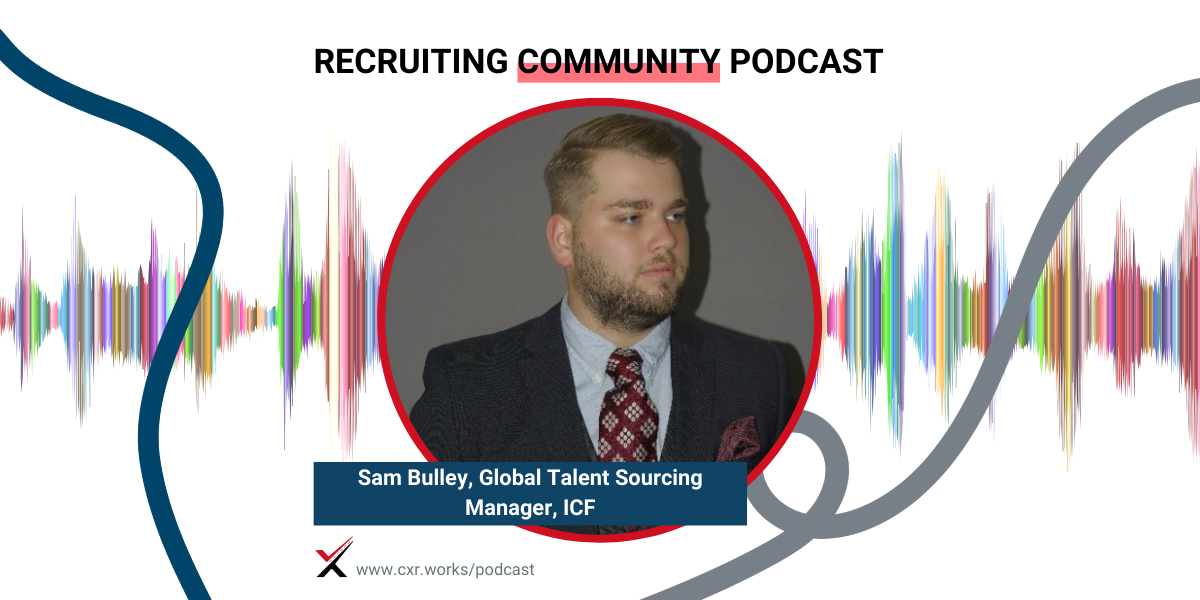
Sam Bulley, Head of Global Sourcing Division, ICF
Hosts:
Chris Hoyt, President, CareerXroads
Gerry Crispin, Co-Founder, CareerXroads
Episode Overview:
In this episode, Sam Bulley shares how ICF is integrating AI into its global sourcing strategies without replacing human roles. The discussion covers how sourcing teams are evolving, the importance of adaptability, and the proactive measures ICF is taking to meet changing hiring demands. Sam also touches on the real-world impact of AI, from increasing efficiency to managing challenges like fraudulent candidates.
Key Topics:
The evolving role of sourcing in the age of AI
ICF’s “Tap Into AI” initiative for ongoing TA training
Balancing traditional networking with AI tools like HireEZ
Emphasizing proactive, strategic sourcing pipelines
Combating fraudulent candidates through passive sourcing
Prioritizing adaptability over tool-specific experience in hiring
The future value of durable skills and learning agility
Notable Quotes:
“AI making hiring decisions is dangerous. What we’ve done well is adapt how we source.” — Sam Bulley
“We’re shifting away from a reactive, bum-in-seat mentality and being more proactive.” — Sam Bulley
“AI is helping prep for meetings, educate the team—but we still make our own decisions.” — Sam Bulley
“It used to be all about what CRM or tools someone knew… Now, it’s agility.” — Sam Bulley
“You still need the fundamentals—like Boolean… that technical thinking helps you troubleshoot prompts.” — Gerry Crispin
Takeaways:
ICF is using AI to enhance—not replace—its sourcing capabilities, focusing on proactive strategies and adaptability. Through biweekly AI training and a shift toward durable skills, the company is preparing its teams to meet the rapidly changing demands of talent acquisition. The conversation highlights how sourcing professionals can stay relevant by embracing AI as a tool, not a substitute.
Want more conversations like this?
Subscribe to the CXR podcast and explore how top talent leaders are shaping the future of recruiting. Learn more about the CareerXroads community at cxr.works.
Chris Hoyt: And you’ve never been to the States?
Sam Bulley: Yeah, I’ve been a couple of times, but not since I’ve been with ICF and had a chance to go to HQ. Pretty much all the guys are there. In the management team, there’s only me and one other that are outside of the US.
So it’s a truly global business, especially with NTA. But yeah, it’d be good to make that trip this year.
Chris Hoyt: Yeah, that’d be great. We have a couple of leaders that sit outside the US, and when they come over, they make a full-blown trip out of it. They come for our leadership event and then they’re here for like two weeks, hitting all the spots.
Is there—Jerry, where’s the number one spot Sam should visit if he pops over to the States?
Gerry Crispin: The one I came back from last night at six o’clock—New Orleans. I spent three and a half days there, and you can probably hear it in my voice.
There are 22 James Beard Award-winning restaurants in New Orleans, and we tried to get to as many as we could.
Chris Hoyt: How many did you hit?
Gerry Crispin: Five.
Chris Hoyt: That’s not bad. Are you still a little food drunk?
Gerry Crispin: Yeah, a little. But it’s my favorite city, Sam—because of the people, the food, and the music.
Quick story: we were walking around the French Quarter and heard this wailing sound—some kind of wind instrument. A woman was sitting in the middle of the street with a few people helping her out, playing at a level that made you think she should be in Carnegie Hall. Turns out, her name is Doreen Ketchens. She’s played for four presidents and has performed at Carnegie Hall. She just prefers staying in New Orleans. People call her the female Louis Armstrong. There were 200 people throwing money in buckets—she’s that good.
You can walk around New Orleans and those kinds of surprises just make your day. And with Mardi Gras coming up, the characters are already out.
Chris Hoyt: I’ve been to Mardi Gras twice. Sam, don’t kill yourself to get here for that.
Gerry Crispin: Yeah, we don’t recommend Mardi Gras—especially if you’re over 25.
Sam Bulley: Noted. New Orleans would definitely be awesome. My old man actually lived in Brooklyn for about seven years—maybe five to ten years ago. I used to love going over to New York, staying outside of Manhattan, trying to blend in with the locals. I’m a big fan of New York and Brooklyn.
Gerry Crispin: That’s a few miles from where I am. I’m in Long Island—also part of Brooklyn, kind of.
Chris Hoyt: Yeah, it’s a cool place. Well, now you’ve got your travel agenda, Sam—you’re all set.
Sam Bulley: Yeah.
Chris Hoyt: There we go. You guys ready to get started?
Gerry Crispin: Betcha.
Chris Hoyt: Alright, let’s do it.
Announcer: Welcome to the Recruiting Community Podcast, the go-to channel for talent acquisition leaders and practitioners. This show is brought to you by CXR, a trusted community of thousands connecting the best minds in the industry to explore topics like attracting, engaging, and retaining top talent. Hosted by Chris Hoyt and Gerry Crispin. We are thrilled to have you join the conversation.
Chris Hoyt: Welcome everybody to the Recruiting Community Podcast. I am Chris Hoyt, President of CXR, here with Gerry Crispin, Co-Founder of CareerXroads. Gerry, say hello.
Gerry Crispin: Hello.
Chris Hoyt: We are your hosts for this podcast. We like to think we bring you industry insights in a fun, conversational way. No hidden agendas, no gimmicks—just good conversation.
All of this is brought to you by the CareerXroads community. We stream on social—YouTube, Facebook, LinkedIn—but you can also check out cxr.works/podcast for all past and future episodes. Hit the likes and subscribes, help make Gerry internet-famous.
We recently kicked off an entirely new design, which we’re excited about. We’re nearing 600 episodes—we did the math and it’s like 560 or something crazy. All interviews with leaders, practitioners, and folks doing interesting work—like our guest today, Sam.
One last disclaimer—Gerry, who pays for this podcast?
Gerry Crispin: I don’t think anybody does.
Chris Hoyt: Correct. It’s an ad-free labor of love. Nobody paid to be here.
Alright, Sam, let’s pull you back in. We’ve got a fun topic today—we’re going to poke the bear a little. But before we do that, give us your escalator pitch. Who is Sam Bulley and what do you do at ICF?
Sam Bulley: Firstly, thank you for having me. I’m Sam Bulley, I head up the global sourcing division at ICF and manage our sourcing center of excellence. My main focus is driving a sourcing methodology within the TA function—bringing in data-driven strategies, supporting growth areas, and engaging top talent to meet short- and long-term goals.
ICF is a global professional services business, primarily in the tech space. We do delivery, advisory, research, program management, analytics—mostly for government clients, though we also serve commercial clients across different domains.
Chris Hoyt: This is a conversation that’s been coming up a lot—especially with the rise of AI. If recruiting teams are utilizing AI really well, do we still need sourcers? Or sourcing teams as we’ve traditionally thought of them?
Sam Bulley: We talked about this at a recent CXR event in London. With AI growing, it’s natural to ask—are robots going to take over?
At ICF, we’ve used AI to make our teams better—not to replace them. AI making hiring decisions is dangerous. What we’ve done well is adapt how we source. The types of roles we hire for are constantly changing.
I read a Gartner article recently—10% of the roles filled by recruiters today are new to them. That means we’re constantly learning what we’re hiring for.
We’re shifting away from a reactive, bum-in-seat mentality and being more proactive—strategic pipelines, staying ahead of hiring needs, and doing the due diligence two months ahead instead of panicking later.
We’re a professional services business—our people are revenue-generating. Time to hire directly affects revenue growth. So it’s not just about filling roles quickly—it’s about doing it right.
Chris Hoyt: I love that. And the strategy you’re applying. How specifically is AI being used—or not used—in your sourcing strategies? Are your sourcers turning into AI prompt engineers?
Sam Bulley: We saw this coming and rolled out “Tap Into AI” at ICF—biweekly training on AI across sourcing and TA. It started with simple stuff—using Copilot for outreach, identifying competitors, or spotting talent trends.
Now, it’s evolved into more—like analyzing who typically bids on certain projects, or saying, “Here’s a good profile, show me more like this.”
We still make our own decisions, but AI helps save time. One team member dropped a JD into Copilot and asked it to “explain it like I’m 10” before a meeting. It gave him a base understanding so he could have a better intake conversation. It’s a great stepping stone.
Chris Hoyt: That’s great. So AI is helping prep for meetings, educate the team—what about search? Are you still going old-school?
Sam Bulley: Some of our sourcers are traditional—and very good at it. They’ve built strong networks. For high-volume roles, AI features—like “similar contact” on HireEZ—are used heavily. But for executive roles, it’s still about networking and precision.
Gerry Crispin: You mentioned looking 2–3 months ahead. I think AI will become essential in helping imagine the kind of people you’ll need six months or a year from now—and start building relationships now. The pace of change in roles demands that foresight.
Sam Bulley: Absolutely. We’re on an AI skills journey—looking at how AI layers onto current roles. The challenge is that not many candidates are doing that work now. So we’re focusing on durable skills—those who can adapt and learn fast. Technology may change in six months, so adaptability is key.
Gerry Crispin: One issue is recruitment marketing is broad-brush, which brings in tons of candidates. Sourcing is more targeted—a rifle approach.
Chris Hoyt: Good sourcers have high learning agility. Ever since recruiting went digital, that’s been the most valued skill. The role has evolved—search, outreach, campaigns, networking—it’s all expanded. Now with AI, we have a new generation of sourcing professionals who are taskmasters of AI agents that help them do it all faster and better.
Sam Bulley: Interestingly, AI has also created problems—like the rise of fraudulent candidates and bot applicants. That’s another reason we emphasize sourcing—going after passive talent lowers that risk. We’ve also got projects re-engaging past early talent, checking in with where they are now, and presenting them back to recruiters. It’s exciting work.
Chris Hoyt: Love that. Sam, if you were hiring a new head of sourcing today, what skills would you look for that you might not have pre-AI?
Sam Bulley: It used to be all about what CRM or tools someone knew—Beamery, Phenom, LinkedIn. Now, it’s agility. The ability to adapt, to pivot based on changing business demands. Someone who knows how to lead change, who understands things might shift in 6–12 months and is okay with that.
Chris Hoyt: It’s wild watching this space evolve—some things cycle, some get replaced. But this AI wave has been my favorite shift so far.
Gerry Crispin: Yep. There’s always a core tech shift that forces a rethink. You still need the fundamentals—like Boolean. Not because you’re building strings all day, but because that technical thinking helps you troubleshoot prompts. It’s exciting for young people who can leapfrog with these tools.
Chris Hoyt: Great stuff. Sam, before we let you go, if you were going to write a book about all this—what would you call it?
Sam Bulley: Probably just Adaptability. It captures everything we’ve talked about. There’s so much going on—it’s the key to it all.
Chris Hoyt: And who gets the first signed copy?
Sam Bulley: My football team—Arsenal. We’re doing well, but getting criticized in the media. I’d give it to them and say, “It’s working—keep going.”
Chris Hoyt: I love it. Sam, thanks so much for joining us. Always great to see you.
Sam Bulley: Thanks for having me. Chris, I look forward to more sushi sometime soon.
Chris Hoyt: That place was fire—one of my favorites.
Alright everybody, that’s a wrap. Remember, cxr.works/podcast to catch past episodes or see what’s coming up. Reach out if you want to be on the show or know someone who should. Maybe not as good as Sam—but close!
Announcer: Thanks for listening to the Recruiting Community Podcast, where talent acquisition leaders connect, learn, and grow together. Visit cxr.works/podcast to explore past episodes, see what’s coming up next, and find out how you can join the conversation. Whether you’ve got insights to share or want to be a guest on the show, we’d love to hear from you. To learn more about becoming a CXR community member, visit www.cxr.works
. Catch you in the next episode.
Is TA just a cost center? James Ellis challenges recruiters to reclaim influence and rethink employer branding in this episode of the CXR Recruiting Community Podcast.