
What’s Driving Hiring in 2026
Hiring slowed in 2025—but costs went up. Appcast’s Chief Economist and CPO break down why, with new full-funnel benchmarks and salary transparency data.
 play_arrow
Empathy, AI, and the Business of People Alessa Rivera Badillo
 play_arrow
Building the TA Machine Alessa Rivera Badillo
 play_arrow
The AI Talent Race Alessa Rivera Badillo
 play_arrow
Built for Change: Tracey Friend’s Career Crossroads Alessa Rivera Badillo
Featured Guests:
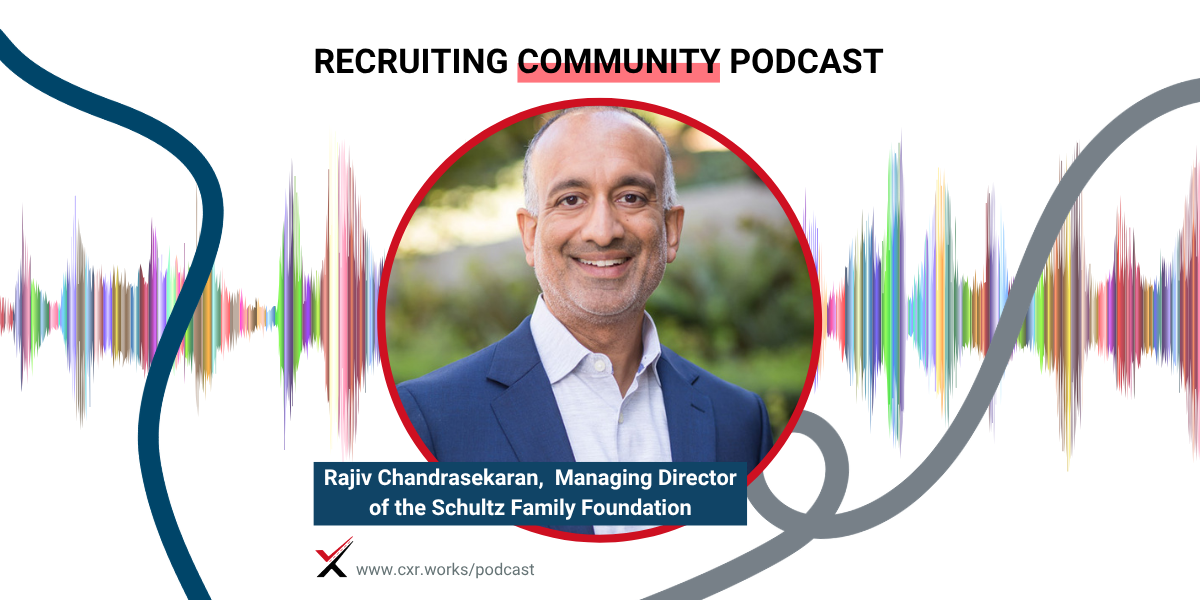
Rajiv Chandrasekaran, Managing Director, Schultz Family Foundation
Hosts:
Chris Hoyt, President, CareerXroads
Gerry Crispin, Co-Founder, CareerXroads
Episode Overview:
Chris Hoyt and Gerry Crispin speak with Rajiv Chandrasekaran about the Where You Work Matters report — a first-of-its-kind employer rating built on workforce outcomes data covering 12 million American workers across 1,750 major U.S. employers. The conversation covers the report’s methodology, what the data reveals about compensation, promotion, and career mobility at the occupation level, and how talent acquisition leaders can apply these findings to employer branding, sourcing, and candidate engagement. The episode also addresses implications for job seekers, including new graduates, and what the findings signal for companies navigating AI-driven workforce disruption.
Key Topics:
The Where You Work Matters report: methodology, scope, and data sources (Burning Glass Institute, Harvard Business School Managing the Future of Work project)
Why the report assesses 12 million workers across 1,750 employers and 55,000 occupations rather than relying on surveys or self-reported company data
Occupation-level analysis: how the same role is evaluated across early career, growth, and stability dimensions
Statistical significance standards and how occupations qualify for inclusion
Surprising findings: great jobs exist across all sectors and geographies, not just in tech or finance
Pay, promotion, and retention gaps between platinum-rated and unrated roles — including 91% pay differential and 247% promotion likelihood gap in retail sales
How TA teams can use occupation-level data to customize recruiting conversations and employer branding
The forthcoming worker-facing tool for career health checks and partnerships with platforms like SkillUp
CEOs who rose through the ranks and what that signals about internal mobility cultures
AI and workforce disruption: why companies with strong internal mobility infrastructure are better positioned for the transition
Notable Quotes:
“This is not what companies say they’re doing. It’s what has really happened to their workers.”
— Rajiv Chandrasekaran
“Creating jobs that generate economic opportunity and enable career growth is much more of a leadership decision at the executive level than it is something constrained by sector.”
— Rajiv Chandrasekaran
“Two people doing roughly similar work — and the gap in lifetime earnings and career trajectory simply comes down to where they work.”
— Rajiv Chandrasekaran
“Companies that have built talent pathways — that have developed real mobility muscle — are going to be best positioned to navigate it.”
— Rajiv Chandrasekaran
“It tells me which companies I want to compete with and what I might need to do internally to be more effective competing with them.”
— Gerry Crispin
Takeaways:
The Where You Work Matters report offers talent acquisition leaders a new category of evidence-based intelligence — occupation-level data on pay, promotion, and retention that can sharpen recruiting conversations and expose internal gaps. For job seekers, the data challenges the assumption that career success is tied to a handful of marquee brands. Companies that have invested in mobility infrastructure are not only better employers today; they are also better positioned to adapt as AI reshapes the workforce.
Want more conversations like this?
Subscribe to the CXR podcast and explore how top talent leaders are shaping the future of recruiting. Learn more about the CareerXroads community at cxr.works.
Chris Hoyt: This is the good stuff. Welcome to the Recruiting Community Podcast. I’m Chris Hoyt, President of CXR. I’m with Gerry Crispin, co-founder of CareerXroads. Gerry, how are you on this lovely day?
Gerry Crispin: It’s a lovely day here — a little chilly, but I have hope for the rest of the month.
Chris Hoyt: The weather is beautiful here in Austin. You’re in New York?
Gerry Crispin: Yep.
Chris Hoyt: Not bad. No two feet of snow.
Gerry Crispin: No, that’s the good news. And I’ve got flowers blooming, so I’m starting to learn new skills.
Chris Hoyt: Can’t be mad. For those who haven’t figured it out yet, we’re the hosts of the Recruiting Community Podcast, where we bring you industry insights and updates in the form of a water cooler conversation. It’s brought to you by the CXR CareerXroads community.
This morning we’re joined by our friend Rajiv. This is actually take two — we’re hoping to get it right this time. He’s with the Schultz Family Foundation, and we’re going to unpack some groundbreaking work: the Where You Work Matters report. We believe it’s the first-ever employer rating built on real workforce outcomes, covering about 12 million American workers. We’ll talk about what the data reveals around compensation, promotion, career mobility, and what it might mean for employers and job seekers in the age of — dun, dun, dun — AI. Was that dramatic enough? I feel pretty good about that.
A few things first: we’re streaming on the socials — YouTube, Facebook, and LinkedIn — so check us out there. You can also find us at cxr.works/podcast for past and future episodes. Like, subscribe, do all the things. If you’re interested in being on the show or want to recommend someone — leaders, practitioners, people doing really interesting work — that’s where you let us know. And a reminder: it’s a labor of love. Nobody pays to be on here. Gerry, did I miss anything?
Gerry Crispin: Nope. You got it all.
Chris Hoyt: Someday I’m going to forget something and you’re going to catch me. Alright, let’s talk quickly before we bring our guest in — the CXR Recruiting Awards. Folks have been building and experimenting with AI within talent acquisition for some time now, at every level: from a basic generalized prompt that helps shift how they do the work, all the way up to complete workflow reimaginings, engagement strategies, and outreach overhauls. And we’ve got awards to show for it.
We’re taking open submissions through April 24th. This is not about vendors. I want to remind everyone: we’re talking about practitioners who are using AI to measurably improve something — anything — within the recruiting workflow or function. Big or small. Gerry, if you had to submit today, what do you think you’d put in?
Gerry Crispin: One would be a fantasy, and the other something more practical. The fantasy: I’d love an AI whispering in my ear during an interview, saying, “Hey — you’re dominating this conversation. You’re talking way too much. Stop and listen to the person you’re interviewing.” That would be fabulous.
But my real passion would be reimagining how we collect data from self-submitted AI-generated resumes. Everyone has started doing that, and I think we fundamentally need to rethink and reimagine the way we collect candidate data to begin with.
Chris Hoyt: So if you had the time to build something in AI, you’d focus on cleaning up that experience — maybe even automating parts of it — and that’s what you’d submit.
Gerry Crispin: Yes, in a way that makes candidates feel good about themselves and about the outcomes they might get from the process.
Chris Hoyt: I love it. And I’ve already seen a few submissions come through — some more straightforward than you’d expect, more rudimentary even, but having a serious impact on those teams. Then there are some that are pretty robust. I’m really looking forward to the range.
Anyone can submit. You don’t have to be a member. April 24th is the deadline. We’re asking for a demo video of 15 minutes or less. If your submission includes any candidate data or proprietary information, just make sure it’s scrubbed before you send it in. We’ll pick three finalists and host them at the Marketplace Live event on June 10th, with a VIP dinner and award presentation. Lots of great stuff tied to it. Check it all out at cxrrecruitingawards.com.
Announcer: Welcome to the Recruiting Community Podcast — the go-to channel for talent acquisition leaders and practitioners. This show is brought to you by CXR, a trusted community of thousands connecting the best minds in the industry to explore topics like attracting, engaging, and retaining top talent. Hosted by Chris Hoyt and Gerry Crispin. We are thrilled to have you join the conversation.
Chris Hoyt: Welcome, Rajiv. Thank you for coming back for take two. We really appreciate your patience today.
Rajiv Chandrasekaran: Great to be with you, Chris and Gerry.
Chris Hoyt: For those who haven’t had the chance to meet you or learn about the work you’re doing, give us the elevator pitch. Who is Rajiv? Tell us about the Schultz Foundation and set the stage — because I have some questions after going through the report and the data. But let’s start with who you are and why people should be paying attention.
Rajiv Chandrasekaran: Well, in the spirit of CareerXroads, I had a big one about ten years ago. I started my professional life as a journalist — I worked at the Washington Post for about 21 years. Then, about eleven years ago, I met a guy named Howard Schultz, who built a small set of coffee houses here in Seattle, Washington into an enormous global brand. We wrote a book together, it forged an unexpected friendship, and I moved to Seattle to work with him on projects in the public interest. I joke that I’m probably the one person to move to Seattle specifically to stop working for Jeff Bezos.
I’ve been with Howard for more than a decade now, working on projects really intended to bring some good to the American people. I’m a Managing Director at the Schultz Family Foundation, which Howard and his wife Sherry started. A big focus of my work — and our work broadly — is creating greater economic opportunity for more people. We believe that better data, companies creating better jobs, and helping workers and job seekers navigate toward better opportunities is the path toward expanding economic prosperity for more Americans and building a better future. That’s the ethos behind the Where You Work Matters project.
Chris Hoyt: I love it. So most employer ratings are built on surveys, culture scores, and self-reported data. But this one is different. Can you walk us through what’s actually under the hood? What did you measure, and why does this methodology matter?
Rajiv Chandrasekaran: It’s not just a little different — it’s big different. It doesn’t start with what companies say they’re doing. It’s not based on how well a PR department filled out a survey for a glossy magazine. It’s not based on a check a company’s marketing team wrote to someone who hands out plaques. It’s not based on small focus group assessments. This is a big data project.
With our partners at the Burning Glass Institute — one of the country’s leading nonprofit labor market research organizations — and along with Harvard Business School’s Managing the Future of Work project, which helped build our methodology, we assess what has actually happened to 12 million workers over a five-year period. This is not what companies say they’re doing. It’s what has really happened to their workers.
We think that is an important lens for understanding how well companies are creating great jobs at different phases of a worker’s career. And it gives us insight down to the occupation level. We don’t look at companies as a monolith. Most large companies have people doing very different things, and the experiences for those people can vary widely depending on their role. So we disaggregate all the way down to that level to provide insights to both HR leaders and those responsible for recruiting, growing, and managing people — as well as to workers themselves.
Chris Hoyt: Keep me honest on the numbers, but I believe the list rates performance at an occupation level across nearly 55,000 roles.
Rajiv Chandrasekaran: Let me walk through the numbers. We start by looking at what’s really happened to 12 million workers at 1,750 major U.S. employers — largely publicly traded companies, but also large privately held companies, some foreign-headquartered companies assessed on their U.S. workforce, and some large nonprofits like major health systems. We don’t look at the public sector, federal or state government, or the military.
Across those 1,750 companies, we have data on 55,000 occupations. Take a company like Walmart — we have insight into 62 unique jobs there. Not just store-level associates and store managers and people at headquarters in Bentonville, Arkansas. I can give you analysis on how butchers do at Walmart. How optometrists do. How truck drivers do. It’s an incredible level of granularity.
Gerry Crispin: Let me play with those numbers for a second, because as an engineer, 12 million sounds like a lot — until you spread it across 1,750 companies and 55,000 occupations. You start splitting those cells and things get thin pretty quickly. I have to assume you’re being careful to make sure there’s enough statistical significance within a given cell. You don’t want to base a rating on one outlier butcher.
Rajiv Chandrasekaran: You’re exactly right. Two things have to be true before we include an occupation at a company. First, we need to make sure we’re mapping people to the right jobs. Someone who says on their LinkedIn profile or in a resume that they’re an “associate” at Walmart gets mapped to a retail sales occupation. Someone who says they’re an “associate” at a law firm does not. And someone who works at Target as a “guest services representative” gets mapped as an equivalent retail sales role to that Walmart associate.
We have algorithms that handle that mapping. If you’re not putting apples in the apples bucket and oranges in the oranges bucket, none of this works. Then — to your point, Gerry — if we only have a handful of records for a particular occupation at a company, we don’t include it. We need enough records for statistical significance. Many companies have far more occupations than we assess, simply because we don’t have sufficient data for all of them.
Gerry Crispin: So there’s an aspiration to expand over time as more data becomes available.
Rajiv Chandrasekaran: Absolutely. More people are sharing their career progression in the digital world — in resumes, on LinkedIn profiles. We believe over time we’ll be able to capture more companies. But we’re not going to sacrifice statistical significance to get there.
Chris Hoyt: Got it. And as a recruiter at heart, the way I’m hearing this is that you’re looking at the job itself, not just the employer — which is a really different lens than most workforce data, which tends to live at the company or industry level.
Rajiv Chandrasekaran: Exactly right. And that creates powerful possibilities. For a worker, it means being able to see how their role at one company compares to the same role at a competitor — in the same sector or same geography. For a recruiter, it means being able to make a targeted, evidence-based case to prospective candidates. Not just “we’ve won these company-wide awards,” but “here’s how this specific occupation performs at our company compared to the same occupation at our competitors.”
And at every occupation, we assess it in three ways: how well it serves as an early career role — that first foothold, that first step up. How well it performs as a growth role. And how well it delivers stability for workers.
Chris Hoyt: That occupational-level framing feels super relevant for TA — for how hiring pitches are made, how hiring managers get advised, and even in Gerry’s wheelhouse, how candidates get counseled.
Gerry Crispin: Exactly. It tells me which companies I want to compete with and what I might need to do internally to be more effective competing with them. That’s pretty powerful.
Rajiv Chandrasekaran: Exactly, Gerry. Company leaders don’t view their workforce as a monolith. There are always certain occupations getting more attention — for competitive reasons, for business transformation, whatever the case may be. What this offers is the ability to use the same yardstick to benchmark performance against competitors at the occupation level.
Take Walmart. They’re in a pitched battle in e-commerce with Amazon, Costco, and others. This lets Walmart look at a role like data scientist and ask: how are we doing compared to the companies we’re competing with for that specific talent?
Chris Hoyt: Okay, slight pivot. You’re looking across 12 million workers. Was there a finding that actually surprised the team? Something that cut against expectations about which employers or sectors were truly investing in their people?
Rajiv Chandrasekaran: I’ve got two — maybe three — things for you.
First: a lot of “great places to work” lists are dominated by Silicon Valley tech companies and big New York banks. What we find is that there are great companies in almost every sector of the American economy and in every geography creating great jobs. We designed this in a way that doesn’t just benefit the biggest brand names. That said, in every single sector there are companies doing really well and companies that are not — companies with similar workforces and similar business models. That really speaks to something important: creating jobs that generate economic opportunity and enable career growth is much more of a leadership decision at the executive level than it is something constrained by sector. There are great insurance companies — and there are insurance companies where you’re going to stagnate.
Second: there are some unexpected places to thrive. Take the job of financial analyst — typically associated with Wall Street. When we look at employers where financial analysts are rated platinum across early career, growth, and stability, there are 27 companies out of 1,750 that hit that mark. Guess what? Only six of them are in banking and financial services. The other 21 are spread across the broader economy — General Mills, Liberty Mutual, and others. So if you’re coming out of school looking for a great financial analyst role, it may pay to look beyond Wall Street.
Third: we find massive differences in how people are paid, promoted, and retained across companies — even for people doing very similar work. Take accountants and auditors. The difference between working in an accounting role we rate as platinum versus an unbadged one: on average, you’re paid 46% more, you’re 55% more likely to be promoted within three years, and 19% more likely to be retained beyond three years.
In retail sales, the numbers are even more striking. Depending on where you work, you could be earning 91% more, have a 247% greater likelihood of promotion, and a 119% greater chance of being retained for more than three years. Two people doing roughly similar work — and the gap in lifetime earnings and career trajectory simply comes down to where they work.
Gerry Crispin: I keep picturing a directory of the report that I could flip through in different ways. As a student, I’d want to search that data and dig in. Obviously today you’d just prompt an AI to pull the answers. But are you positioning this equally for candidates and employers — or is it primarily one or the other?
Rajiv Chandrasekaran: It’s really both. The list and the data-rich website — whereyouworkmatters.org — is primarily aimed at the corporate audience: business leaders, HR leaders who want to see how they’re doing, where they’re falling short, and build strategies for improvement. But we are actively working to bring this data to job seekers and workers as well.
We’re building a first-of-its-kind tool that will let any American worker check the health of their career. We expect to have that out in a couple of months. We’re also embedding this data through partnerships with platforms like SkillUp and others, helping people navigate into careers. And over time, we’ll be getting this data onto learning management systems as well.
Chris Hoyt: As you talk through this, it really strikes me that for a new grad — easy target, I know — what an incredible resource. Imagine being able to find employers you’d never have thought of otherwise. Brands that haven’t crossed your radar, but that are rated platinum for exactly the type of work you want to do. That’s remarkable. I love that you’re building that out.
Rajiv Chandrasekaran: Yes. And it dispels some of the mythology. You know — “I have to get a job at Apple, Nike, or Google.” Those are all great companies, and I’m not disparaging them. But what this shows is that there are so many great jobs where workers can rise, at companies that aren’t household names and that people might not have otherwise thought of as great places to work.
Chris Hoyt: I also want to pivot to what Gerry was touching on earlier, because in this era of AI — and we’ve been pretty direct about framing this as signals and intelligence for the world we’re all now living and working in — can you make it concrete for the recruiters and TA leaders? How should this list change how they think about employer branding, about sourcing, about candidate engagement and those conversations?
Rajiv Chandrasekaran: What this allows talent acquisition teams to do is customize their talk track by occupation. “This role is a great growth opportunity at this company — and here’s objective data from Where You Work Matters to back it up.” It’s not the company’s own marketing claim; it’s third-party, outcomes-based evidence.
And quite frankly, if you’re trying to recruit for a role at a company that isn’t badged by us — that opens a door to internal conversations. What are we not doing well enough? How do we improve the worker experience to become more competitive for this role?
Chris Hoyt: That’s really interesting. The list celebrates top performers, but it’s also going to expose those who are lagging. What do you want the companies that didn’t make the platinum cut to actually do with that information?
Rajiv Chandrasekaran: We’ve taken a very deliberate approach. We’re celebrating the leaders, but we’re not publicly castigating those who haven’t received recognition or don’t have many occupations rated at platinum or gold. What we’re offering those companies is insight — a way to see how they’re stacking up and an invitation to start having those internal conversations. Where am I compared to my competitors? What are they doing that I could learn from?
The long-run goal isn’t just celebrating the leaders. It’s getting those other companies to raise their game.
Gerry Crispin: Will you be offering some kind of resource to help them do that?
Rajiv Chandrasekaran: In the coming months, we’re going to start sharing benchmarks down to the occupation level — giving companies transparency into what mobility, pay, and retention need to look like at that level to hit the platinum threshold, so they can actually manage against it.
And because we’re not turning this into a purely relative ranking going forward, success will look like having more jobs rated platinum and gold across the board a year or two from now. We want people running the race faster. If 20 runners next year hit what the top 10 hit this year, they all get medals.
Chris Hoyt: I love that. Rajiv, before we let everyone go — we do this with all our guests — based not necessarily on the output but on the experience of doing all this work: if you were going to write a book about that journey, what would you title it?
Rajiv Chandrasekaran: I might title it Why Does Where You Work Matter? — really getting into the “why” behind this. We see the outcomes now. The next step is telling the stories of the companies that have cracked the code.
Take the 22 companies that are platinum across the board — early career, growth, and stability. An interesting percentage of the CEOs at those companies are people who rose through the ranks themselves. There’s an insurance company whose CEO started as a claims adjuster. Mary Barra at GM essentially started right out of school as a trainee and worked her way up. The CEO of Costco — not in the top 22, but an overall platinum company — began as a forklift operator. There’s something meaningful about CEOs who know firsthand what the mobility experience is like and are committed to paying it forward and building pathways for others to follow.
Chris Hoyt: You’re nuts if you don’t write that book. It would be a great read.
Gerry Crispin: That’s definitely coming.
Chris Hoyt: No question. Rajiv, present company excluded — who gets the first signed copy?
Rajiv Chandrasekaran: Two people. First, Howard — the man behind my own career crossroads. He deserves a copy. And second, my two boys, who are still in school but will be entering the workforce soon. They’re going to need it as they navigate — especially the AI-transformed labor market ahead of them.
Chris Hoyt: Oh, yeah.
Rajiv Chandrasekaran: I was waiting for you to tee that up! But I’ll make the AI plug myself. We think this is genuinely relevant in the era of AI, because none of us have a perfect crystal ball on how quickly or significantly any specific occupation, company, or sector will be impacted. But we know disruption is coming, and we know it’s going to create both challenges and opportunities.
What we believe is that companies that have built talent pathways — that have developed real mobility muscle — are going to be best positioned to navigate it. When you find you need fewer people here and more people there, if you’ve already built the infrastructure to cross-train and move people up, you’re better equipped to ride those waves. Because of its mobility focus, this list highlights the companies and occupations that are great for exactly that. We believe the companies doing well here are also the ones best positioned for what’s coming.
Chris Hoyt: That’s a whole other podcast episode right there.
Gerry Crispin: Without a doubt.
Chris Hoyt: We actually have a great show coming up soon with a researcher who’s done fascinating work on the gaps AI is already exposing. Very hot topic this year. Rajiv, thank you so much for your time. We know you’re busy, and we appreciate you carving some of it out for us and for our members and listeners.
Rajiv Chandrasekaran: Great talking to you both.
Chris Hoyt: You too. Good luck with everything.
Alright, everyone — a few reminders. cxr.works/podcast: like, subscribe, make us internet famous. If you’ve got someone you’d love to see on the show, let us know. And don’t forget: cxrrecruitingawards.com. April 24th is the submission deadline. We’ll be in Louisville hosting the finalists, with an award presentation and a lot of great stuff tied to the Marketplace Live event on June 10th. Check it all out at cxrrecruitingawards.com. We’ll see you next time.
Announcer: Thanks for listening to the Recruiting Community Podcast, where talent acquisition leaders connect, learn, and grow together. Visit cxr.works/podcast to explore past episodes, see what’s coming up next, and find out how you can join the conversation. Whether you’ve got insights to share or want to be a guest, we’d love to hear from you. If you’re interested in becoming a member of the CXR community, visit cxr.works. We’ll catch you in the next episode.
Hiring slowed in 2025—but costs went up. Appcast’s Chief Economist and CPO break down why, with new full-funnel benchmarks and salary transparency data.