In Praise of the Office
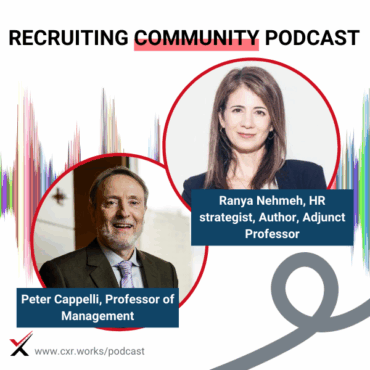
How do hybrid models affect productivity, inclusion, and career growth? Authors Peter Cappelli and Ranya Nehmeh reveal the surprising organizational costs of remote work.
 play_arrow
Proving TA’s Value: Sourcing’s Role in Revenue Growth Cami Grace
 play_arrow
Talent Chooses You: Reframing the Role of TA in Driving Growth Cami Grace
 play_arrow
Inside the Cox Career Site Redesign: Data, AI & Candidate Experience Cami Grace
 play_arrow
Vietnam TA/HR Delegation Recap Cami Grace
Featured Guests:
Rachel Allen, Head of Talent Acquisition, 7-Eleven
Hosts:
Gerry Crispin, Principal and Co-Founder, CareerXroads
Episode Overview:
Rachel Allen joins Gerry Crispin live from Nashville to discuss her journey in talent acquisition, her return to 7-Eleven, and how the company is evolving its approach to high-volume hiring. She shares insights from recent sessions, including the impact of merging legacy hiring models, adopting new technologies, and addressing the complexities of candidate experience at scale.
Key Topics:
Transitioning from dual hiring models post-Speedway acquisition
Challenges of manual processes and candidate drop-off
Shifting accountability for hiring to store leaders
Role of AI in scaling and optimizing frontline recruitment
Importance of defining the business problem before selecting technology
The impact of early career experiences on leadership and empathy in TA
Industry-wide need for transparency around AI and candidate engagement
Notable Quotes:
“Lead with the problem, not the shiny new technology.” – Rachel Allen
“If you have a crappy process and you apply technology to it, you just amplify the crappiness.” – Gerry Crispin
“AI, for instance, shouldn’t be your strategy—it should be the ‘how,’ not the ‘what.’” – Rachel Allen
“Candidates think AI is the villain in their job search, but it might be what gets them seen.” – Rachel Allen
Takeaways:
Rachel Allen shares how 7-Eleven restructured its high-volume hiring process following a major acquisition, emphasizing that technology should support—not drive—the strategy. She reflects on the evolving role of AI in talent acquisition and stresses the importance of empathy, transparency, and continuous learning in navigating industry challenges.
Want more conversations like this?
Subscribe to the CXR podcast and explore how top talent leaders are shaping the future of recruiting. Learn more about the CareerXroads community at cxr.works.
Gerry Crispin: So it’s a beautiful sunny day here in Nashville. We’re at breakfast with circus tents, people milling around, and sessions going on. I’m thrilled to sit here with Rachel Allen—did I get that right?
Rachel Allen: You did!
Gerry Crispin: I want to make sure I’m on target. From 7-Eleven, who heads up TA. Just a chance to chat a bit about the experience here and what’s going on.
Rachel Allen: Love it. Happy to be here.
Gerry Crispin: Rachel, when did you start at 7-Eleven?
Rachel Allen: I’m actually a boomerang. This is my second time. I was there from 2010 to 2015, then left to join Schneider Electric until 2021. I came back to 7-Eleven at the end of 2021. I think this week is my four-year anniversary—second time around.
Gerry Crispin: That’s cool. Do they vest you into the total time?
Rachel Allen: Typically, no—not with that much time in between.
Gerry Crispin: Maybe you can negotiate that at some point.
Rachel Allen: Yeah!
Gerry Crispin: Then it would be nine years.
Rachel Allen: Exactly. Bridging my time there!
Gerry Crispin: You’ve done some sessions here?
Rachel Allen: Yes, more than one.
Gerry Crispin: Tell me a little about the one focused on 7-Eleven. What were the main points?
Rachel Allen: I did a couple yesterday—one panel and one specifically on a journey we’ve been on at 7-Eleven. Both had technical difficulties, but we pivoted and came out stronger. The session I shared was focused on our high-volume space—frontline recruitment.
When I rejoined, we had just acquired Speedway. People in the Midwest will know that brand well. So we were working with two tech stacks, two hiring models, and two brands.
Legacy Speedway had recruiters in the field handling store-level recruitment. Legacy 7-Eleven had store leaders managing their own recruitment. At that time, we faced serious challenges: slow, manual processes across the board, lots of candidate drop-offs, and no-shows. We were losing people to competitors because we weren’t moving fast enough.
Our first move was to mimic Speedway’s model. They had 300 recruiters; we added 100 on the 7-Eleven side. That helped. But then, a business decision was made to hold store leaders accountable for labor optimization—including hiring.
We realized recruiters on the Speedway side were doing a lot more than just recruiting, so their time for actual sourcing was limited. We flipped the switch—store leaders were now accountable, even though no tech was in place yet to support that shift.
So, we started a journey to find technology that could enable store leaders to succeed in hiring. The key takeaway from my session was: lead with the problem, not the shiny new technology. It’s easy to chase the next cool tool, but it’s critical to understand the business problem you’re solving. AI, for instance, shouldn’t be your strategy—it should be the “how,” not the “what.”
Gerry Crispin: When we chase shiny objects without a clear goal, we end up scaling flaws. Someone told me once—if you have a crappy process and you apply technology to it, you just amplify the crappiness.
Rachel Allen: That was you, actually!
Gerry Crispin: Oh, maybe. That’s one of my favorite sayings.
Rachel Allen: It stuck with me!
Gerry Crispin: Give me a sense of scale. We’re not talking dozens of hires here.
Rachel Allen: Right. Globally, 7-Eleven has over 86,000 locations. A new store opens every two and a half hours. But I was talking about 7-Eleven Inc.—US and Canada. Last year, we made about 130,000 hires and have over 70,000 employees. We’re roughly 45% corporate and 55% franchise. My focus is on the corporate side.
Gerry Crispin: Even still, that’s a massive operation. How did you get into TA?
Rachel Allen: Ah, the accidental path! I have a finance degree and had a job lined up with the CIA—yes, the CIA. It was a desk job in finance. My dream was to somehow become a field operative, probably inspired by the show Alias with Jennifer Garner.
So, like any good finance grad, I went backpacking in Europe using student loan money. While I was over there, my CIA offer got rescinded—this was during the dot-com bust. Companies had over-offered and had to pull back.
Gerry Crispin: I did some consulting for the CIA, NSA, FBI after 9/11. Maybe we’ll trade stories—but not for publication!
Rachel Allen: I had to take a lie detector test for the interview process—it was unlike anything else.
Gerry Crispin: Fascinating world.
Rachel Allen: So I came home jobless and tapped into the Texas A&M Aggie network. Found a job in mortgage servicing—thought it was related to finance, but ended up in a call center, tethered to a phone, handling tough conversations about foreclosures.
That’s where I learned the importance of empathy. De-escalating tough situations helped me later in recruiting—especially with rejection, which we do a lot more of than hiring.
Gerry Crispin: Rejection is an underdeveloped skill in TA. We need to do better there.
Rachel Allen: Agreed. So then the housing crisis hit. I’d met my husband at the mortgage company, but I wanted a change. I went to Robert Half Finance & Accounting for help finding a finance job. They said I was too far removed from my degree, but offered me a recruiting role instead.
That was my foray into TA. Staffing agencies are incredible training grounds. I stayed two years, was Rookie of the Year, and during the housing market crash no less. Eventually, 7-Eleven—one of my clients—recruited me.
Gerry Crispin: I love how those early, seemingly unrelated experiences shape the careers we have now.
Rachel Allen: Totally. My toughest moments have been my greatest teachers.
Gerry Crispin: So what’s the biggest challenge 7-Eleven faces going forward?
Rachel Allen: I’ll speak more to the industry than just 7-Eleven. TA is navigating a lot of gray areas, especially around AI. There are no clear precedents yet, and it’s draining as we figure it out.
Also, we need to lock arms and educate—not just our peers, but also candidates. Right now, many think AI is the villain in their job search. They don’t realize they might be applicant #900, and without AI, I’d never see them. With it, they might be surfaced.
Gerry Crispin: Yes, candidates want to feel seen. But with massive applicant volume, human review just isn’t scalable anymore.
Rachel Allen: Exactly. AI removes friction, which we wanted, but the result is a volume no human can handle. It’s a weird dynamic, and the narrative is off. We need to be more transparent as an industry about the process.
Gerry Crispin: I really appreciate that you’re thinking beyond just your company. That’s leadership.
Rachel Allen: Thank you.
Gerry Crispin: Where do you get your learning?
Rachel Allen: Experiences like this—being surrounded by passionate practitioners. I also read articles, attend webinars, and listen to podcasts. But truly, life is the best teacher. My biggest failures have taught me the most.
When mentoring others, I encourage them to reflect and reframe tough moments: “What did I learn? What can I do differently next time?” A mini after-action review every time. Surrounding myself with passionate people in this space is my favorite way to learn.
Gerry Crispin: That’s a perfect close. We all need our peers for support and learning. Thank you so much.
Rachel Allen: Thank you.
Announcer: Thanks for listening to the Recruiting Community Podcast, where talent acquisition leaders connect, learn, and grow together. Be sure to visit cxr.works/podcast to explore past episodes, see what’s coming up next, and find out how you can join the conversation. If you’d like to be a guest on the show, we’d love to hear from you. To learn more about becoming a CXR community member, visit www.cxr.works. Catch you in the next episode.
How do hybrid models affect productivity, inclusion, and career growth? Authors Peter Cappelli and Ranya Nehmeh reveal the surprising organizational costs of remote work.